The market, that fickle beast, exhaled a collective sigh, a momentary reprieve from its own anxieties. Nvidia, the purveyor of silicon dreams, reported its earnings, and the numbers – $68 billion in revenue – were, on the surface, a triumph. But to focus solely on the figures is to miss the deeper, more troubling currents at play. It is as if a man, deeply in debt, boasts of a temporary windfall, ignoring the abyss that still yawns before him. The concerns regarding a potential cooling in artificial intelligence spending – a slowing of the fever dream – were, for the moment, quieted. But is this a genuine recovery, or merely a postponement of the inevitable reckoning?
Oracle, that oracle of database and, increasingly, of caution, has become the harbinger of potential overreach. Its warnings echo through the canyons of Wall Street, a reminder that even the most robust of booms are built on foundations of sand. Yet, Nvidia persists, seemingly immune to the gathering storm. This resilience is not merely a matter of technological prowess; it is a testament to the intoxicating power of belief – a collective delusion, perhaps, that sustains itself on its own momentum.
When Four and a Half Trillion Feels… Insufficient
Less than three years ago, Nvidia’s market capitalization breached the trillion-dollar mark. A milestone, certainly. But what is a trillion in these days of boundless digital ambition? A mere stepping stone, it seems. The stock has since quadrupled, reaching a valuation of $4.5 trillion. For some, this ascent must appear… unsettling. Too swift, too absolute. A dangerous hubris. But to dismiss it as mere speculation is to ignore the underlying reality: Nvidia is not simply selling hardware; it is selling a vision of the future – a future where intelligence is artificial, and computation is limitless. And humanity, ever susceptible to grand narratives, is buying it, hook, line, and sinker.
That 73% year-over-year revenue growth was not a statistical anomaly, a fleeting moment of grace. It is a symptom of something far more profound – a fundamental shift in the economic landscape. The question is not whether Nvidia can maintain this pace of growth, but whether the world can withstand the consequences of its success. For in a society obsessed with innovation, stagnation is the ultimate sin. And Nvidia, with its relentless pursuit of progress, has become both the savior and the potential destroyer of the old order.
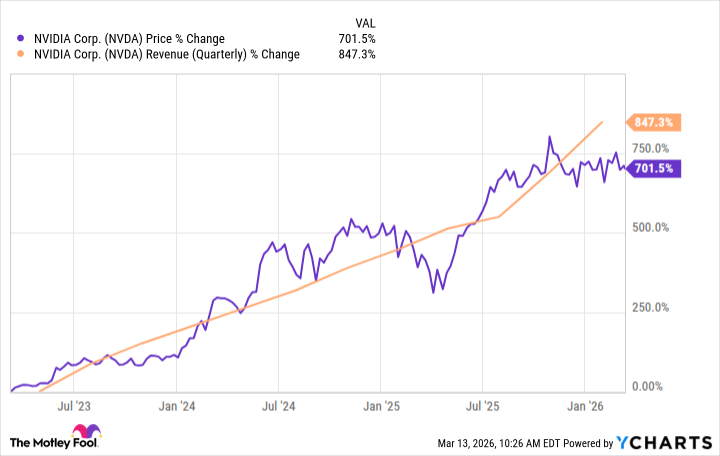
Investors, understandably, anticipate further expansion. Oracle’s optimistic guidance, a rare beacon of hope in a sea of uncertainty, reinforces this expectation. Nvidia itself projects quarterly sales of $78 billion – a staggering figure, even by today’s inflated standards. But such projections are built on assumptions – on the belief that the AI spending announced by tech giants will materialize. And what if it doesn’t? What if the promises of artificial intelligence prove to be hollow, the dreams of a digital utopia nothing more than a mirage? The thought, though unsettling, cannot be dismissed. It is the shadow that haunts every boom, the specter of inevitable collapse.
The Pursuit of a Comprehensive Illusion
Nvidia is not content to merely sell chips and software. It aspires to something far grander – a complete ecosystem of artificial intelligence. This week’s unveiling of a new open-weight model – designed to run complex AI systems – is a testament to this ambition. By releasing the underlying parameters of its technology, Nvidia is attempting to cultivate a community of developers, to foster innovation, and to solidify its position as the dominant force in the AI landscape. It is a clever strategy, but also a dangerous one. For in a world where knowledge is power, sharing that power – even partially – is an act of immense risk.
The prevailing optimism surrounding AI remains strong. Research suggests that a majority of retail investors plan to continue investing in stocks, fueled by the promise of future returns. Nvidia, naturally, will be a primary beneficiary of this sentiment. But this enthusiasm is not necessarily rational. It is, rather, a reflection of our collective desire for something… more. A belief that technology can solve our problems, alleviate our suffering, and ultimately, transcend our limitations. It is a comforting illusion, but an illusion nonetheless.
Jensen Huang, Nvidia’s CEO, envisions a “five-layer stack” of energy, chips, infrastructure, models, and applications. A comprehensive, interconnected system that will power the future of artificial intelligence. It is an audacious vision, and one that requires immense resources, unwavering determination, and a healthy dose of… recklessness. Investors should expect further innovation, further expansion, and further risk. For in the world of technology, as in life, there are no guarantees. Only possibilities – and the ever-present threat of ruin.
Read More
- Spotting the Loops in Autonomous Systems
- Seeing Through the Lies: A New Approach to Detecting Image Forgeries
- Staying Ahead of the Fakes: A New Approach to Detecting AI-Generated Images
- Julia Roberts, 58, Turns Heads With Sexy Plunging Dress at the Golden Globes
- Palantir and Tesla: A Tale of Two Stocks
- Gold Rate Forecast
- The Glitch in the Machine: Spotting AI-Generated Images Beyond the Obvious
- How to rank up with Tuvalkane – Soulframe
- 20 Best TV Shows Featuring All-White Casts You Should See
- TV Shows That Race-Bent Villains and Confused Everyone
2026-03-18 05:02