
The market, dear reader, is a peculiar beast. It fancies itself a rational actor, yet behaves with the capriciousness of a fever dream. Adobe, a company that consistently delivers revenue growth – a rather pedestrian achievement, one might think – finds itself under scrutiny, not for what is, but for what might be. A rather Kafkaesque predicament, wouldn’t you agree? Eleven percent growth, constant currency, a respectable showing. Yet, the shares wilt as if afflicted by a sudden, algorithmic chill. It’s enough to make one suspect a conspiracy of silicon and code.
The whispers, of course, concern Artificial Intelligence. This new god, this digital demon, is said to be devouring the software landscape. And while I’ve seen enough market cycles to treat such pronouncements with a healthy dose of skepticism – remember the Y2K panic? – there’s a disquieting undercurrent. The fear isn’t that Adobe is failing now, but that it might become irrelevant in some distant, digitally-rendered future. The market, it seems, prefers to punish companies for hypothetical sins. A rather uncharitable approach, even for Wall Street.
The Phantom Menace of Progress
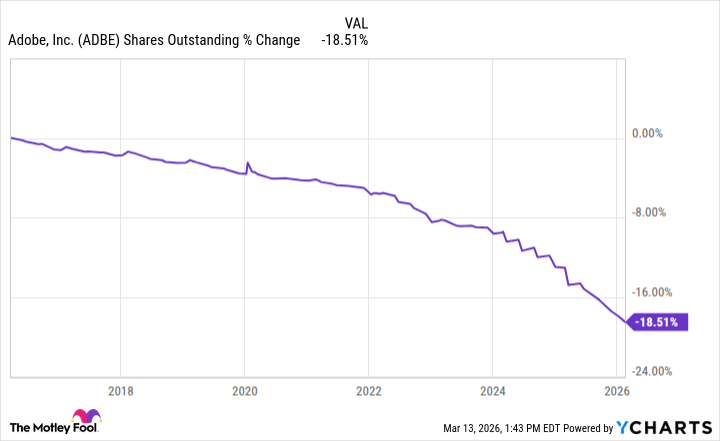
The financials themselves are almost…irritatingly solid. Revenue up, profits healthy, a rather aggressive share repurchase program underway – a clear signal of management’s confidence, or perhaps a desperate attempt to prop up a failing narrative? One can never be quite sure. The outgoing CEO, a Mr. Narayen, has departed with a quiet dignity, leaving the helm to…well, to someone else. The market dislikes change, naturally. It prefers the comforting predictability of stagnation. A bit like a particularly stubborn bureaucrat, really.
Salesforce and Constellation Software have offered a glimmer of hope, a slight rebound in a sea of pessimism. But these are merely ripples in a vast, turbulent ocean. The market, you see, is not interested in logic. It’s interested in momentum. And right now, the momentum is decidedly…algorithmic. These capital return programs – the stock buybacks – are a temporary palliative, a sugar-coated pill for a market that craves instant gratification. They may boost earnings per share, but they don’t address the underlying anxiety.
Portents and Omens
This week, we turn our attention to a pair of crucial earnings reports. Micron Technology, purveyor of memory chips – the very building blocks of this digital revolution – reports on March 18th. If their outlook remains bullish, if demand for these chips continues to soar, it will be a clear signal that the AI juggernaut is gaining momentum. And that, my friends, is not good news for companies reliant on traditional software models. It suggests a fundamental shift in the landscape, a displacement of the old order by the new.
Then, on March 19th, Accenture – a veritable army of consultants, deployed to implement these digital transformations – will offer its perspective. Pay close attention to their commentary. Are clients embracing AI? Are they abandoning legacy systems? Are they willing to pay a premium for innovation? These are the questions that truly matter. The answers, I suspect, will be far more revealing than any financial forecast.
Adobe, at a price-to-earnings ratio of 15, appears…temptingly undervalued. But value, dear reader, is a subjective concept. It depends on your faith in the future. If you believe that Adobe can navigate this turbulent landscape, that its creativity suite will remain relevant in the age of AI, then this may be a worthwhile investment. But be warned: the market is a fickle mistress. And sometimes, even the most solid foundations can crumble beneath the weight of irrational fear.
Read More
- Spotting the Loops in Autonomous Systems
- Seeing Through the Lies: A New Approach to Detecting Image Forgeries
- Staying Ahead of the Fakes: A New Approach to Detecting AI-Generated Images
- Julia Roberts, 58, Turns Heads With Sexy Plunging Dress at the Golden Globes
- Gold Rate Forecast
- Palantir and Tesla: A Tale of Two Stocks
- The Glitch in the Machine: Spotting AI-Generated Images Beyond the Obvious
- How to rank up with Tuvalkane – Soulframe
- 20 Best TV Shows Featuring All-White Casts You Should See
- TV Shows That Race-Bent Villains and Confused Everyone
2026-03-18 02:22