Senate Banking Committee Chair Tim Scott (R-SC), a man whose calendar apparently runs on blockchain time, will open the DC Blockchain Summit on Tuesday with a session so thrilling it might finally address the Clarity Act’s next markup-assuming the Senate remembers where it left the bill.
The Digital Asset Market Clarity Act, passed by the House in July 2025 with a 294-134 vote, has since vanished into the Senate Banking Committee’s void like a coin dropped down a bureaucratic black hole, last seen arguing with a stablecoin yield over tea.
Stablecoin Yield Standoff Inches Toward Resolution, or So They Claim
Digital Chamber CEO Cody Carbone allegedly told Crypto in America on Friday that negotiations between the crypto industry and banks are “nearing a conclusion”-a phrase diplomats also use when describing peace talks with warlords.
🚨 HUGE: Tomorrow at 10 AM ET, Tim Scott is Holding a Senate Banking Committee Meeting and the next Clarity Act markup is to be discussed.
Digital Chamber CEO Cody Carbone says “They’re getting closer and closer to a deal, so I feel very confident we can reach a resolution in…
– Mark (@markchadwickx) March 16, 2026
The central dispute, a tale as old as time, asks: Can U.S.-regulated stablecoins offer rewards or yield through intermediaries? Banks insist this would trigger deposit flight. Crypto firms counter that stripping rewards would send issuers fleeing to offshore jurisdictions faster than a bear in a cryptocurrency-themed circus.
Coinbase Chief Policy Officer Faryar Shirzad warned that Hong Kong, Singapore, the UAE, and Bermuda have all built licensing regimes to attract USD stablecoin issuers-a claim met with equal parts skepticism and existential dread.
Lots of questions about why rewards matter and why we need to keep the competitiveness of GENIUS stablecoins. The answer is that you don’t have to issue a US dollar stablecoin in the US.
Hong Kong, Singapore, UAE, Bermuda & others have built licensing regimes specifically to…
– Faryar Shirzad 🛡️ (@faryarshirzad) March 16, 2026
Senators Thom Tillis (R-NC) and Angela Alsobrooks (D-MD) are reportedly crafting compromise language that would ban passive yields while preserving transaction-based rewards-a solution as logically coherent as a tax code written by Lewis Carroll.
Ticking Clock for 2026: Cue the Dramatic Music
The White House set a March 1 deadline for a deal. It passed unceremoniously, like a ghost at a seance. Polymarket odds for passage have plummeted from 82% to 60%, proving optimism is a finite resource.
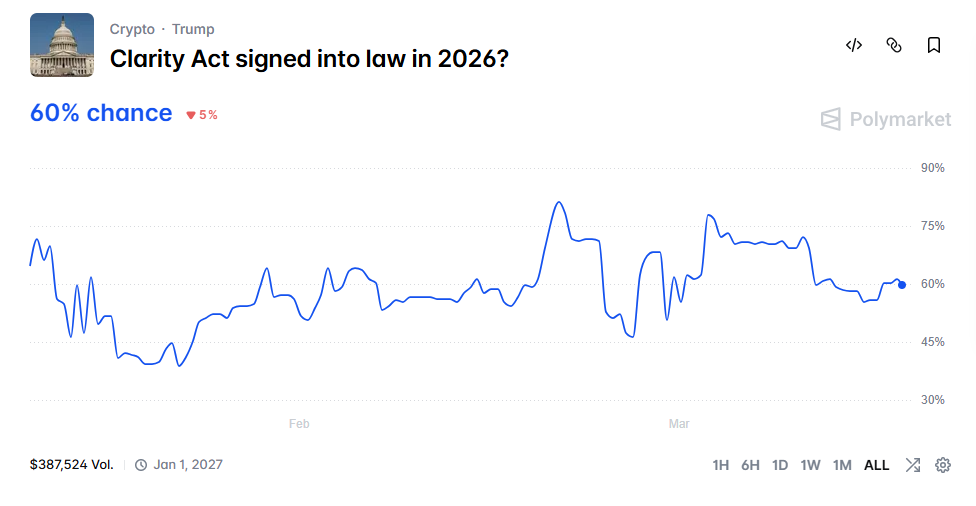
Senate Majority Leader John Thune has declared there will be no floor action before April 2026-a statement that oozes confidence, like a baker promising “maybe” to make bread after June.
If the bill fails to clear committee by late April, analysts warn passage odds drop to near zero, potentially triggering crypto market volatility and stalling institutional inflows. In other words, the markets might react as poorly as a vampire exposed to daylight.
Read More
- Spotting the Loops in Autonomous Systems
- Seeing Through the Lies: A New Approach to Detecting Image Forgeries
- 20 Best TV Shows Featuring All-White Casts You Should See
- Julia Roberts, 58, Turns Heads With Sexy Plunging Dress at the Golden Globes
- Staying Ahead of the Fakes: A New Approach to Detecting AI-Generated Images
- The Best Directors of 2025
- The Glitch in the Machine: Spotting AI-Generated Images Beyond the Obvious
- Palantir and Tesla: A Tale of Two Stocks
- Gold Rate Forecast
- How to rank up with Tuvalkane – Soulframe
2026-03-17 11:12