They call them “leveraged” ETFs. Which, if you ask me, is a bit like calling a runaway train “enthusiastically propelled.” My uncle, bless his heart, got into these a few years back. He’d explain them to me at Thanksgiving, waving a gravy-stained printout, convinced he’d cracked the code. He’d always start with, “Now, it’s not gambling…” which, naturally, was the first thing everyone thought. He’s now very enthusiastic about birdwatching, a much safer pursuit.
The proliferation of these things has been…remarkable. It used to be you needed a broker with a vaguely unsettling air of confidence to access this level of financial engineering. Now, anyone with a smartphone and a pulse can buy an ETF that promises to triple their returns (or, more likely, triple their losses). ProShares and Direxion, the usual suspects, have been churning these out like limited-edition porcelain dolls, and the assets under management keep climbing. It’s a bit unnerving, honestly.
Three years of a relentlessly rising S&P 500 will do that to a market, though. It breeds a certain…optimism. A belief that up is the only direction. People start thinking they’re smarter than the market, and then they look for ways to amplify that perceived intelligence. Leveraged ETFs are the financial equivalent of adding a turbocharger to a golf cart.
The problem, as my uncle eventually discovered, is that leverage cuts both ways. It’s like trying to steer a boat with a very long, very wobbly oar. You might make some impressive progress, but you’re also more likely to end up in the weeds. These aren’t investments for the faint of heart, or for anyone who gets twitchy when their portfolio dips below six figures. They’re aggressive, bordering on reckless, and require a level of understanding that, frankly, most people don’t possess.
How They Work (Or Don’t, Depending on Your Luck)
It’s not as simple as owning the underlying stock. You’re not buying Apple shares; you’re buying a derivative—usually a swap or futures contract—designed to deliver a multiple of Apple’s daily return. It’s financial alchemy, really. And like most alchemy, it’s more likely to produce lead than gold. These contracts need to be reset daily, which adds cost and complexity. The expense ratios can be surprisingly high—often exceeding 1%. It’s a bit like paying a toll to ride a rollercoaster that might derail.
That daily rebalancing is where things get particularly tricky. It creates something called “volatility decay,” which is a fancy way of saying that gains and losses don’t compound symmetrically. In a stable market, it might not be noticeable. But in a volatile one—like, say, the financial crisis of 2008—it can erode your returns faster than a receding hairline. You can lose money even if you correctly predict the direction of the market. It’s a paradox that keeps fund managers employed.
Volatility: The Unseen Enemy
The Direxion Daily Financial Bull 3x Shares ETF (FAS) and the Direxion Daily Financial Bear 3x Shares ETF (FAZ) are excellent case studies in volatility decay. Initially, they performed as expected. But as the financial crisis deepened, the volatility took its toll. Both funds plummeted, leaving investors with substantial losses. It was a harsh lesson in the perils of leverage. I remember reading about it at the time, and thinking, “Well, that’s just sensible.”
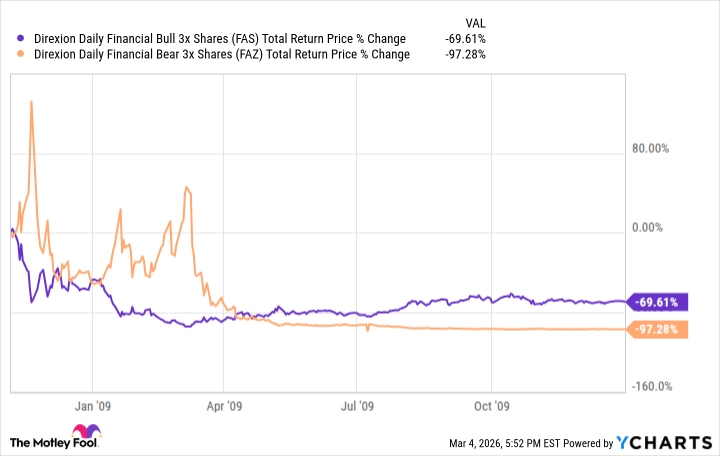
If the underlying security enjoys a slow, steady uptrend, leveraged ETFs might work out. But in a choppy, unpredictable market, they’re more likely to inflict pain. It’s a bit like trying to navigate a sailboat in a hurricane. You might get lucky, but the odds are stacked against you.
If you have a strong conviction about a short-term event, leveraged ETFs might be a way to capitalize on it. But if you hold them for too long, get caught in a volatile market, or simply make a bad call, the losses can mount quickly. It’s a high-risk, high-reward game, and most people are better off sitting it out.
A Word of Caution
The proliferation of leveraged ETFs reflects investor demand, of course. People want to amplify their returns, and these products offer a way to do that. But it also suggests a lack of education. Many investors don’t question things when prices are rising. They just assume the good times will continue. They learn the hard way when prices fall. It’s a timeless pattern.
Leveraged ETFs aren’t suitable for most buy-and-hold investors. A strategy built around diversification, low fees, and long-term wealth creation is usually the best way to go. It’s not glamorous, but it’s effective. And it allows you to sleep at night. Which, frankly, is priceless.
Read More
- Building 3D Worlds from Words: Is Reinforcement Learning the Key?
- Securing the Agent Ecosystem: Detecting Malicious Workflow Patterns
- The Best Directors of 2025
- Gold Rate Forecast
- 2025 Crypto Wallets: Secure, Smart, and Surprisingly Simple!
- Mel Gibson, 69, and Rosalind Ross, 35, Call It Quits After Nearly a Decade: “It’s Sad To End This Chapter in our Lives”
- 20 Best TV Shows Featuring All-White Casts You Should See
- TV Shows Where Asian Representation Felt Like Stereotype Checklists
- Umamusume: Gold Ship build guide
- Top 20 Educational Video Games
2026-03-11 16:02