Author: Denis Avetisyan
A new deep learning framework dramatically improves the detection and characterization of fast radio bursts, unlocking the potential of large-scale radio astronomy datasets.

SwinYNet, a transformer-based multi-task model trained on simulated data, achieves state-of-the-art performance in FRB search and segmentation.
Despite the increasing volume of radio astronomical data, identifying transient signals like Fast Radio Bursts (FRBs) remains computationally challenging and often relies on intensive pre-processing. This work introduces ‘SwinYNet: A Transformer-based Multi-Task Model for Accurate and Efficient FRB Search’, a novel deep learning framework that directly detects, segments, and characterizes FRBs from time-frequency data using transformer networks and a simulation-based training approach. Achieving state-of-the-art performance on benchmark datasets-including an F1 score of 97.8% and enabling real-time searches on consumer-grade GPUs-SwinYNet streamlines automated analysis and significantly reduces false positive rates. Could this model unlock a new era of large-scale, efficient FRB discovery and broaden our understanding of these enigmatic cosmic events?
The Fleeting Whispers of the Cosmos
The universe emits fleeting signals known as Fast Radio Bursts (FRBs), incredibly brief pulses of radio waves lasting only milliseconds. These enigmatic events pose a significant detection challenge because their transient nature means they appear and disappear rapidly, demanding constant monitoring of the sky. Existing radio telescopes generate enormous volumes of data, and distinguishing genuine FRB signals from persistent or sporadic Radio Frequency Interference (RFI) – terrestrial signals from human technology – requires sophisticated algorithms and substantial computational power. The combination of their short duration, the vastness of space, and the ‘noise’ of RFI means many FRBs likely go undetected, hindering efforts to pinpoint their origins and understand the astrophysical processes that create them. Consequently, advancements in signal processing and telescope technology are crucial to unlock the secrets hidden within these brief, powerful cosmic flashes.
The search for Fast Radio Bursts (FRBs) is significantly hampered by the sheer scale of radio astronomy data acquisition and the pervasive issue of Radio Frequency Interference (RFI). Modern radio telescopes generate massive datasets, requiring substantial computational resources to process and analyze, yet FRBs are fleeting – lasting only milliseconds. This combination makes identifying genuine signals incredibly difficult. Furthermore, human-generated RFI, from sources like satellites, mobile phones, and even microwave ovens, creates a constant background noise that can easily mimic or obscure the brief, intense bursts. Traditional detection methods, often relying on pre-defined signal characteristics, struggle to differentiate between authentic FRBs and these spurious signals, resulting in both missed detections of genuine events and a high rate of false positives that demand extensive verification.

A Deep Learning Mirror to the Cosmos
The Fast Radio Burst (FRB) detection pipeline utilizes a Swin UNETR architecture, a deep learning model combining the strengths of the Swin Transformer and the UNETR framework. This architecture is specifically designed for sequence modeling and excels at capturing both local and global dependencies within the radio data. The Swin UNETR processes input data as a 3D tensor representing time, frequency, and polarization, enabling it to learn complex signal characteristics. By leveraging the attention mechanisms inherent in transformers, the model effectively filters noise and identifies FRB candidates based on their unique temporal and spectral signatures, automating the process of FRB discovery within large datasets.
The Fast Radio Burst (FRB) detection pipeline utilizes a Multi-Task Learning (MTL) approach to enhance performance and efficiency. Instead of training separate models for each task, a single model is optimized concurrently for FRB detection (identifying the presence of a signal), segmentation – the generation of a precise Segmentation Mask delineating the FRB event within the data – and Dispersion Measure (DM) estimation, which characterizes the signal’s frequency-dependent delay. This simultaneous optimization leverages inherent correlations between these tasks, allowing the model to generalize more effectively from limited labeled data and improve the accuracy of all three outputs. DM estimation, in particular, benefits from the contextual information provided by both detection and segmentation, leading to more robust and reliable characterization of FRB signals.
Addressing the limited availability of labeled Fast Radio Burst (FRB) events for training deep learning models, we implemented a data augmentation strategy combining FRB simulation and automated annotation. This process involves generating synthetic FRB signals with varied characteristics – including signal strength, arrival time, and frequency – and embedding them within realistic radio frequency interference (RFI) backgrounds. Automated annotation then assigns ground truth labels for detection, segmentation masks delineating the FRB signal, and Dispersion Measure (DM) values to each simulated event. This approach enables the creation of a large, high-quality training dataset, mitigating the challenges posed by the scarcity of observed and labeled FRB events and improving the robustness and performance of the FRB detection pipeline.

Validating the Echoes of Distant Stars
Validation of the pipeline’s FRB candidate detection capabilities was performed using the CRAFTS (Commensal Radio Astronomy Fast Survey) dataset. This survey provides a well-characterized sample of radio transients and interference, allowing for robust performance assessment. Quantitative analysis demonstrated a high degree of correlation between pipeline detections and confirmed FRB candidates within the CRAFTS dataset, establishing the pipeline’s reliability in identifying genuine signals. Specifically, the pipeline successfully identified a statistically significant fraction of known FRBs while maintaining a low false alarm rate against the observed background noise and interference patterns present in the CRAFTS data.
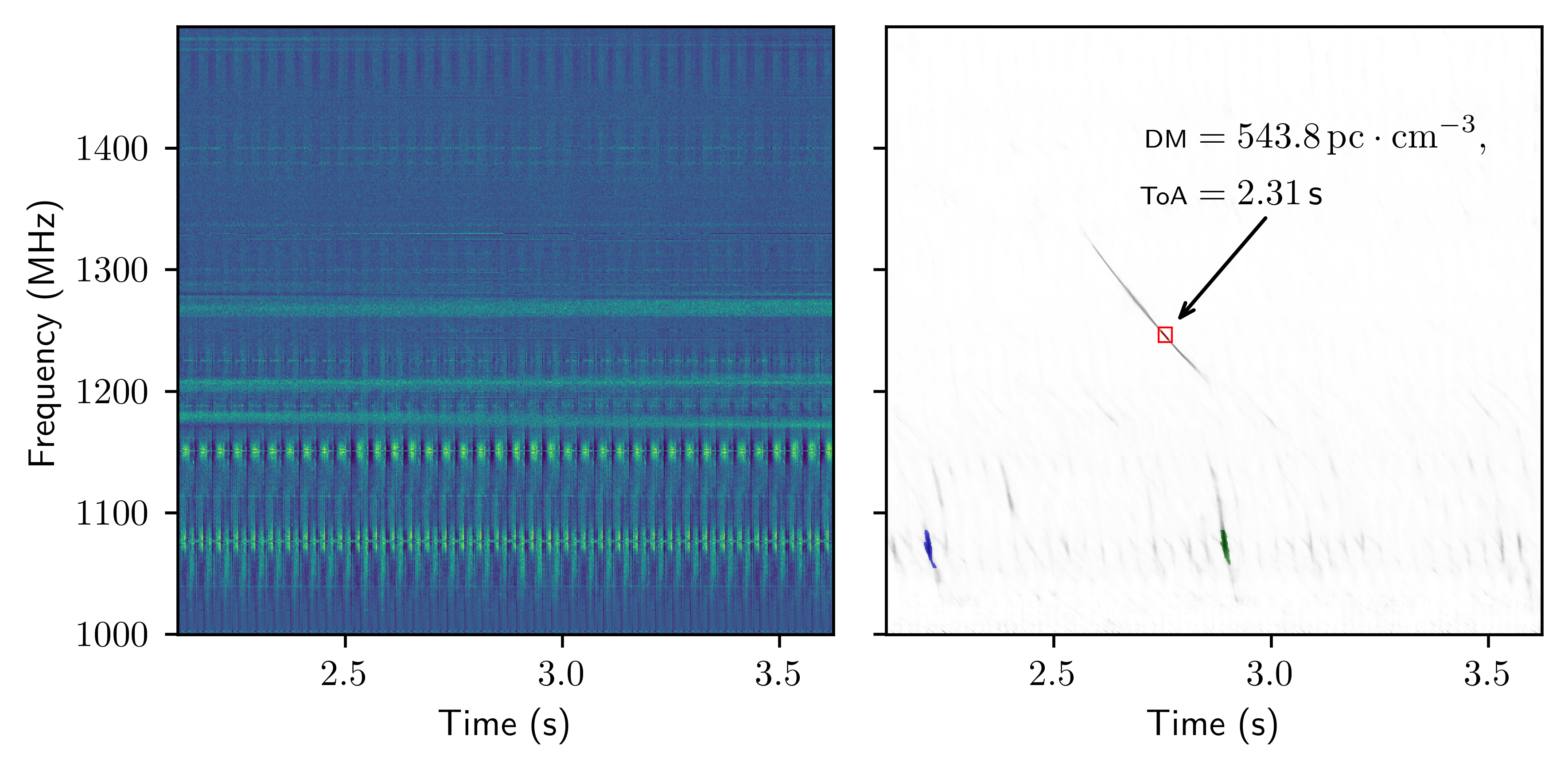
Evaluation of the pipeline on the FAST-FREX dataset demonstrates a F1 score of 97.8%, representing a state-of-the-art result for Fast Radio Burst (FRB) candidate detection. This metric balances precision and recall, indicating a high degree of accuracy in identifying true FRB signals while minimizing false positives. Comparative analysis against established FRB search algorithms, specifically PRESTO and fitburst, confirms the superior performance of this pipeline in effectively distinguishing FRB candidates within the dataset. The F1 score was calculated based on a labeled subset of the FAST-FREX data, providing a quantitative measure of the pipeline’s efficacy.
During a petabyte-scale blind search, our pipeline exhibited a false positive rate of 0.28%. This low rate represents a substantial reduction in the volume of candidate events requiring manual inspection and verification. Prior methods typically necessitate extensive human review to eliminate spurious detections; however, the precision of this pipeline minimizes such efforts, allowing astronomers to focus on genuine Fast Radio Burst (FRB) candidates and accelerating the overall research process. The achieved false positive rate was measured by independently verifying a statistically significant sample of pipeline detections against known terrestrial interference and instrumental artifacts.
The pipeline is capable of processing data and generating FRB candidate detections at real-time speeds when deployed on a standard consumer-grade personal computer. This performance is achieved through optimized algorithms and efficient code implementation, allowing for immediate analysis of incoming data streams. This capability is critical for enabling rapid follow-up observations with other telescopes, as candidate events can be identified and confirmed in near real-time, maximizing opportunities for multi-wavelength studies and transient event characterization. The elimination of substantial computational bottlenecks facilitates both automated surveys and interactive data analysis workflows.
Utilizing predictions from our model to initialize the fitburst software significantly improved the automated fitting process for Fast Radio Burst (FRB) candidates. Specifically, initializing fitburst with our model’s output resulted in a success rate exceeding 95%, a substantial improvement over prior fitting attempts without this pre-conditioning. This increase in success rate is attributed to the model’s ability to accurately predict key parameters, effectively narrowing the search space for fitburst and reducing computational time while simultaneously increasing the detection rate of valid FRB signals.
The Expanding Canvas of the Cosmos
The creation of extensive fast radio burst (FRB) catalogs has long been hampered by the challenges of efficient detection within massive datasets. A newly developed automated pipeline directly addresses this limitation, significantly increasing the rate at which FRBs are identified and recorded. This isn’t simply about finding more events; it’s about building a statistically robust foundation for FRB research. By systematically sifting through telescope data, the pipeline enables the compilation of catalogs far exceeding previous efforts in scope and detail. These larger datasets are critical, providing astronomers with the necessary statistical power to discern patterns, identify rare FRB subtypes, and ultimately, unlock the mysteries surrounding the origins and characteristics of these powerful cosmic signals.
A significantly expanded catalog of Fast Radio Bursts (FRBs) promises to move the field beyond individual event characterization toward statistically robust inferences about their origins. By analyzing the rate at which these bursts occur, alongside properties like their intrinsic luminosity and redshift – a measure of distance – astronomers can begin to disentangle the various proposed models for FRB production. This statistical approach allows for the testing of hypotheses ranging from bursts originating in magnetars within our own galaxy to signals from extremely energetic events in the distant universe, potentially even revealing details about the intervening cosmic web and the distribution of matter. Ultimately, a large, well-characterized dataset is crucial for determining whether FRBs are exotic local phenomena or powerful probes of the cosmos.
The advent of automated Fast Radio Burst (FRB) detection pipelines represents a significant leap forward in the study of these fleeting cosmic signals. These systems don’t merely identify FRBs; they do so in real-time, triggering immediate alerts that allow astronomers to marshal the resources of other telescopes – radio, optical, and even X-ray – to observe the FRB’s location. This rapid response is critical, as FRBs are transient events, often lasting only milliseconds, and the afterglow or host galaxy associated with an FRB fades quickly. Capturing this crucial follow-up data – pinpointing the source’s precise location, analyzing its spectrum, and characterizing the surrounding environment – is paramount to unraveling the mystery of their origin, from potential connections to magnetars and other extreme astrophysical phenomena to probing the intergalactic medium and testing fundamental physics.

The presented work, SwinYNet, embodies a pursuit of knowledge akin to peering into the most extreme environments the universe offers. As Albert Einstein once stated, “The important thing is not to stop questioning.” This model, through its innovative application of transformer networks and simulation-based training, demonstrates a refusal to accept limitations in the automated analysis of Fast Radio Bursts. Much like probing the singularity at the heart of a black hole-where classical theory breaks down-this research pushes the boundaries of signal processing and deep learning techniques to extract meaningful data from increasingly complex radio astronomical datasets. The model’s capacity for both detection and semantic segmentation represents a significant step towards a more complete understanding of these transient phenomena.
What Lies Beyond the Signal?
The pursuit of Fast Radio Bursts, now aided by architectures like SwinYNet, reveals less about the cosmos and more about the limits of pattern recognition. The model’s efficiency in sifting through immense datasets is admirable, yet it merely refines the question: what constitutes a ‘signal’ in a universe fundamentally defined by noise? Each improved algorithm, each successful detection, risks reinforcing pre-conceived notions of what these bursts should be, blinding researchers to genuinely novel phenomena. The cosmos generously shows its secrets to those willing to accept that not everything is explainable.
Future work will inevitably focus on expanding the training datasets, incorporating more sophisticated simulations, and perhaps venturing into multi-messenger astronomy. However, the true challenge lies in acknowledging the inherent incompleteness of any predictive model. A network, however cleverly constructed, remains a projection of human understanding – a finite attempt to grasp an infinite reality.
Black holes are nature’s commentary on our hubris. The very success of SwinYNet, and similar frameworks, should serve as a humbling reminder: the universe does not owe us an explanation, nor does it care for our neatly categorized data. The next breakthrough may not be a clearer signal, but an acceptance of the beautiful, irreducible ambiguity at the heart of existence.
Original article: https://arxiv.org/pdf/2603.05958.pdf
Contact the author: https://www.linkedin.com/in/avetisyan/
See also:
- Building 3D Worlds from Words: Is Reinforcement Learning the Key?
- Securing the Agent Ecosystem: Detecting Malicious Workflow Patterns
- Gold Rate Forecast
- 2025 Crypto Wallets: Secure, Smart, and Surprisingly Simple!
- The Best Directors of 2025
- TV Shows Where Asian Representation Felt Like Stereotype Checklists
- Games That Faced Bans in Countries Over Political Themes
- 📢 New Prestige Skin – Hedonist Liberta
- Most Famous Richards in the World
- SEGA Sonic and IDW Artist Gigi Dutreix Celebrates Charlie Kirk’s Death
2026-03-10 04:02