
The market, as always, breathes with a rhythm all its own. It is rarely a single tremor that fells a prevailing sentiment, but a subtle confluence of doubts, a quiet turning of heads. Recent readings from the Bank of America’s Global Fund Manager Survey suggest just such a shift, a cooling in the once fervent embrace of capital expenditure – a phenomenon we observe with a certain, melancholic inevitability.
For a time, the great engines of our digital age – Meta Platforms, Alphabet, Amazon, Microsoft – seemed to defy gravity, their valuations ascending on a tide of optimism. These hyperscalers, hungry for the raw materials of artificial intelligence – data centers, infrastructure, the very sinews of a new computational epoch – drove a surge in capital investment. Yet, the bloom, it appears, may be fading. These very titans now trail the broader S&P 500, a quiet testament to the market’s capacity for recalibration.
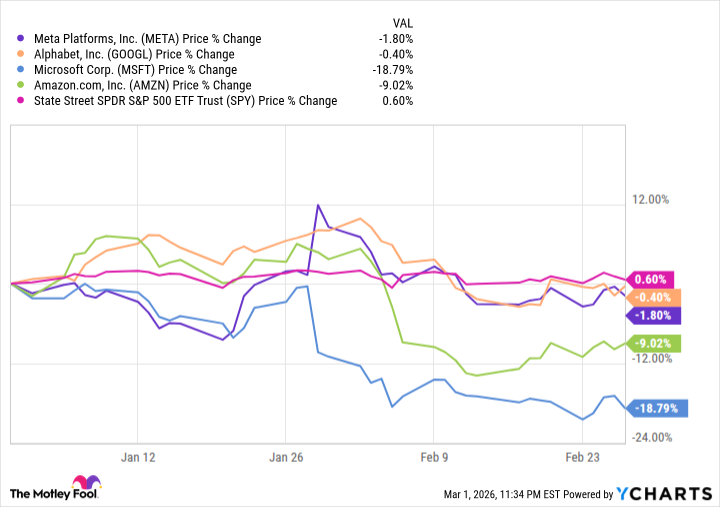
The survey reveals a growing skepticism towards further expansion, a sense that the relentless pursuit of growth may have reached a point of diminishing returns. It is as if the soil itself is tiring, unable to sustain the weight of so many ambitious plantings. AI, though not explicitly named, is the ghost in this machine, the unseen force driving these immense investments. JPMorgan’s Michael Cembalest estimates a staggering 90% of capital expenditure growth since late 2022 is linked to this singular pursuit. A beautiful, precarious bloom.
The Weight of Expectations
For two decades, the Bank of America survey has served as a barometer of investor sentiment. For most of that time, the prevailing wisdom favored expansion, a belief that capital, judiciously deployed, could always unlock further growth. But the pendulum swings. Now, a quiet unease is taking hold, a suspicion that the market may have overextended itself. It is a feeling familiar to anyone who has watched the seasons turn, the inevitable ebb and flow of fortune.
The question, of course, is not simply whether these investments will yield a return, but whether the market has already priced in that return, and then some. The air is thick with expectation, and expectation, as any seasoned investor knows, is a fragile thing.
Navigating the Shifting Landscape
What, then, is a prudent course of action? To abandon the field entirely would be rash, but to remain blindly committed would be folly. Diversification, that ancient and reliable principle, remains the cornerstone of a sound strategy.
Consider, for example, a shift towards international equities, represented by the Vanguard Total International Stock ETF (VXUS 0.94%). Or a bolstering of value stocks through the Vanguard Value ETF (VTV 1.14%). Fixed income, in the form of the Vanguard Total Bond Market ETF (BND 0.14%), offers a stabilizing influence, a quiet harbor in a turbulent sea. These allocations have, thus far, outperformed the hyperscalers and the tech-heavy Nasdaq-100, a subtle but significant divergence.
Vanguard’s projections suggest a continued advantage for these asset classes over the next five to ten years. High-quality fixed income, value-oriented stocks, and non-U.S. developed markets offer a more compelling risk-return profile, a more sustainable path forward.
The market, as always, is in motion. New breakthroughs may reignite enthusiasm for the AI trade, and valuations may once again soar. But a prudent portfolio manager must prepare for all eventualities, and diversification remains the most reliable shield against the unpredictable currents of the market. The seasons change, and so too must our strategies. The weight of capital, after all, is a force to be reckoned with.
Read More
- Building 3D Worlds from Words: Is Reinforcement Learning the Key?
- Gold Rate Forecast
- Securing the Agent Ecosystem: Detecting Malicious Workflow Patterns
- 2025 Crypto Wallets: Secure, Smart, and Surprisingly Simple!
- Wuthering Waves – Galbrena build and materials guide
- The Best Directors of 2025
- Games That Faced Bans in Countries Over Political Themes
- TV Shows Where Asian Representation Felt Like Stereotype Checklists
- 📢 New Prestige Skin – Hedonist Liberta
- SEGA Sonic and IDW Artist Gigi Dutreix Celebrates Charlie Kirk’s Death
2026-03-09 04:32