
The market, as is its wont, exhibits a familiar fragility. The gains of Wednesday, a fleeting mirage, have largely dissolved, leaving in their wake a somber acknowledgement of underlying anxieties. The indices, those cold arbiters of collective hope and despair, are in retreat. And at the heart of this downturn, one observes the outsized influence of a single entity – Nvidia, a name now synonymous with both innovation and, increasingly, the precariousness of concentrated power.
As of this hour, the Nasdaq Composite has yielded 1.9%, the S&P 500 a more restrained, yet significant, 1.1%. The Dow Jones Industrial Average, however, displays a curious resilience, declining a mere 0.4%. This divergence, a subtle fracturing of the whole, demands scrutiny. It is not merely a matter of percentages, but of the structural vulnerabilities revealed by their uneven distribution.
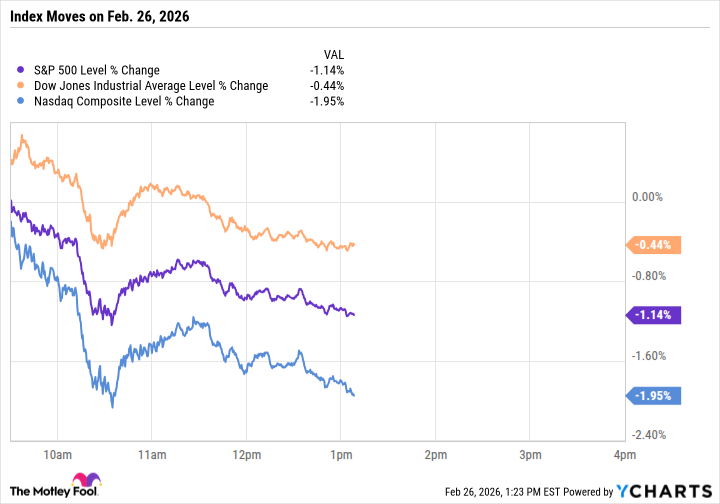
The Weight of Expectation & The Spectre of Disappointment
The prevailing mood is not dictated by the health of the American economy, but by the pronouncements emanating from Nvidia itself. The earnings report, released last night, while ostensibly positive, contained within it the seeds of present unease. To declare victory based solely on headline numbers—$68.1 billion in sales, $43.00 billion in earnings—is to engage in a willful blindness to the subtleties of the narrative. The company’s commentary, couched in the language of measured optimism, offered a veiled acknowledgement of shifting currents.
The growth in sales to hyperscalers, those vast digital estates, is slowing, while demand from smaller clients remains robust. One might interpret this as diversification, a prudent broadening of the customer base. Yet, a more cynical observer might see it as the waning of a speculative bubble, the inevitable contraction following a period of unsustainable expansion. The distinction, as always, lies in the interpretation.
The Illusion of Stability & The Arithmetic of Influence
Nvidia’s stock, initially buoyed by the earnings announcement, has since succumbed to the gravity of market sentiment, falling by 5%. This decline, while significant in absolute terms, is disproportionately amplified by the company’s sheer size. With a market capitalization of $4.5 trillion, Nvidia exerts an undue influence over both the S&P 500 and the Nasdaq. However, the Dow, weighted by share price rather than market capitalization, offers a partial shield against this dominance. After the recent stock split, Nvidia’s $191 share price represents a mere 2.4% weighting in the Dow’s calculation. This is a quirk of the system, a deliberate obfuscation of true power.
Today, 13 Dow components advanced while 17 declined, the largest impacts stemming from Caterpillar’s 2.4% decrease and Goldman Sachs’ 2.8% gain. Their elevated share prices—$768 and $902, respectively—exert a correspondingly greater influence on the index. This is not a reflection of inherent strength or weakness, but a consequence of the Dow’s peculiar arithmetic, a system that privileges price over substance. It is a reminder that the market, for all its complexity, remains susceptible to manipulation, to the illusion of stability built upon a foundation of shifting sands.
Read More
- Gold Rate Forecast
- 2025 Crypto Wallets: Secure, Smart, and Surprisingly Simple!
- HSR 3.7 story ending explained: What happened to the Chrysos Heirs?
- ETH PREDICTION. ETH cryptocurrency
- Here Are the Best TV Shows to Stream this Weekend on Paramount+, Including ‘48 Hours’
- Games That Faced Bans in Countries Over Political Themes
- Uncovering Hidden Groups: A New Approach to Social Network Analysis
- ‘Zootopia+’ Tops Disney+’s Top 10 Most-Watched Shows List of the Week
- The 10 Most Beautiful Women in the World for 2026, According to the Golden Ratio
- When Wizards Buy Dragons: A Contrarian’s Guide to TDIV ETF
2026-02-26 22:12