Author: Denis Avetisyan
As electric vehicle adoption accelerates, accurately forecasting charging demand is crucial for grid stability and efficient energy management.

This review assesses time series forecasting techniques, including the application of federated learning, to improve EV demand prediction while preserving data privacy.
Accurate prediction of energy demand is increasingly challenging amidst the proliferation of distributed energy resources and growing privacy concerns. This paper, ‘On Electric Vehicle Energy Demand Forecasting and the Effect of Federated Learning’, investigates the efficacy of established time series forecasting methodologies-ranging from ARIMA to XGBoost and deep learning architectures-in predicting electric vehicle supply equipment (EVSE) load. Experimental results demonstrate that gradient boosted trees (XGBoost) offer superior predictive accuracy and energy efficiency, while federated learning approaches provide a viable path toward balancing forecasting fidelity with data privacy and decentralized operation. Could federated learning unlock a new era of sustainable and secure energy management for the rapidly expanding electric vehicle infrastructure?
Decoding the Energy Frontier: Demand, Data, and Disruption
The world’s appetite for energy is undergoing a significant surge, propelled by two major forces: a growing global population and the accelerating adoption of electric vehicles. As more people inhabit the planet, the overall demand for power inevitably increases, spanning residential, commercial, and industrial sectors. Simultaneously, the transition towards electric mobility, while crucial for decarbonization, introduces a new layer of complexity to energy requirements. Each new electric vehicle adds to the base load, but also creates fluctuating demand peaks tied to charging habits. This dual pressure – a rising baseline coupled with intermittent spikes – is placing unprecedented strain on existing energy infrastructure and highlighting the need for proactive strategies to ensure a stable and sustainable energy future. The convergence of these trends necessitates not only increased energy production but also smarter distribution and consumption patterns.
Reliable energy demand forecasting is becoming increasingly vital as societies transition towards electrified systems and growing populations place strain on existing infrastructure. Accurate predictions allow grid operators to proactively manage supply and demand, preventing potentially catastrophic blackouts and ensuring consistent power delivery. Beyond grid stability, effective forecasting is fundamental to efficient resource allocation; utilities can optimize power generation, reduce reliance on expensive peak-load plants, and minimize energy waste. Critically, precise EDF plays a significant role in mitigating greenhouse gas emissions by enabling greater integration of renewable energy sources – forecasting allows operators to anticipate fluctuations in solar and wind power, and adjust conventional generation accordingly, thus reducing carbon footprints and supporting climate goals.
Conventional energy demand forecasting techniques, often relying on historical averages and linear projections, are increasingly challenged by the unpredictable dynamics of modern energy consumption. The proliferation of electric vehicles introduces a particularly disruptive element; charging behavior is characterized by both intermittency – occurring at irregular times – and ‘lumpiness’, where significant demand concentrates during specific periods. This pattern, coupled with the sheer volume and variety of data now available – encompassing weather patterns, economic indicators, and real-time grid information – overwhelms traditional statistical models. These models struggle to discern meaningful signals from the noise inherent in such complex datasets, leading to inaccuracies in prediction and potentially compromising the stability and efficiency of power grids. Consequently, a shift towards more adaptive and sophisticated forecasting methodologies is essential to navigate the evolving energy landscape.
Addressing the escalating complexities of energy demand requires a shift towards innovative forecasting methodologies. Traditional models, often reliant on historical averages, are proving inadequate when confronted with the fragmented and varied data streams characteristic of modern energy systems – encompassing everything from rooftop solar generation to the unpredictable charging behaviors of electric vehicles. Consequently, research is increasingly focused on techniques capable of integrating diverse data types – including weather patterns, real-time grid loads, and even socioeconomic indicators – into cohesive and accurate predictions. Machine learning algorithms, particularly those designed for handling ‘noisy’ and incomplete datasets, are at the forefront of this effort, promising to not only refine short-term load forecasting but also to enhance long-term resource planning and bolster the resilience of the electrical grid against unforeseen fluctuations.
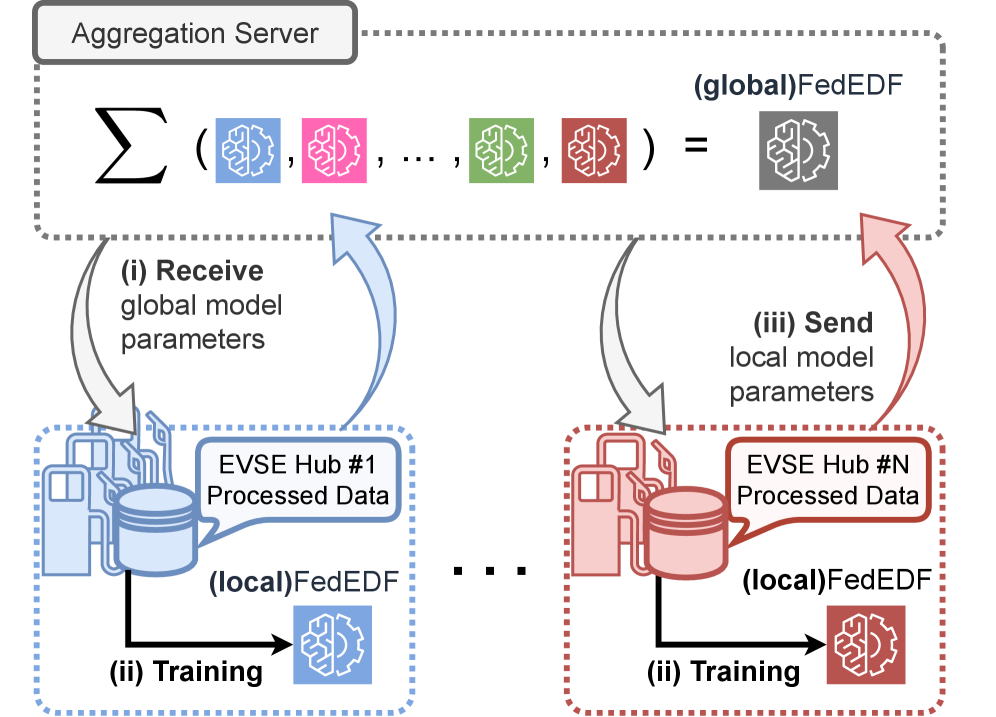
![Our [Fed]EDF framework provides a comprehensive approach to forecasting by integrating federated learning with ensemble deep forecasting.](https://arxiv.org/html/2602.20782v1/x1.png)
Unveiling Predictive Power: Time Series Analysis and Beyond
Time series forecasting is fundamental to modern Electric Distribution Function (EDF) operations, enabling the analysis of historical load data – typically spanning hourly, daily, or seasonal intervals – to predict future energy demand. These forecasts are critical for multiple applications including unit commitment, economic dispatch, and grid stability maintenance. Accurate predictions allow EDF operators to optimize resource allocation, minimize operational costs, and ensure a reliable power supply. The process relies on identifying patterns, trends, and seasonality within the historical data to extrapolate future values, with forecasting horizons ranging from short-term (hours ahead) to long-term (days or weeks ahead) depending on the specific application.
Autoregressive Integrated Moving Average (ARIMA) and Seasonal ARIMA (SARIMA) models serve as fundamental statistical baselines for time series forecasting in Energy Demand Forecasting (EDF). ARIMA models analyze the autocorrelations within a single time series to predict future values, requiring stationarity or transformation to achieve it. SARIMA extends this capability to explicitly model seasonal patterns, utilizing parameters to represent the autoregressive (AR), integrated (I), moving average (MA), seasonal AR, seasonal I, and seasonal MA components – denoted as ARIMA(p,d,q)(P,D,Q)s. While effective for capturing inherent temporal dependencies, these models are limited in their ability to account for external influences; SARIMAX addresses this limitation by incorporating exogenous variables – factors outside the time series itself – into the model, allowing for a more comprehensive and potentially accurate forecast.
Machine learning algorithms, specifically XGBoost, Long Short-Term Memory (LSTM) networks, and Gated Recurrent Units (GRU), provide enhanced capabilities for time series forecasting compared to traditional statistical methods due to their ability to model non-linear relationships and complex dependencies within data. XGBoost, a gradient boosting algorithm, excels in handling large datasets and capturing intricate interactions between features. LSTM and GRU, both types of recurrent neural networks, are designed to process sequential data, effectively remembering past information to predict future values, and are particularly well-suited for capturing temporal patterns that may be missed by models assuming data stationarity. These algorithms achieve increased accuracy by learning hierarchical representations of the data and adapting to changes in the underlying patterns, offering greater flexibility in capturing the complexities inherent in energy demand forecasting.
Utilizing Pinball Loss, also known as quantile loss, during the training of XGBoost models for Energy Demand Forecasting (EDF) directly optimizes the prediction of specific quantiles – such as the 50th percentile for median demand or the 95th percentile for peak demand – rather than solely focusing on point forecasts. This quantile-based approach provides a probabilistic forecast, quantifying the uncertainty associated with predictions. Empirical results demonstrate that XGBoost models trained with Pinball Loss consistently outperform those using traditional loss functions like Mean Squared Error in terms of prediction accuracy across various quantiles, and currently serve as the benchmark for highest forecasting accuracy in EDF applications. This improvement is crucial for reliable grid operation and resource allocation under uncertain conditions, enabling more informed decision-making regarding energy supply and pricing.

Decentralized Intelligence: The Rise of Federated Learning
Federated Learning (FL) is a distributed machine learning approach that enables model training on a decentralized network of devices – such as smart meters or edge computing nodes – without requiring the direct exchange of raw data. Instead of aggregating data in a central location, FL algorithms train models locally on each device using its own data. These locally trained models then contribute to a global model through iterative averaging of model parameters – weights and biases – rather than the data itself. This process preserves data privacy by keeping sensitive information on the user’s device, while still allowing for the development of a robust and generalized predictive model applicable to the entire network. The aggregation process typically involves a central server coordinating the model updates, but the raw data remains distributed and secure.
Data heterogeneity and non-IID (non-independent and identically distributed) data are inherent challenges in decentralized energy systems due to variations in consumer behavior, device capabilities, and environmental factors. FedAvg (Federated Averaging) and FedProx are algorithms designed to mitigate these issues. FedAvg addresses data heterogeneity by averaging model updates from multiple clients, but can struggle with significant statistical differences. FedProx improves upon this by adding a proximal term to the local objective function, encouraging local models to stay close to the global model, thus stabilizing training with non-IID data and reducing divergence between clients. This approach enables effective model training even when data distributions vary considerably across participating devices, which is typical in diverse energy networks.
Federated Learning (FL) improves data privacy in Energy Demand Forecasting (EDF) by processing data locally on consumer devices – such as smart meters or edge computing nodes – and only sharing model updates, not the raw energy consumption data itself. This decentralized approach mitigates the risks associated with centralized data storage and transmission, addressing growing concerns regarding user privacy and data security. Despite this enhanced privacy, FL maintains forecasting accuracy by aggregating insights from diverse data sources, enabling the development of robust models capable of generalizing across varying consumption patterns and improving the reliability of EDF systems. The technique effectively decouples data access from model training, allowing for collaborative learning without compromising individual consumer data confidentiality.
Experimental results indicate that a streamlined Federated Learning implementation, employing Bi-directional Gated Recurrent Unit (BiGRU) models, achieved an 80.6% reduction in energy consumption. This performance was evaluated against a centralized XGBoost model, which served as a baseline for both energy usage and prediction accuracy. While implementing Federated Learning resulted in a decrease in prediction fidelity, as measured by the R2 score, this decrease was limited to 12.5%. This demonstrates a favorable trade-off between energy efficiency and predictive performance within the tested decentralized energy system.
Harmonizing the Grid: Smart Charging and a Sustainable Future
Smart charging systems represent a dynamic approach to energy management, utilizing both electricity demand forecasts (EDF) and flexibility layers (FL) to intelligently schedule electric vehicle (EV) charging. These systems don’t simply charge vehicles when plugged in; instead, they anticipate periods of peak electricity demand and strategically delay charging to off-peak hours, thereby lessening the strain on the power grid. Accurate EDFs predict when demand will be highest, while FL allows the system to modulate charging rates or even temporarily pause charging without impacting the driver’s needs. This coordinated approach minimizes the risk of grid overloads, reduces the need for expensive infrastructure upgrades, and ultimately contributes to a more stable and efficient energy distribution network, paving the way for greater EV adoption without compromising grid reliability.
Electric Vehicle Supply Equipment, or EVSE, extends far beyond simply delivering electricity to a vehicle; it functions as a critical interface for advanced energy management systems. Modern EVSE incorporates sophisticated communication protocols that allow it to respond dynamically to grid signals, optimizing charging schedules based on factors like electricity pricing and renewable energy availability. This responsiveness is fundamental to implementing smart charging strategies, preventing overloading of the grid during peak hours and maximizing the use of cleaner energy sources. Furthermore, increasingly capable EVSE is paving the way for Vehicle-to-Grid (V2G) technology, where electric vehicles can not only draw power from the grid but also contribute energy back, effectively turning EV batteries into distributed energy storage assets and bolstering grid resilience. The evolution of EVSE, therefore, is not just about faster charging; it represents a fundamental shift in how vehicles interact with, and contribute to, the broader energy ecosystem.
Intelligent management of electric vehicle (EV) charging represents a pivotal strategy for bolstering grid stability and fostering a more sustainable energy future. By shifting charging loads away from peak demand periods, the strain on existing grid infrastructure is significantly reduced, minimizing the risk of blackouts and enhancing overall reliability. This optimized approach not only lowers energy costs for both EV owners and utility providers, but also facilitates greater integration of renewable energy sources. When charging is strategically aligned with periods of high renewable energy generation – such as midday solar or overnight wind – the carbon footprint of transportation is minimized, promoting a cleaner and more environmentally responsible energy ecosystem. Ultimately, a proactive and data-driven approach to EV charging unlocks substantial economic and environmental benefits, paving the way for a resilient and sustainable energy landscape.
Analysis reveals a substantial environmental advantage to employing a ‘light’ federated learning (FL) configuration for smart charging initiatives. Comparative studies demonstrate that this streamlined approach yields a carbon footprint of just 0.11 grams of CO2 equivalent (CO2e) per unit, a figure dramatically lower than the 0.35 g CO2e associated with a more computationally intensive ‘heavy’ FL setup. This reduction in greenhouse gas emissions underscores the potential of optimized algorithms to not only enhance energy management but also contribute meaningfully to broader sustainability goals, suggesting that algorithmic efficiency is a critical, often overlooked, component of green technology.

The pursuit of accurate electric vehicle (EV) demand forecasting, as detailed in the study, isn’t merely about predicting a number; it’s about probing the system’s boundaries. One considers the inherent limitations of any model, recognizing that discrepancies may not represent errors, but rather reveal unseen interactions within the charging infrastructure. As Edsger W. Dijkstra observed, “In moments of crisis, the only thing that matters is that you have been thinking.” This sentiment resonates with the core principle of this work; the exploration of Federated Learning isn’t just about enhancing privacy, but about stress-testing the conventional centralized approaches to forecasting, and uncovering new patterns in energy consumption that might otherwise remain hidden. The study’s meticulous evaluation of time series methods exemplifies a dedication to understanding the system through rigorous examination and intellectual challenge.
Beyond the Forecast
The pursuit of accurate electric vehicle charging demand prediction, as explored within this work, reveals itself less as a solved problem and more as a meticulously defined boundary. The current focus on algorithmic refinement – XGBoost, federated learning, and their various permutations – addresses symptoms, not the underlying chaos. The system will be perturbed by unforeseen incentives, infrastructural failures, and the delightfully irrational behavior of human beings. To treat the forecast as a final answer is to misunderstand its purpose – it is a controlled demolition of assumptions, a stress test for the grid.
Federated learning, presented as a privacy-preserving technique, is, at its core, a distributed experiment in controlled information loss. The question isn’t merely “how much accuracy can be retained?” but “what information should be discarded to reveal systemic vulnerabilities?” The future likely lies in actively introducing controlled noise – deliberately flawed data points – to probe the robustness of the forecasting models and the grid itself.
Ultimately, the goal isn’t to predict demand with ever-increasing precision, but to engineer a system that gracefully degrades in the face of inevitable uncertainty. The true measure of success will not be the R-squared value, but the speed and efficiency with which the system adapts to the unexpected. The forecast is merely a map; the real challenge is navigating the territory when the map is demonstrably wrong.
Original article: https://arxiv.org/pdf/2602.20782.pdf
Contact the author: https://www.linkedin.com/in/avetisyan/
See also:
- 2025 Crypto Wallets: Secure, Smart, and Surprisingly Simple!
- Gold Rate Forecast
- Brown Dust 2 Mirror Wars (PvP) Tier List – July 2025
- HSR 3.7 story ending explained: What happened to the Chrysos Heirs?
- ETH PREDICTION. ETH cryptocurrency
- Gay Actors Who Are Notoriously Private About Their Lives
- 9 Video Games That Reshaped Our Moral Lens
- Uncovering Hidden Groups: A New Approach to Social Network Analysis
- The Best Actors Who Have Played Hamlet, Ranked
- Games That Faced Bans in Countries Over Political Themes
2026-02-26 00:59