
The tech sector had a bad month. A real bad month. Software took the worst of it. The QQQ, that broad-stroke index, barely flinched, down a couple of points. But the software ETF? It cratered. Nearly eighteen percent gone. Like smoke in a high wind.
And D-Wave Quantum? They weren’t wearing a halo. Shares took a beating, down thirty-seven percent. Quantum computing. The future, they said. Right now, it looked more like a ghost town.
The question wasn’t whether it was cheap. It was whether it was a falling knife. And in this market, there were plenty of those.
A Reckoning in Silicon
There were reasons, of course. The big boys – Microsoft, Amazon, Alphabet – suddenly decided they needed to spend a lot more money. More data centers, more infrastructure. They weren’t whispering about it either. They were shouting it from the rooftops. Wall Street didn’t like being surprised. It’s a sensitive beast.
The market doesn’t care about promises of future AI payoffs. It cares about cash. Right now. These companies were sacrificing today for a maybe tomorrow. That kind of gamble doesn’t sit well with everyone.
Then there’s the enterprise software side. Anthropic, OpenAI…these names are starting to spook the old guard. The idea that everything we know about data analytics and workplace productivity could be replaced by a clever algorithm? It’s enough to give a CFO indigestion. SaaS stocks, always priced like they were wearing a crown, were starting to lose their shine.
D-Wave: A Quantum Gamble?
Looking at a stock chart is like reading tea leaves. It tells you what was, not what will be. D-Wave had been losing ground, but that didn’t necessarily mean it was a bad company. It just meant it was a company trying to build the future, and the future, as always, was expensive.
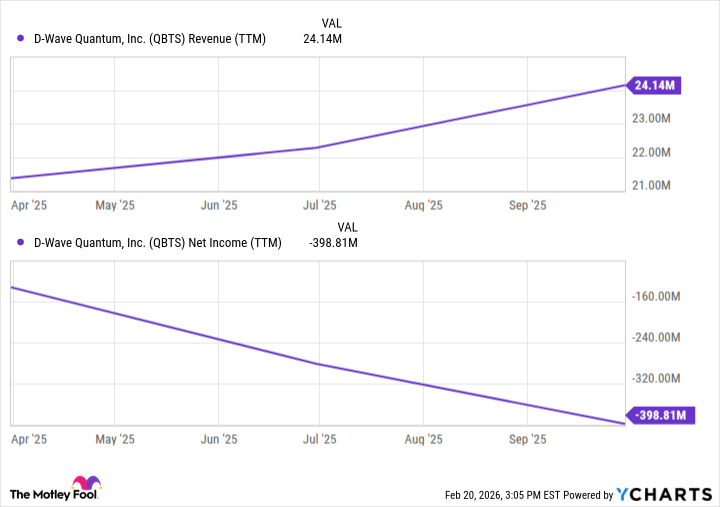
The numbers didn’t lie. Revenue was inching up, but profits were heading south. A classic case of chasing a dream with an empty wallet. It reminded me of a gambler doubling down on a losing hand, hoping for a miracle.
Quantum computing is still years away from being a practical reality. Years. That’s a long time in the tech world. A lifetime, almost. D-Wave might run out of runway before it reaches the finish line. And the big boys weren’t exactly throwing money at quantum computers. Their capital expenditures were focused on the here and now, on AI that could deliver results today.
D-Wave’s price-to-sales ratio? A ridiculous 237. A premium for a promise. Anyone buying now was walking into a value trap, a beautifully painted illusion hiding a gaping hole. It was like buying a ticket to a show that might never open.
There’s no compelling reason for a long-term investor to touch this stock at its current price. It’s a play for the risk-takers, the day traders who like to gamble with other people’s money. The kind of guys who think they can beat the house. They rarely do.
Read More
- 2025 Crypto Wallets: Secure, Smart, and Surprisingly Simple!
- Gold Rate Forecast
- Brown Dust 2 Mirror Wars (PvP) Tier List – July 2025
- HSR 3.7 story ending explained: What happened to the Chrysos Heirs?
- Gay Actors Who Are Notoriously Private About Their Lives
- ETH PREDICTION. ETH cryptocurrency
- Games That Faced Bans in Countries Over Political Themes
- Uncovering Hidden Groups: A New Approach to Social Network Analysis
- The Best Actors Who Have Played Hamlet, Ranked
- The 10 Most Beautiful Women in the World for 2026, According to the Golden Ratio
2026-02-25 20:22