Author: Denis Avetisyan
New research demonstrates that artificial intelligence can effectively remove the ‘jitter’ caused by star activity, improving our ability to find Earth-like planets.
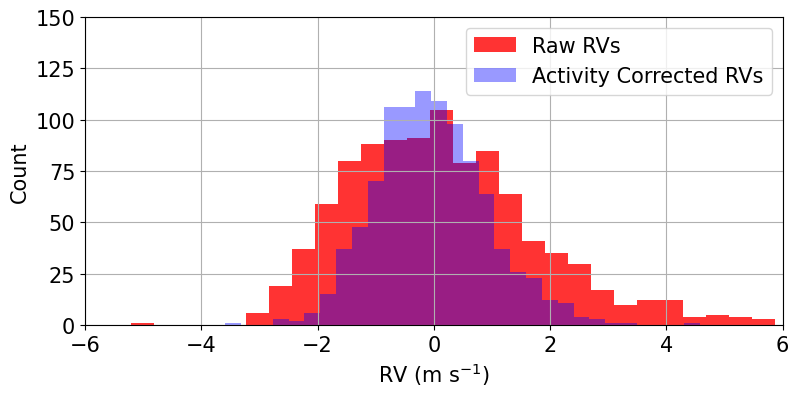
Convolutional neural networks enhance radial velocity signal processing to mitigate stellar activity and improve exoplanet detection.
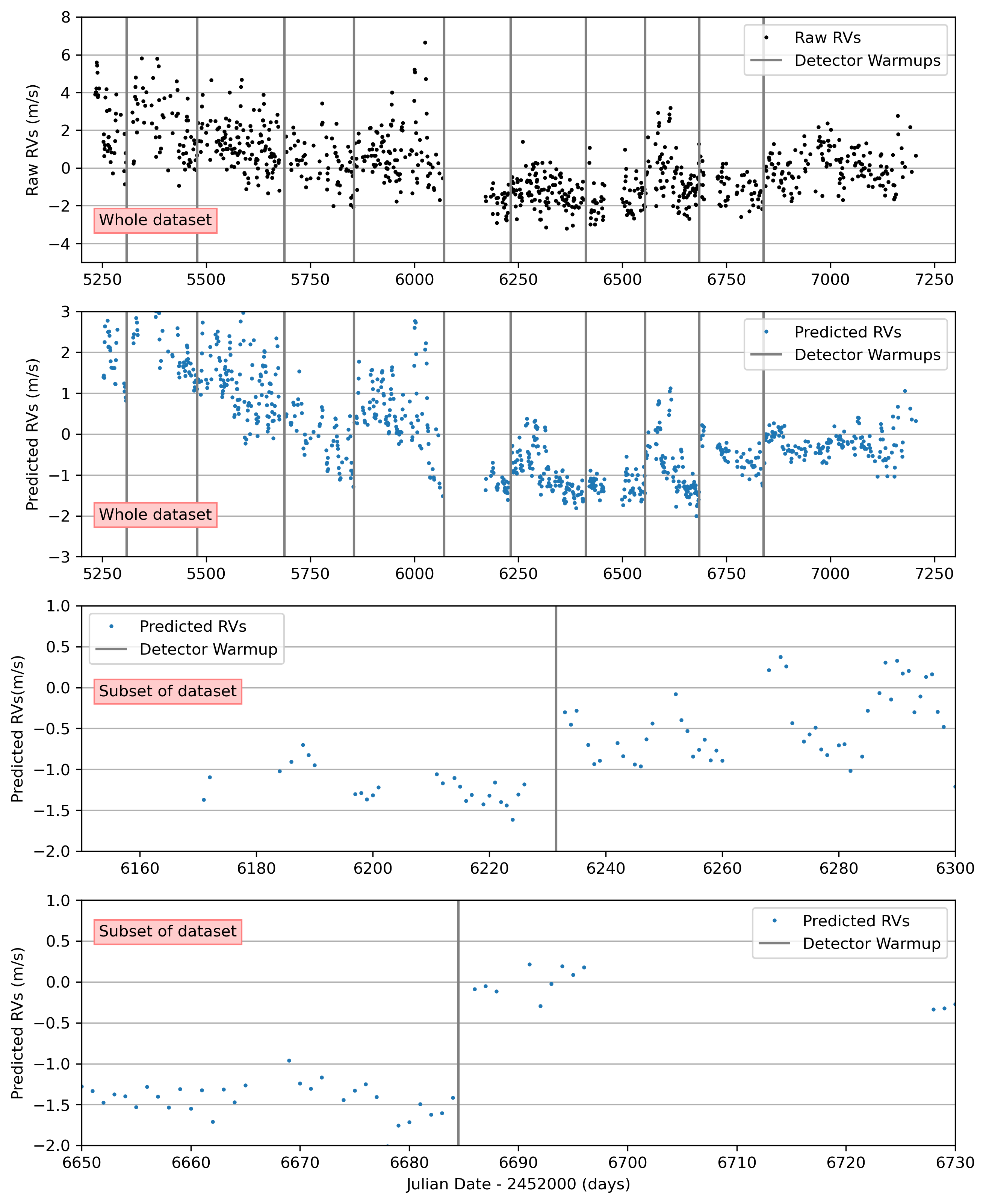
Accurate exoplanet mass determination via radial velocity (RV) measurements is fundamentally challenged by stellar activity, which introduces spurious signals mimicking planetary orbits. This study, ‘Identifying Exoplanets with Deep Learning VI. Enhancing neural network mitigation of stellar activity RV signals with additional metrics’, investigates the efficacy of incorporating a broader range of stellar activity indicators-including chromatic cross-correlation functions, magnetic flux, and total solar irradiance-into a convolutional neural network designed to filter these noise sources. Results demonstrate that supplementing traditional white light RV data with these parameters significantly reduces RV scatter, achieving a reduction from 147.1 cm/s to 93.3 cm/s and approaching levels attributable to supergranulation noise. Will refining these activity tracers, and the models that utilize them, ultimately unlock the detection of Earth analogues amidst the stellar din?
The Stellar Veil: Unmasking False Signals
The radial velocity method, a primary technique in the search for exoplanets, relies on detecting the subtle wobble of a star caused by the gravitational pull of orbiting planets. However, this technique is inherently challenged by the extremely faint signals it attempts to measure – signals easily overwhelmed by what astronomers term ‘stellar noise’. This noise isn’t simply random static; it represents genuine physical activity within the star itself, including the turbulent motions of gas, the shifting of magnetic fields, and even pulsations in the star’s brightness. Because these internal stellar processes produce variations in the star’s velocity that mimic the signal of a planet, discerning a true exoplanet from this inherent stellar activity requires increasingly sophisticated data analysis and observational strategies. Consequently, the detection of smaller, Earth-like planets – which produce even weaker radial velocity shifts – remains a significant hurdle in the ongoing quest to find worlds beyond our own.
Exoplanet detection isn’t simply a matter of finding a dimming star or a gravitational wobble; stellar activity introduces significant complications. Stars aren’t static points of light; they possess complex, dynamic interiors and magnetic fields that cause them to naturally ‘vibrate’ and fluctuate in brightness. These intrinsic variations – arising from convective motions within the star and the evolution of its magnetic field – generate signals that closely resemble those produced by orbiting planets. Consequently, astronomers must carefully distinguish between genuine planetary signals and these ‘false positives’ caused by the star itself, a process requiring advanced data analysis techniques and sophisticated modeling of stellar behavior. The challenge lies in the fact that these stellar ‘noises’ often have frequencies and amplitudes similar to those expected from Earth-sized planets in the habitable zones of their stars, making accurate detection incredibly difficult.
Detecting exoplanets, particularly those resembling Earth, presents a significant challenge due to the inherent ‘noise’ within stars themselves. Conventional radial velocity methods, which rely on measuring the wobble of a star caused by an orbiting planet, often mistake stellar activity – like turbulent convection or fluctuating magnetic fields – for genuine planetary signals. These stellar variations create false positives, masking the subtle signatures of smaller, Earth-sized planets. Consequently, astronomers face the difficult task of differentiating between a star’s own dynamic behavior and the gravitational influence of an actual orbiting world, a distinction that currently limits the effectiveness of exoplanet searches and hinders the discovery of potentially habitable planets beyond our solar system.

The Neural Filter: Isolating Planetary Whispers
Convolutional Neural Networks (CNNs) address the challenge of stellar activity masking planetary signals in radial velocity (RV) data by leveraging their ability to identify and filter patterns. RV measurements are often contaminated by signals originating from starspots, plages, and oscillations – collectively referred to as ‘noise’. CNNs, traditionally employed in image processing, are adapted to treat RV time series data as a one-dimensional signal. By applying convolutional filters, the network learns to recognize characteristic patterns associated with stellar activity, distinguishing them from the expected signatures of orbiting planets. This pattern recognition allows the CNN to effectively suppress the stellar activity noise, improving the signal-to-noise ratio and enabling the detection of weaker planetary signals that would otherwise be obscured.
Neural networks employed for signal isolation are trained through supervised learning techniques, utilizing labeled datasets of radial velocity time series data. These datasets contain examples of both stellar activity – such as starspots and flares – and simulated or confirmed planetary signals. The network learns to identify characteristic patterns within the data associated with each phenomenon; for stellar activity, these may include quasi-periodic variations and high-frequency noise, while planetary signals typically manifest as low-amplitude, sinusoidal waveforms. Through iterative adjustments of internal weights during the training process, the network develops the capacity to classify input data and differentiate between these patterns, effectively isolating planetary signals from the confounding effects of stellar activity.
Effective training of neural networks for signal isolation in radial velocity data is contingent on the selection of appropriate input features representing stellar behavior. These features typically include parameters derived from the light curve, such as periods and amplitudes of stellar oscillations, as well as indicators of magnetic activity like starspot coverage and chromospheric emission levels. Additionally, time-series data representing the star’s overall brightness variations and spectral line profiles are frequently incorporated. The network’s ability to accurately differentiate between planetary signals and stellar activity is directly proportional to the completeness and relevance of these input features, enabling it to learn the complex relationship between stellar phenomena and observed radial velocity variations.
Revealing the Signal: Key Indicators of Planetary Presence
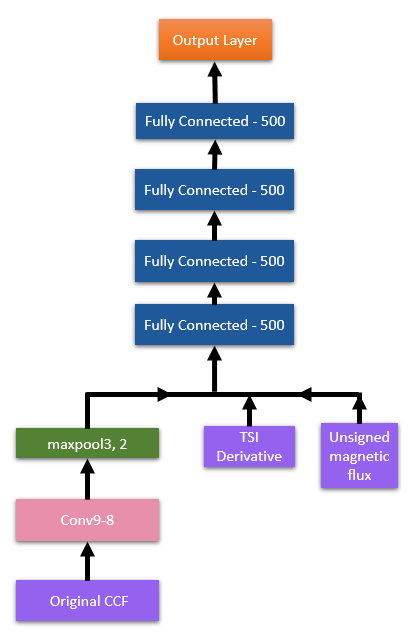
Unsigned magnetic flux and total solar irradiance (TSI) are incorporated as key input features due to their direct relationship with stellar activity and its influence on radial velocity measurements. Unsigned magnetic flux quantifies the strength of magnetic fields on the stellar surface, irrespective of polarity, and is typically measured in Gauss. TSI, expressed in Watts per square meter, represents the total energy radiated by the star across all wavelengths. Variations in both unsigned magnetic flux and TSI are directly correlated with phenomena like starspots and faculae, which induce radial velocity signals unrelated to planetary orbits; therefore, accounting for these features improves the accuracy of exoplanet detection algorithms by allowing for the mitigation of stellar noise.
The Cross-Correlation Function (CCF) is a signal processing technique employed to identify and mitigate correlated noise within radial velocity datasets. This function operates by comparing the observed radial velocity signal with a template representing the expected stellar spectrum, effectively quantifying the similarity between the two as a function of velocity shifts. Correlated noise, often originating from instrument characteristics or data acquisition processes, manifests as patterns that resemble true stellar signals, hindering accurate radial velocity measurements. By identifying these noise patterns via the CCF, they can be subtracted from the original data, leading to a reduction in systematic errors and an improved signal-to-noise ratio, thereby enhancing the clarity and precision of the radial velocity measurements used for exoplanet detection and stellar characterization.
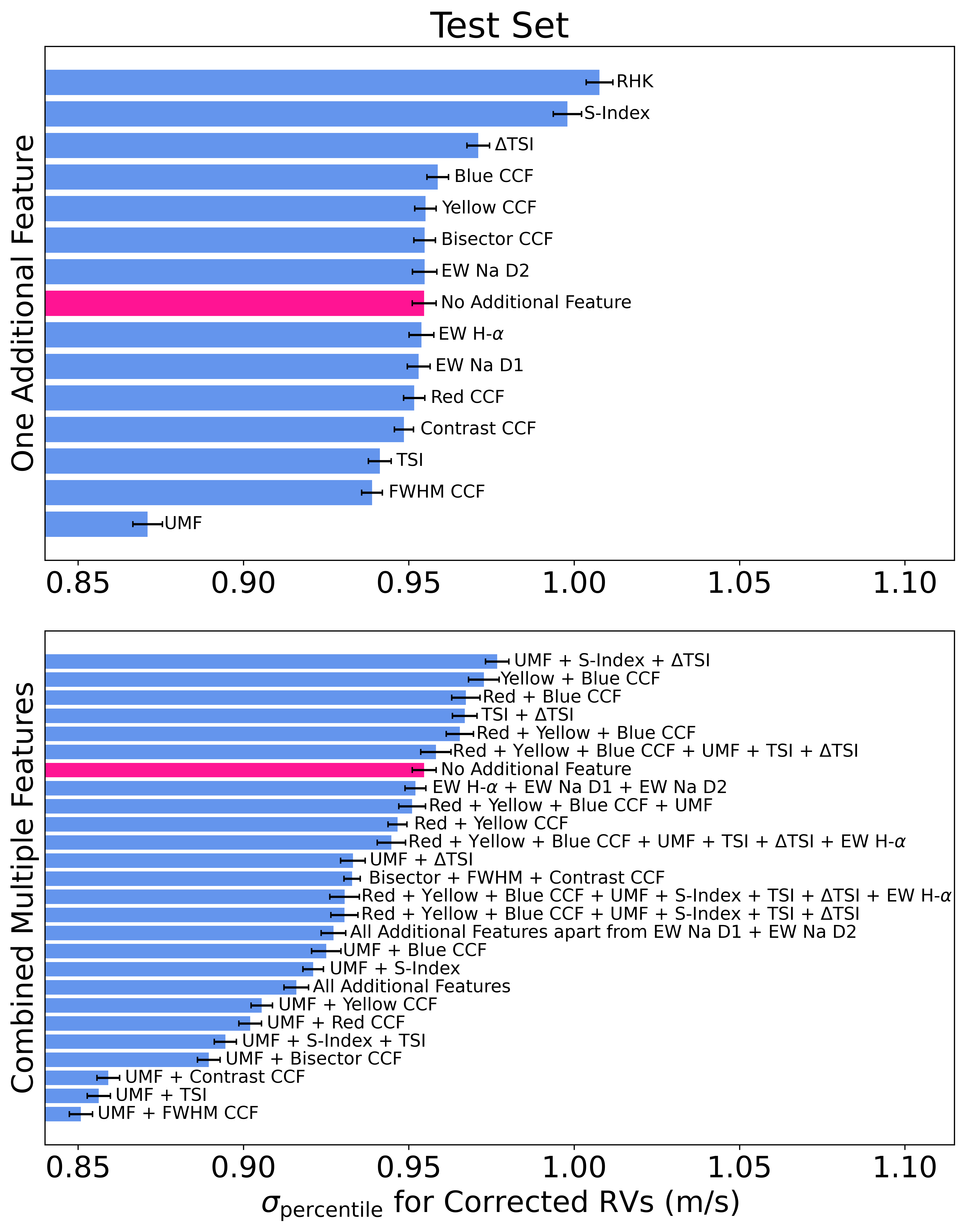
The implementation of robust statistical measures, specifically the Sigma Percentile, is critical for data quality control in radial velocity analysis. The Sigma Percentile calculates the percentage of data points that fall within a specified number of standard deviations (σ) from the mean, effectively quantifying data dispersion. Values exceeding a predetermined percentile threshold are flagged as potential outliers, which may result from instrumental errors, stellar activity, or non-astrophysical signals. By identifying and mitigating the influence of these outliers, the training dataset used for the neural network is refined, leading to improved model generalization and more accurate predictions of planetary signals.
Beyond Detection: The Impact on Exoplanetary Science
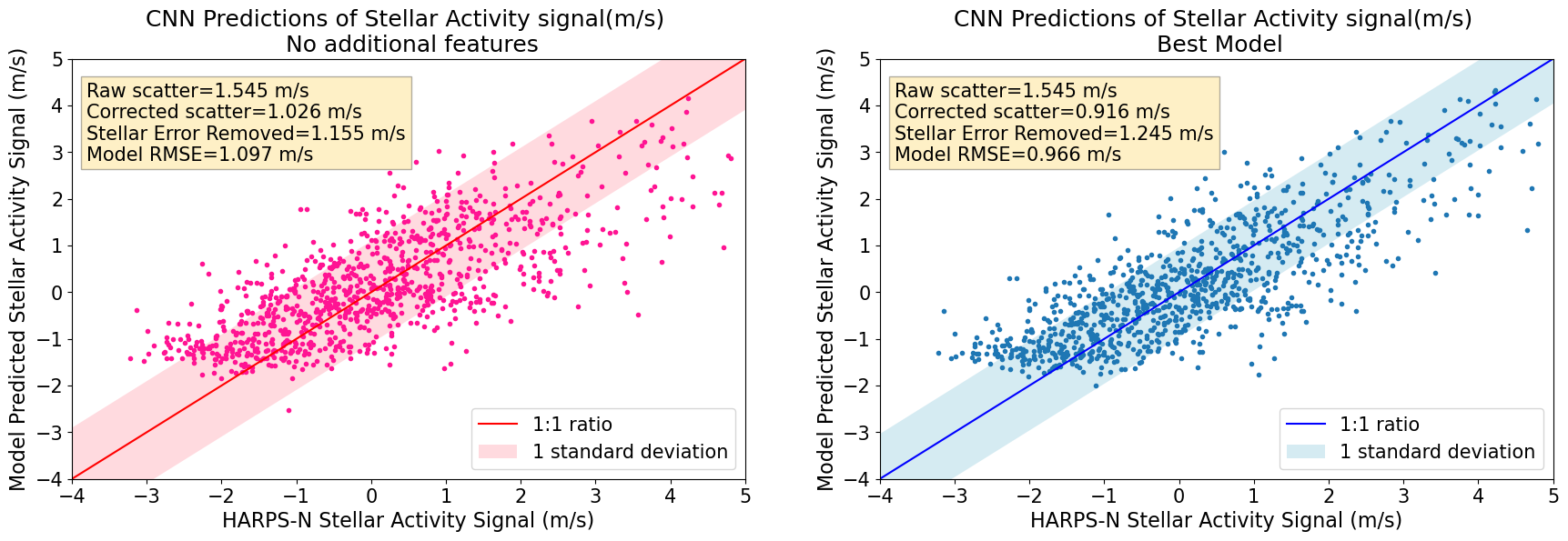
The efficacy of the convolutional neural network (CNN) in isolating planetary signals from stellar noise is rigorously assessed through quantifiable metrics, most notably the Root Mean Square (RMS) Error. This measurement calculates the standard deviation of the differences between the radial velocity variations predicted by the CNN and those actually observed in the stellar spectra. A lower RMS Error indicates a more accurate prediction and, therefore, a more effective removal of stellar noise. By minimizing this error, the CNN demonstrably improves the precision of radial velocity measurements, allowing astronomers to discern subtle planetary wobbles previously obscured by stellar activity and ultimately enhancing the ability to detect smaller, potentially habitable exoplanets. RMS\,Error = \sqrt{\frac{1}{n}\sum_{i=1}^{n}(y_i - \hat{y}_i)^2}
A significant advancement in exoplanet detection hinges on the capacity to diminish disruptive stellar noise within radial velocity (RV) data. This novel method achieves a substantial reduction in RV scatter, decreasing it from 147.1 cm/s to a remarkably low 93.3 cm/s. This improvement isn’t merely statistical; it directly translates to heightened sensitivity for the RV method, a technique reliant on subtle stellar wobbles induced by orbiting planets. By effectively filtering out stellar “jitter,” researchers can now reliably detect the significantly weaker signals produced by smaller, Earth-like exoplanets that were previously obscured, opening new avenues in the search for potentially habitable worlds and a more complete understanding of planetary system demographics.
A significant advancement in exoplanet detection lies in the refined ability to minimize false positive signals. Prior methods often mistook stellar activity – such as starspots or pulsations – for the presence of orbiting planets, leading to inaccurate confirmations. This new technique, however, demonstrably filters out these stellar “noise” sources with greater precision, drastically reducing the number of incorrectly identified exoplanets. Consequently, astronomers can now build a more reliable catalog of planetary systems, focusing resources on genuine exoplanet signals and improving the statistical accuracy of population studies. This refined approach not only validates existing discoveries with increased confidence but also paves the way for the detection of subtle planetary signatures previously obscured by stellar interference, ultimately leading to a more complete understanding of planets beyond our solar system.
The Horizon Beckons: Future Directions in Exoplanetary Research
Future investigations stand to benefit from incorporating observations of supergranulation, a large-scale convective process within stars analogous to boiling water but spanning thousands of kilometers. This phenomenon introduces subtle velocity variations on stellar surfaces, creating a ‘jitter’ that can mimic or mask the signals of orbiting exoplanets. By modeling and accounting for these supergranulation-induced velocity shifts, researchers can refine the precision of radial velocity measurements – the primary method used to detect exoplanets by observing the wobble they induce in their host star. Accurate modeling of stellar convection, therefore, represents a crucial step toward disentangling genuine planetary signals from stellar ‘noise’, ultimately allowing for the discovery of smaller, Earth-like planets currently hidden within the data.
The relentless pursuit of exoplanet discovery is fundamentally limited by the inherent noise within astronomical instruments – subtle, unwanted signals that can mimic or obscure the faint signatures of orbiting worlds. This instrumental noise arises from numerous sources, including detector imperfections, thermal fluctuations, and electronic interference. Researchers are actively developing sophisticated algorithms and calibration techniques to characterize and subtract these noise patterns, effectively sharpening the observational ‘image’. Improved noise reduction isn’t merely about detecting smaller planets; it allows for more precise measurements of planetary properties like mass and orbital period. Consequently, a deeper understanding of exoplanetary systems, and ultimately, the potential for finding habitable worlds, hinges on continued advancements in mitigating the effects of instrumental noise, pushing the boundaries of what is currently observable.
Combining radial velocity measurements with techniques like the transit method offers a powerful synergy in exoplanetary science. While the transit method excels at revealing a planet’s size by measuring the dimming of its host star, it provides limited information about its mass. Radial velocity measurements, conversely, are highly sensitive to a planet’s mass and orbital period. By uniting these approaches, astronomers can not only confirm the existence of exoplanets but also determine their densities, offering crucial insights into their composition – whether rocky, gaseous, or even potentially habitable. This integrated strategy dramatically improves the accuracy of planetary characterization, moving beyond simple detection toward a more complete understanding of the remarkable diversity of worlds beyond our solar system and refining estimations of their potential to harbor life.
The pursuit of exoplanet detection, as detailed in this study, necessitates increasingly sophisticated methodologies to disentangle planetary signals from stellar noise. Current quantum gravity theories suggest that inside the event horizon spacetime ceases to have classical structure, and similarly, the intricacies of stellar activity present a challenge to conventional radial velocity analysis. Igor Tamm once stated, “The most valuable thing is to retain a childlike curiosity.” This sentiment resonates with the ongoing effort to refine machine learning techniques – specifically convolutional neural networks – to mitigate stellar activity. The study’s success in enhancing signal processing reflects a persistent, inquisitive approach to unraveling the complexities of astronomical data, inching closer to identifying potentially habitable Earth-like planets.
What Lies Beyond the Signal?
The refinement of techniques to isolate exoplanetary signals from stellar ‘noise’ feels, at times, like polishing the lens while ignoring the vast darkness beyond. This work, with its incremental improvements to neural network mitigation of radial velocity variations, offers a sharper image, certainly. But discovery isn’t a moment of glory, it’s realizing how little is truly known. The subtle dance of supergranulation, the complexities of stellar activity-these are not obstacles to be overcome, but reminders of the limitations inherent in any attempt to impose order on chaotic systems.
The pursuit of Earth-like planets around Sun-like stars risks becoming an exercise in confirmation bias. Each refined metric, each successful noise reduction, brings into sharper focus not necessarily a planet, but the image of what is sought. It is tempting to believe the universe will conform to expectation, to reveal its secrets readily. Yet, everything called law can dissolve at the event horizon.
Future work will undoubtedly focus on expanding the training datasets, incorporating more sophisticated models of stellar activity, and perhaps even venturing into multi-wavelength observations. But a more fruitful path may lie in acknowledging the fundamental unknowability of the cosmos. To ask not “can we detect this planet?” but “what are we willing to believe, given the data?” Perhaps the true signal isn’t a planet at all, but the echo of our own presumptions.
Original article: https://arxiv.org/pdf/2602.17760.pdf
Contact the author: https://www.linkedin.com/in/avetisyan/
See also:
- 2025 Crypto Wallets: Secure, Smart, and Surprisingly Simple!
- Gold Rate Forecast
- Brown Dust 2 Mirror Wars (PvP) Tier List – July 2025
- Banks & Shadows: A 2026 Outlook
- Gemini’s Execs Vanish Like Ghosts-Crypto’s Latest Drama!
- The 10 Most Beautiful Women in the World for 2026, According to the Golden Ratio
- ETH PREDICTION. ETH cryptocurrency
- Gay Actors Who Are Notoriously Private About Their Lives
- Uncovering Hidden Groups: A New Approach to Social Network Analysis
- Top gainers and losers
2026-02-24 06:40