
The markets, as ever, convulse with anxieties—a perpetual tremor masked as innovation. The seasoned observer knows these are but surface disturbances, the froth upon a deeper current. The tendency of sound enterprise, however belatedly, is towards accretion. Thus, to engage with companies possessing genuine, if nascent, strength is not a gamble, but a recognition of an underlying order. To abstain is merely to surrender to the prevailing disquiet.
Here, then, are observations concerning three entities—MercadoLibre, Alibaba, and Uber Technologies—each a potential vessel in this uncertain sea, to be examined not for fleeting exuberance, but for the possibility of enduring value.
MercadoLibre: A South American Echo
One cannot help but recall, with a certain melancholic amusement, the early days of Amazon. A time of crude interfaces, improbable promises, and a faith bordering on fanaticism. To have foreseen its ascendance then was to possess a clarity denied to most. Now, to seek a similar, if attenuated, opportunity requires a turning of the gaze southward.
MercadoLibre, a name lacking the poetic resonance of its northern counterpart, is attempting to construct a similar edifice within the complex and often turbulent economies of Latin America. With a projected revenue nearing $29 billion by 2025—a figure not to be dismissed—it is clearly finding some measure of success. The key, however, lies not merely in the replication of Amazon’s model, but in its adaptation. MercadoLibre operates a substantial payment infrastructure, extending beyond the mere facilitation of transactions on its platform. It is, in effect, attempting to create a circulatory system for commerce within a region long accustomed to the inefficiencies of barter and shadow economies.
The proliferation of mobile internet access—Latin America witnessed 140.5 million smartphone deliveries last year—is, of course, a crucial enabling factor. But this is not simply a matter of technological adoption. It is a shift in the very fabric of society—a slow, inexorable erosion of traditional constraints. Endeavor predicts a $215.3 billion e-commerce market this year, growing at a rate exceeding that of the developed world. This is not merely growth; it is a re-calibration of economic power.
Alibaba: The Enclosed Kingdom
To observe the growth of Alibaba is to confront a paradox. It is, in many respects, a mirror image of Amazon—a vast, sprawling empire built upon the foundations of e-commerce. Yet, it exists within a fundamentally different context—a political and economic system characterized by enclosure and control.
Alibaba’s revenue, projected to grow by roughly 15% this year, is substantial. Its diversification into streaming video, workplace collaboration, and grocery delivery is a testament to its ambition. But it is its foray into cloud computing—generating $5.6 billion in revenue last quarter—that warrants closer scrutiny. This is not simply a matter of technological innovation; it is a strategic assertion of power.
The development of its own artificial intelligence capabilities—including the Qwen conversational AI assistant and a prototype AI processing chip—is particularly noteworthy. This is a deliberate attempt to break free from reliance on Western technology—to create a self-contained ecosystem of innovation. Goldman Sachs predicts a $1.4 trillion AI market in China by 2030. Alibaba, naturally, intends to capture a significant share. This is not merely commerce; it is a geopolitical calculation.
Uber Technologies: The Vanishing Proprietorship
Uber Technologies presents a more ambiguous case. The stock has experienced a recent decline—a consequence of slowing growth and concerns about future capital outlays. But to focus solely on these short-term fluctuations is to miss the larger trend.
The analyst community, despite these anxieties, still anticipates steady growth through 2030. This is not based on blind optimism, but on a fundamental shift in societal preferences. The ownership of a private vehicle is becoming increasingly burdensome—both financially and logistically. A growing number of individuals are opting to outsource their transportation needs—to embrace the convenience of a third-party service.
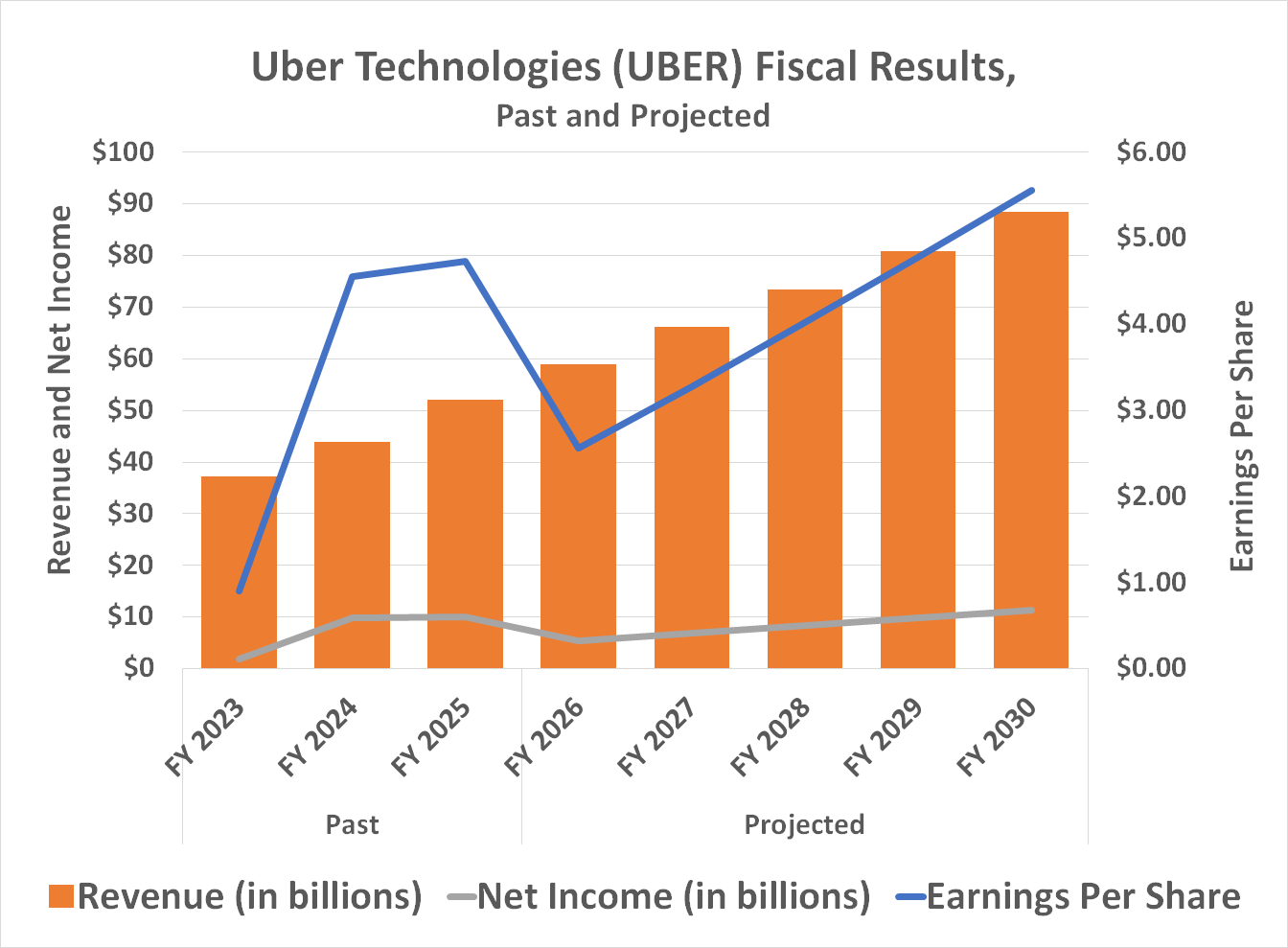
The decline in driver’s license ownership among teenagers—only one-third currently hold a license, compared to two-thirds in 1995—is a particularly telling indicator. This is not a temporary aberration; it is a generational shift. Uber, and its competitors, are positioned to benefit from this trend.
The prospect of autonomous vehicles—robotaxis—further amplifies this potential. Uber CEO Dara Khosrowshahi predicts a trillion-dollar market. While the widespread deployment of this technology remains uncertain, the underlying logic is compelling. A self-driving taxi, devoid of the expense of a human driver, offers a potentially transformative reduction in transportation costs. This is not merely innovation; it is a re-imagining of the very concept of personal mobility.
These three companies—MercadoLibre, Alibaba, and Uber Technologies—represent different facets of a complex and rapidly evolving global landscape. They are not without risk. But they also offer the possibility of enduring value—a prospect worthy of careful consideration in these turbulent times.
Read More
- 2025 Crypto Wallets: Secure, Smart, and Surprisingly Simple!
- Gold Rate Forecast
- Brown Dust 2 Mirror Wars (PvP) Tier List – July 2025
- Banks & Shadows: A 2026 Outlook
- Gemini’s Execs Vanish Like Ghosts-Crypto’s Latest Drama!
- ETH PREDICTION. ETH cryptocurrency
- The 10 Most Beautiful Women in the World for 2026, According to the Golden Ratio
- The Weight of Choice: Chipotle and Dutch Bros
- Uncovering Hidden Groups: A New Approach to Social Network Analysis
- Gay Actors Who Are Notoriously Private About Their Lives
2026-02-24 06:13