
For a considerable period, fixed income instruments have presented a challenging value proposition. The protracted period of historically low interest rates, following the 2008 financial crisis, effectively diminished yields across much of the bond universe. While shorter-duration funds offered minimal returns, longer-duration strategies, while yielding marginally more, failed to adequately compensate investors for associated interest rate risk. The subsequent inflationary pressures of 2022, and the Federal Reserve’s response, underscored this dynamic, resulting in notable declines for broad bond market ETFs.
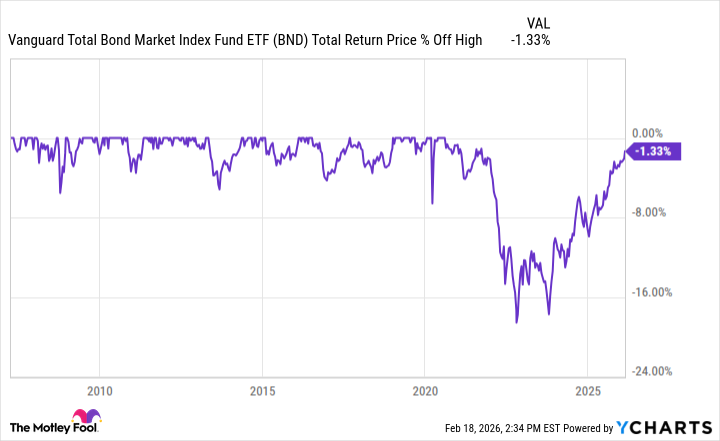
Current conditions, however, suggest a potential shift. Stabilization in long-term yields has resulted in the Vanguard Total Bond Market ETF (BND +0.21%) offering a yield of 4.2%, potentially re-establishing its role as a contributor to a diversified portfolio. This assessment, however, requires nuanced consideration.
Understanding the Vanguard Total Bond Market ETF
The ETF is designed to replicate the performance of the Bloomberg US Aggregate Float Adjusted Index, providing exposure to a broad spectrum of US investment-grade, intermediate-term government, corporate, and mortgage-backed securities. It functions as a comprehensive, passively managed fixed income solution.
The portfolio’s composition currently skews heavily toward government securities, accounting for approximately 68% of assets, with Treasuries representing 49% and mortgage-backed securities comprising 19%. The remaining allocation primarily consists of corporate bonds. While a significant allocation to government securities provides stability, a more balanced approach, incorporating a greater proportion of corporate bonds, may enhance long-term return potential. Supplementing with a dedicated corporate bond ETF, such as the Vanguard Total Corporate Bond ETF, could be a viable strategy.
Income Generation and Risk Management
The Vanguard Total Bond Market ETF’s primary strength lies in its ability to deliver comprehensive bond market coverage without undue concentration in higher-risk or excessively volatile segments. By focusing on investment-grade securities with intermediate-term maturities, the ETF mitigates exposure to both default risk and the pronounced interest rate sensitivity inherent in longer-duration bonds. This approach fosters a blended fixed income profile prioritizing quality and stability.
The current yield of approximately 4% provides a meaningful, albeit modest, incentive for allocating a portion of a portfolio to fixed income. Given emerging headwinds in equity markets, increasing vulnerabilities in certain segments of the economy, and a potential shift in investor risk tolerance, the ETF may serve as a prudent counterbalance to equity-heavy portfolios. However, investors should not anticipate substantial capital appreciation or outperformance in the current environment.
It remains to be seen how the ETF will perform in a rising interest rate environment, but its intermediate-term duration and focus on investment-grade securities should provide a degree of protection against significant downside risk.
Read More
- 2025 Crypto Wallets: Secure, Smart, and Surprisingly Simple!
- Gold Rate Forecast
- Brown Dust 2 Mirror Wars (PvP) Tier List – July 2025
- Banks & Shadows: A 2026 Outlook
- Gemini’s Execs Vanish Like Ghosts-Crypto’s Latest Drama!
- ETH PREDICTION. ETH cryptocurrency
- Gay Actors Who Are Notoriously Private About Their Lives
- 9 Video Games That Reshaped Our Moral Lens
- Uncovering Hidden Groups: A New Approach to Social Network Analysis
- The Weight of Choice: Chipotle and Dutch Bros
2026-02-24 01:02