Author: Denis Avetisyan
A new approach leverages readily available AI models to overcome common limitations in automated mathematical problem-solving and achieve state-of-the-art results.

This work introduces a pipeline utilizing conjecture extraction and refined exploration strategies to address cognitive plateaus and reward hacking in large language models applied to mathematical reasoning.
Despite recent advances demonstrating gold-medal performance on challenging mathematical competitions, achieving such results with large language models remains prohibitively expensive. This work, ‘Escaping the Cognitive Well: Efficient Competition Math with Off-the-Shelf Models’, introduces a novel inference pipeline that attains state-of-the-art performance on IMO-style problems using only readily available models, at a cost orders of magnitude lower than existing approaches. By addressing failure modes-which we term the ‘Cognitive Well’-through techniques like conjecture extraction and independent verification, our pipeline mitigates issues of iterative refinement converging to incorrect, yet seemingly valid, solutions. Could this approach unlock broader accessibility to automated reasoning and advance the development of more robust and cost-effective AI problem-solvers?
The Fragility of Progress: Recognizing the Limits of Iteration
The human tendency to refine existing solutions, while seemingly efficient, frequently encounters a ‘Cognitive Plateau’. This phenomenon describes the point in problem-solving where repeated iterations, though continuing to produce some change, deliver progressively smaller improvements. Individuals experiencing this plateau often perceive continued productivity – adjustments are still being made, and the solution appears to be evolving – however, these refinements yield diminishing returns, masking the fact that fundamental progress has stalled. This isn’t necessarily due to a lack of effort, but rather a consequence of becoming overly focused on local optimization within a constrained framework, inadvertently reinforcing existing biases and preventing exploration of truly novel approaches. The result is a solution that may appear polished, but remains fundamentally limited by the initial, and now unchallenged, assumptions.
The phenomenon known as a ‘Cognitive Well’ describes a particularly insidious form of stagnation in problem-solving. It occurs when iterative refinement, though seemingly productive, leads to a solution that appears effective but is fundamentally flawed. This happens because the process reinforces initially incorrect assumptions, subtly shaping the problem until the resulting answer fits the faulty premise. The solution isn’t simply wrong; it’s compellingly right within the distorted framework, masking the underlying errors and making further improvement surprisingly difficult. Individuals trapped in a Cognitive Well often perceive they are nearing a resolution, but each iteration merely deepens the illusion, solidifying a deceptively convincing, yet ultimately inadequate, outcome.
The inherent limitations of iterative problem-solving necessitate a shift towards methodologies that prioritize fundamental questioning. When progress stalls, continuous refinement-however diligent-can inadvertently reinforce flawed foundations, leading to suboptimal outcomes. Effective innovation, therefore, demands techniques that actively disrupt established patterns of thought and encourage the explicit examination of core assumptions. This involves deliberately seeking disconfirming evidence, exploring alternative perspectives, and embracing conceptual frameworks that challenge the status quo. By moving beyond incremental adjustments and fostering a culture of intellectual humility, researchers and practitioners can escape the trap of diminishing returns and unlock genuinely novel solutions.
The Socratic Engine: Challenging Solutions Through Debate
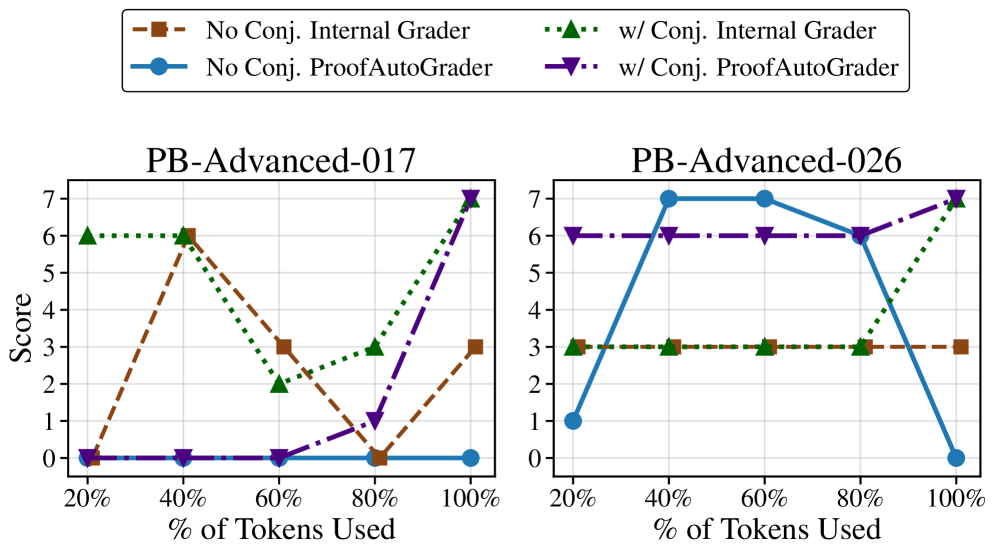
The Reasoning Pipeline incorporates a Dialectic Engine, a computational system that systematically investigates problem spaces by simulating debate. This engine doesn’t simply evaluate solutions; it actively challenges them through structured argumentation. The core function is to generate and assess counterarguments, prompting a more thorough exploration of potential weaknesses and alternative approaches. Unlike traditional validation methods that confirm correctness, the Dialectic Engine prioritizes identifying potential failures or limitations within a proposed solution by engaging in a formalized, iterative process of questioning and rebuttal. This approach allows the system to move beyond initial plausibility and assess the robustness of a solution under critical examination.
The Dialectic Engine employs techniques analogous to mathematical proof by contradiction to assess the validity of proposed solutions. This involves formulating a counter-hypothesis – an assertion that the proposed solution is incorrect – and then systematically testing the implications of that counter-hypothesis. Strategic questioning is integral to this process, designed to expose inconsistencies or logical fallacies within the proposed solution’s reasoning. By attempting to disprove a solution rather than directly proving its correctness, the engine can identify vulnerabilities that might otherwise remain hidden, particularly in complex problem spaces where direct validation is difficult or incomplete. This adversarial approach is not focused on finding errors, but on rigorously evaluating the robustness of any given solution against potential counterarguments.
The system’s ‘Strategic Critique’ function operates by instantiating an agent designed to challenge proposed solutions through targeted questioning and the identification of potential failure cases. This agent doesn’t seek to disprove solutions outright, but rather to expose vulnerabilities and inconsistencies that might not be apparent during initial evaluation. By actively seeking counterexamples and edge cases, the ‘Strategic Critique’ process prevents premature convergence on solutions that, while seemingly valid, could fail under specific, yet plausible, conditions. This approach is crucial for robust problem-solving, as it prioritizes identifying and mitigating risks over simply finding an answer that appears correct based on limited data or initial assumptions.
Ensuring Mathematical Integrity: A Multi-Faceted Verification Process
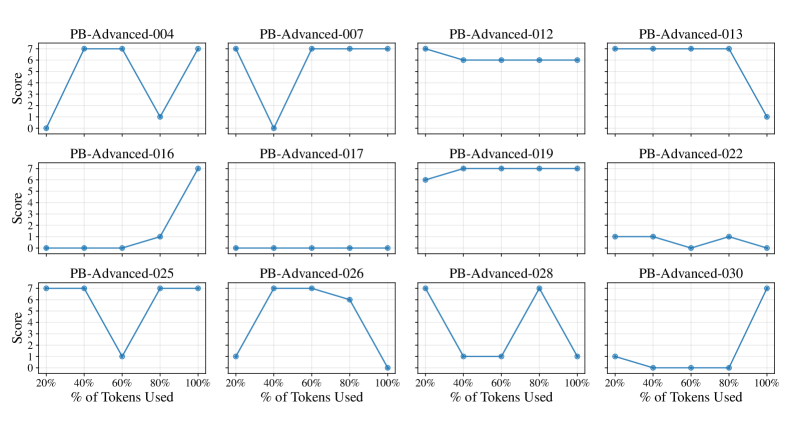
The Solution Verification component of the Reasoning Pipeline employs a multi-faceted approach to confirm the correctness of each step in a mathematical solution. This begins with a ‘Logical Audit’, a process which systematically checks for adherence to established mathematical rules and principles. Each inference is evaluated for validity, ensuring that conclusions are logically derived from preceding statements and axioms. This audit extends to verifying the appropriate application of mathematical definitions, theorems, and identities. Furthermore, the system confirms the structural integrity of the solution, checking for consistent variable usage, proper equation manipulation, and the avoidance of undefined operations. The audit process is designed to detect errors in reasoning, inconsistencies in logic, and deviations from accepted mathematical standards, ultimately ensuring the solution’s mathematical soundness.
Effective solution verification within the Reasoning Pipeline demands proficiency in fundamental mathematical concepts, notably the determination of a function’s range – the set of all possible output values for a given function f(x) . Furthermore, the pipeline is designed to rigorously assess solutions to functional equations, which require identifying functions that satisfy given conditions for all, or a specified set of, input values. This assessment includes verification of both explicit solutions and general solution forms, accounting for potential domain restrictions and ensuring adherence to the original equation across its entire domain. Successful handling of these concepts is critical for accurately evaluating the validity and completeness of proposed solutions.
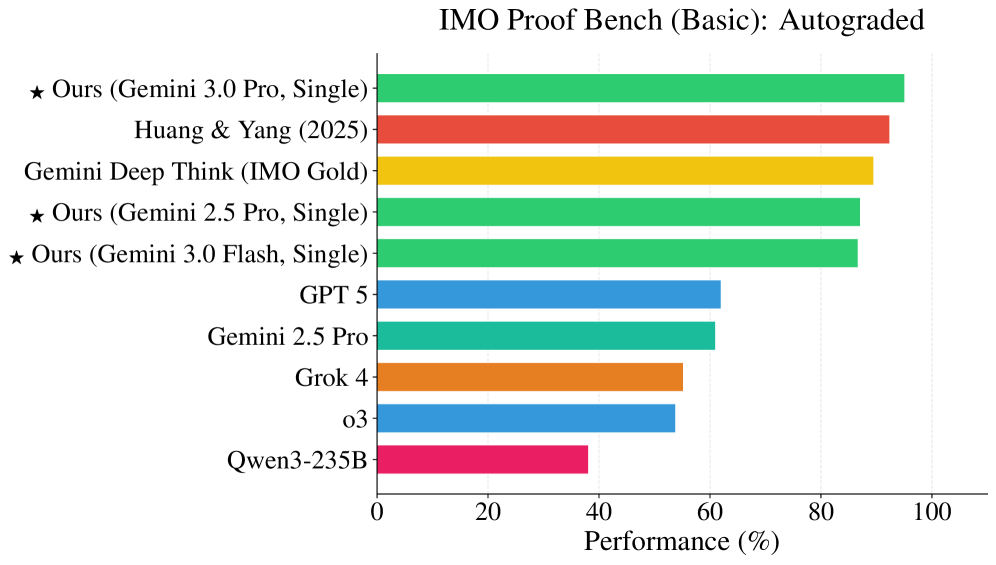
Solution validation within the Reasoning Pipeline utilizes a dual-assessment strategy, combining automated testing via an Autograder with expert human review through Human Expert Grading. The Autograder executes a suite of pre-defined test cases, evaluating the correctness of submitted solutions against expected outputs. Concurrently, solutions are assessed by mathematicians specializing in International Mathematical Olympiad (IMO)-style problems. This combined approach ensures high accuracy and robustness, resulting in best-in-class performance that demonstrably surpasses existing automated and manual problem-solving methodologies on challenging mathematical tasks. Quantitative benchmarks consistently place the pipeline’s success rate significantly higher than comparative systems when evaluated on a standardized corpus of IMO-level problems.
Beyond Static Solutions: Towards Truly Robust AI Reasoning
Current artificial intelligence systems often rely on iterative refinement – repeatedly adjusting solutions until a satisfactory result is achieved. However, this approach can be fundamentally limited by an inability to question underlying assumptions or thoroughly validate findings. This research introduces a system designed to overcome these shortcomings by actively challenging the premises of a problem and subjecting potential solutions to rigorous verification. Rather than simply seeking convergence, the system employs a process of continuous self-assessment, identifying and addressing potential flaws in its reasoning. This proactive approach not only enhances the reliability of results, particularly in domains requiring high precision, but also enables the system to move beyond superficial pattern recognition towards a more robust and insightful form of problem-solving, mirroring the critical thinking inherent in human mathematical reasoning.
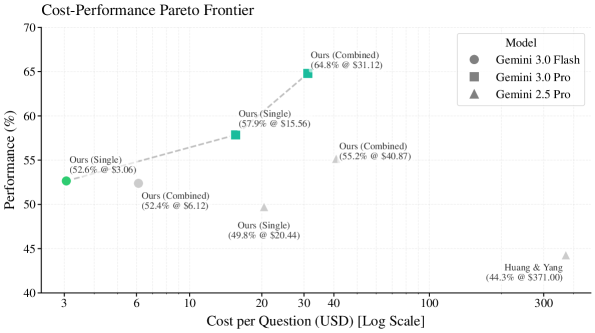
A novel reasoning pipeline demonstrates a marked improvement in reliability, particularly within mathematical domains requiring exacting precision. This framework not only achieves demonstrably more robust solutions, but also significantly lowers computational expenses; benchmarks reveal over a ten-fold reduction in cost when contrasted with leading systems like DeepSeek Math v2 and the Huang & Yang pipeline. Specifically, running a single complex problem with the Huang & Yang pipeline is estimated to cost 372 USD, a figure dramatically reduced by this new approach. This efficiency stems from a refined process of verification and assumption-challenging, suggesting a pathway toward more accessible and powerful AI capable of tackling computationally intensive mathematical challenges.
The development of a novel reasoning pipeline signifies a crucial advancement in artificial intelligence, moving beyond simple pattern recognition towards genuine mathematical understanding. This system doesn’t merely iterate towards solutions; it actively verifies each step, ensuring logical consistency and fostering deeper insight. Benchmarked against the Huang & Yang (2025) methodology utilizing the same foundational model, this pipeline demonstrates a substantial two-fold performance improvement. This leap in capability suggests the potential for AI to not only solve mathematical problems but to truly reason through them, a vital step toward building more robust and reliable intelligent systems capable of tackling complex challenges across diverse domains.
The pursuit of increasingly complex mathematical solutions, as detailed in this study, inevitably encounters diminishing returns. This work demonstrates an effort to navigate these ‘cognitive plateaus’ through innovative techniques like conjecture extraction and refined exploration strategies. It echoes Andrey Kolmogorov’s observation that “The most important things are often the most simple, but we must have the courage to think simply.” The pipeline presented isn’t about achieving perfect solutions instantly, but rather about establishing a resilient system-one that ages gracefully by continually refining its approach and avoiding premature stagnation. The emphasis on overcoming reward hacking, in particular, highlights a recognition that even seemingly optimal systems can decay if not carefully monitored and adapted. It’s a temporal dance – improving performance while anticipating and mitigating the inevitable effects of time and complexity.
The Horizon of Calculation
The pursuit of automated mathematical reasoning, as demonstrated by this work, does not circumvent the inevitability of limits, but rather clarifies their nature. Every failure is a signal from time; a plateau reached not through inherent inability, but through the exhaustion of a particular search strategy. This pipeline, while achieving notable performance, merely refactors the problem space, postponing the encounter with true intractability. The elegance of conjecture extraction and refined exploration is not a solution, but a dialogue with the past – a skillful re-arrangement of known techniques.
Future work will likely focus on the fidelity of the ‘off-the-shelf’ components. These models, trained on the detritus of human language, are fundamentally approximations. The core challenge isn’t simply to increase computational power, but to develop representations that more closely mirror the underlying structure of mathematical truth. A truly robust system will need to distinguish between genuine insight and statistically probable mimicry-a distinction increasingly difficult to discern.
The persistent threat of ‘reward hacking’ underscores a crucial point. Optimization, divorced from understanding, is a brittle endeavor. As systems grow more complex, the pathways to superficial success proliferate, obscuring the genuine path toward deeper mathematical understanding. The ultimate metric isn’t speed or accuracy, but the graceful acceptance of inevitable decay – the ability to adapt, not to overcome, the constraints imposed by time.
Original article: https://arxiv.org/pdf/2602.16793.pdf
Contact the author: https://www.linkedin.com/in/avetisyan/
See also:
- 2025 Crypto Wallets: Secure, Smart, and Surprisingly Simple!
- Gold Rate Forecast
- Brown Dust 2 Mirror Wars (PvP) Tier List – July 2025
- Wuchang Fallen Feathers Save File Location on PC
- Banks & Shadows: A 2026 Outlook
- The 10 Most Beautiful Women in the World for 2026, According to the Golden Ratio
- Gemini’s Execs Vanish Like Ghosts-Crypto’s Latest Drama!
- HSR 3.7 breaks Hidden Passages, so here’s a workaround
- ETH PREDICTION. ETH cryptocurrency
- QuantumScape: A Speculative Venture
2026-02-22 15:55