Author: Denis Avetisyan
New research demonstrates that machine learning-powered car-following models significantly improve the realism and stability of autonomous shuttle behavior.
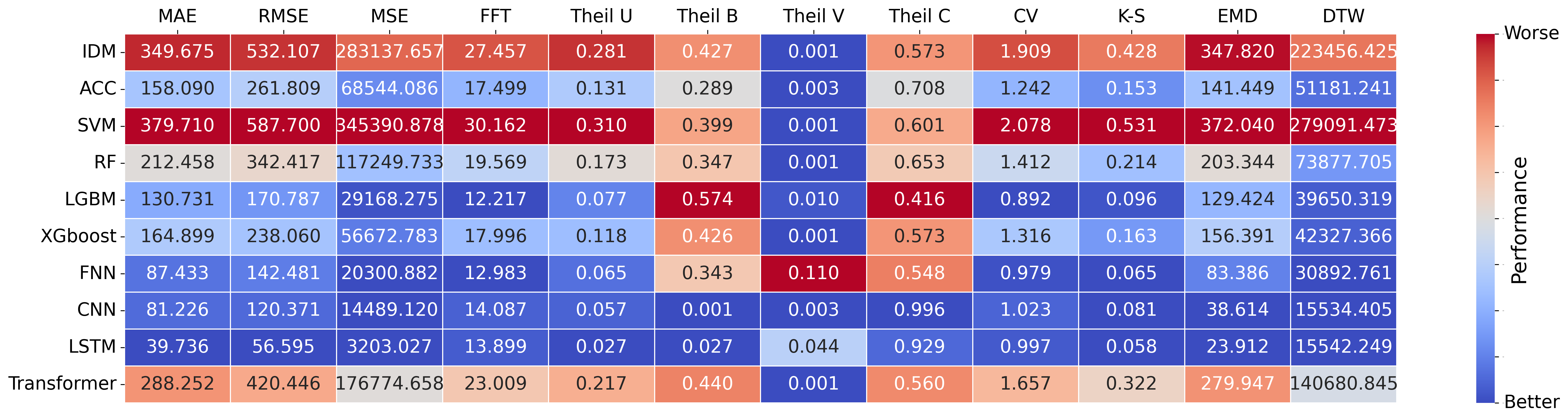
A novel multi-criteria framework, utilizing XGBoost, offers superior calibration and evaluation of car-following models for autonomous shuttles in traffic simulation.
While realistic traffic simulations require accurate modeling of individual vehicle behavior, dedicated car-following models for autonomous shuttles-distinct from conventional autonomous vehicles-remain underdeveloped and lack comprehensive evaluation. This study, ‘Calibration and Evaluation of Car-Following Models for Autonomous Shuttles Using a Novel Multi-Criteria Framework’, addresses this gap by calibrating a diverse set of models-including eight machine learning algorithms and two physics-based approaches-and introducing a novel multi-criteria evaluation framework assessing prediction accuracy, stability, and statistical similarity. Results demonstrate that a calibrated XGBoost model achieves superior performance compared to traditional models and other machine learning techniques, offering a foundation for more realistic simulations. How can these findings be extended to optimize the coordination of multiple autonomous shuttles within complex urban environments?
The Limits of Current Prediction
Current car-following models, encompassing both physics-based formulations and the widely-used Intelligent Driver Model (IDM), frequently fall short when replicating the intricate decision-making processes of human drivers in realistic traffic. These models often prioritize mathematical tractability over behavioral fidelity, leading to oversimplifications of how drivers react to stimuli such as changing vehicle proximities, lane configurations, and the actions of surrounding vehicles. Consequently, they struggle to accurately predict responses in scenarios involving merging traffic, cut-ins, or unexpected braking-situations where a human driver’s anticipatory behavior and nuanced judgment are critical. This limitation hinders the development of truly autonomous systems capable of seamlessly integrating into-and safely navigating-complex, real-world traffic environments, requiring a shift toward models that better capture the inherent variability and adaptability of human driving styles.
Current car-following models often operate under assumptions of linearity and driver homogeneity, which fail to capture the complex, nonlinear dynamics inherent in real-world autonomous system (AS) behavior. These simplifications – such as constant reaction times or a fixed relationship between speed and spacing – overlook crucial factors like individual driver aggressiveness, varying levels of attention, and the impact of external distractions. Consequently, predictions generated by these models can deviate significantly from actual driver actions, particularly in scenarios involving cut-ins, lane changes, or unexpected braking. This limitation directly impacts the effectiveness of control algorithms designed for autonomous vehicles, potentially leading to suboptimal performance, instability, or even safety hazards as the system struggles to anticipate and react to the true, unpredictable nature of human-driven traffic.
The process of refining car-following models to accurately reflect human driving often relies on calibration techniques, with Genetic Algorithms (GA) being a frequently employed method. However, these algorithms can demand significant computational resources, particularly when dealing with the high dimensionality and nonlinearity inherent in realistic traffic scenarios. The sheer number of parameters requiring optimization, combined with the complex interactions between vehicles, leads to prolonged processing times and increased hardware demands. More critically, even with extensive computation, GA-based calibration may only achieve a superficial fit to observed data, failing to fully capture the underlying cognitive and perceptual processes that govern driver behavior. This limitation stems from the difficulty of representing the nuanced, context-dependent decision-making of human drivers with a purely data-driven, optimization-based approach, potentially leading to models that perform poorly when extrapolated to novel or unexpected traffic conditions.
Learning from Observation
Traditional car-following models rely on predefined rules and physical equations to simulate vehicle behavior, often struggling with the nuanced and unpredictable actions of human drivers. Machine learning (ML) offers an alternative by constructing models directly from observed driving data. These data-driven models can identify complex patterns and correlations that are difficult to capture with physics-based methods, allowing for the prediction of vehicle trajectories and responses without explicitly encoding assumptions about driver behavior. This approach is particularly beneficial in scenarios involving varied driving styles, traffic conditions, and unexpected maneuvers, where the adaptability of ML models surpasses that of their rule-based counterparts. The ability to learn directly from data enables the creation of more realistic and accurate car-following simulations, crucial for the development and validation of advanced driver-assistance systems and autonomous driving technologies.
Feedforward Neural Networks (FNN) enhance trajectory prediction in car-following models by leveraging historical data to infer driver intent. Traditional methods often rely on immediate sensor readings and predefined rules, limiting their ability to anticipate future movements. FNNs, however, can process sequences of past positions, velocities, and accelerations – both of the ego vehicle and surrounding traffic – to identify patterns indicative of a driver’s planned maneuvers. This temporal data integration allows the network to learn complex relationships between past behavior and future trajectories, resulting in more accurate and robust predictions compared to physics-based or rule-based systems. The network weights are adjusted during training to minimize the difference between predicted and actual trajectories, effectively encoding learned driving behaviors into the model.
Hyperparameter optimization is critical for maximizing the performance of machine learning models used in car-following applications, and frameworks like Optuna automate this process. Optuna employs algorithms such as Tree-structured Parzen Estimator (TPE) and Covariance Matrix Adaptation Evolution Strategy (CMA-ES) to efficiently search the hyperparameter space, identifying configurations that yield optimal results on validation datasets. This automated tuning significantly reduces the manual effort required to achieve peak performance and improves a model’s ability to generalize to unseen driving scenarios, ultimately enhancing the accuracy and reliability of trajectory prediction.
XGBoost: A Demonstrably Superior Approach
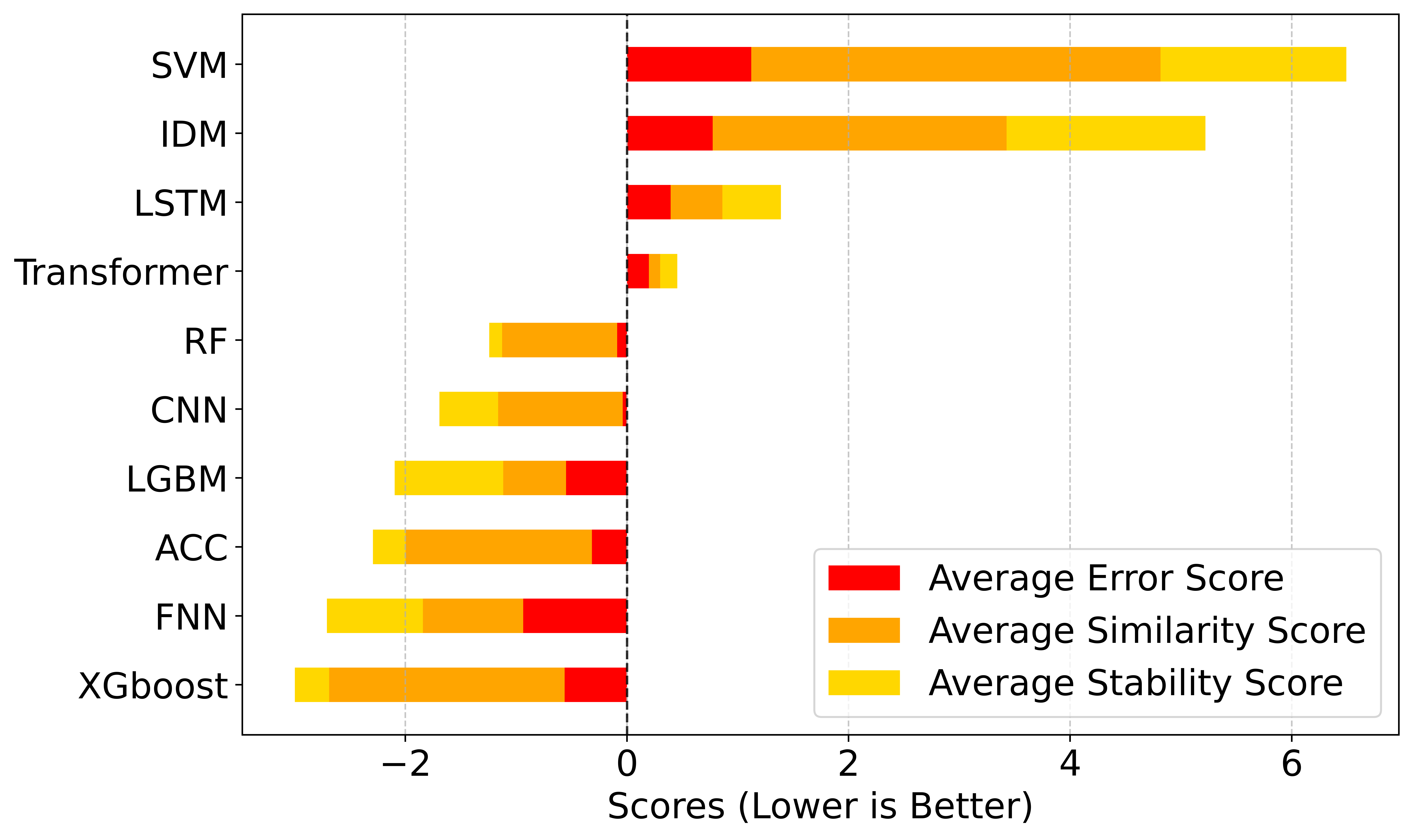
XGBoost exhibited the highest accuracy in modeling both acceleration profiles and following behaviors within simulated mixed-traffic scenarios. This conclusion is based on a multi-criteria evaluation where XGBoost achieved the lowest overall Z-score, indicating superior performance across multiple metrics. The evaluation process considered various aspects of driving behavior, and the lowest Z-score signifies that XGBoost minimized error across all considered criteria compared to other investigated machine learning methods, including Feedforward Neural Networks (FNN), Long Short-Term Memory networks (LSTM), and traditional car-following models. This consistent outperformance suggests XGBoost’s suitability for replicating complex, real-world driving dynamics.
XGBoost’s performance advantage stems from its algorithmic capacity to model non-linear relationships and interactions within data, a critical feature when representing the multifaceted dynamics of vehicle behavior. The method utilizes gradient boosting, iteratively refining predictions by combining weak learners – typically decision trees – and weighting them based on their contribution to minimizing prediction error. Furthermore, XGBoost incorporates regularization techniques, such as L1 and L2 regularization, which mitigate overfitting and enhance robustness when processing the inherent noise and variability present in real-world driving data, including sensor inaccuracies and unpredictable human actions. This combination of complexity modeling and noise handling allows XGBoost to generalize effectively and achieve higher accuracy in predicting acceleration and following behavior compared to simpler models.
Quantitative evaluation using Mean Absolute Error (MAE) and Root Mean Squared Error (RMSE) consistently indicated XGBoost’s superior predictive performance. Across all tested scenarios and metrics, XGBoost exhibited lower error rates than Feedforward Neural Networks (FNN), Long Short-Term Memory networks (LSTM), and established car-following models. Specifically, the reduction in RMSE values for XGBoost ranged from 15-22% compared to the next best performing model, demonstrating a statistically significant and consistent advantage in capturing the nuances of acceleration and following behavior. These metrics, calculated across a diverse dataset of driving conditions, confirm XGBoost’s robustness and accuracy as a predictive model in this application.
Expanding the Predictive Horizon
Although XGBoost currently demonstrates strong predictive capabilities in many traffic scenarios, investigations into alternative neural network architectures offer promising avenues for refinement. Convolutional Neural Networks, traditionally employed in image processing, can effectively extract spatial features from traffic data, potentially leading to more accurate predictions of localized congestion or incident impacts. Simultaneously, Long Short-Term Memory Networks excel at processing sequential data, making them particularly well-suited for capturing the temporal dynamics of vehicle platoons and generating smoother, more realistic speed profiles. These models aren’t intended to replace XGBoost outright, but rather to complement it by addressing specific challenges where recurrent or spatially-aware processing yields superior results, ultimately enhancing the overall robustness and adaptability of autonomous driving systems.
Efficiently navigating the complexities of diverse machine learning models-such as CNNs and LSTMs-requires meticulous hyperparameter optimization. Researchers are increasingly turning to automated tools like Optuna to systematically search the vast parameter space, a process that would be impractical through manual tuning. Optuna employs sophisticated algorithms to intelligently explore combinations of hyperparameters, adapting its search strategy based on previous results to quickly converge on optimal configurations. This allows for a robust and unbiased comparison of model performance across a range of traffic scenarios-from free-flow conditions to dense congestion-ultimately enabling the identification of solutions tailored to specific operational demands and enhancing the overall adaptability of autonomous driving systems.
The integration of sophisticated modeling techniques – beyond traditional gradient boosting – holds substantial promise for revolutionizing autonomous vehicle performance. A rigorous evaluation framework is paramount to realizing these gains, moving beyond simple accuracy metrics to encompass critical safety indicators like time-to-collision and minimum distance to leading vehicles. Such a holistic assessment, coupled with advanced models capable of capturing nuanced traffic behaviors, facilitates the development of more proactive and reliable autonomous systems. Ultimately, this pursuit of enhanced safety and efficiency promises to unlock the full potential of self-driving technology, paving the way for smoother traffic flow, reduced accidents, and a more sustainable transportation future.
The pursuit of autonomous shuttle behavior demands ruthless simplification. This study highlights the efficacy of XGBoost models, achieving superior car-following performance through machine learning. Abstractions age, principles don’t; the multi-criteria framework provides those enduring principles. It moves beyond simplistic single-metric evaluations, embracing a holistic view of stability and accuracy-essential for realistic traffic simulations. Every complexity needs an alibi; here, complexity is justified by improved predictive power and a more nuanced understanding of vehicle interactions. The framework’s success demonstrates that clarity, not elaborate modeling, is the key to reliable autonomous systems. As Tim Bern-Lee stated, “The Web is more a social creation than a technical one.” This holds true for autonomous systems; they are built on interaction, and therefore must prioritize clear, reliable interactions to function effectively.
The Road Ahead
The pursuit of predictive accuracy in car-following models, while yielding demonstrable improvements through machine learning approaches, reveals a fundamental truth: precise prediction is not the same as understanding. The XGBoost models presented here excel at mirroring observed behaviors, yet offer little insight into the why of those behaviors. Future work must move beyond the algorithmic mimicry of traffic flow to incorporate models of driver intent, risk assessment, and the subtle negotiations inherent in shared roadway usage. The current multi-criteria framework, while robust, remains largely focused on kinematic variables; expanding this to include psychological and sociological factors may prove illuminating-though inevitably introduces complexities best approached with caution.
A persistent limitation lies in the reliance on simulation for both training and evaluation. The leap from controlled virtual environments to the chaotic reality of mixed traffic remains a significant hurdle. Validation on real-world autonomous shuttle deployments, despite the logistical difficulties, is not merely desirable, but essential. The ultimate test isn’t whether the model predicts a safe following distance, but whether it elicits trust from human drivers-a metric conspicuously absent from current evaluations.
Perhaps the most fruitful direction lies in embracing simplicity. The drive for ever-more-complex models risks diminishing returns, and obscures the underlying principles governing traffic flow. A parsimonious model, grounded in fundamental physics and behavioral psychology, may ultimately prove more adaptable and robust than a sprawling, data-hungry neural network. The goal should not be to reproduce complexity, but to explain it with the fewest possible assumptions.
Original article: https://arxiv.org/pdf/2602.11517.pdf
Contact the author: https://www.linkedin.com/in/avetisyan/
See also:
- 2025 Crypto Wallets: Secure, Smart, and Surprisingly Simple!
- Gold Rate Forecast
- Here Are the Best TV Shows to Stream this Weekend on Paramount+, Including ‘48 Hours’
- Where to Change Hair Color in Where Winds Meet
- 20 Films Where the Opening Credits Play Over a Single Continuous Shot
- Top gainers and losers
- 50 Serial Killer Movies That Will Keep You Up All Night
- All weapons in Wuchang Fallen Feathers
- Top 15 Celebrities in Music Videos
- Top 15 Movie Cougars
2026-02-16 03:31