Author: Denis Avetisyan
Researchers have developed a new approach to time-series anomaly detection that combines the reasoning power of large language models with the rigor of classical statistical analysis.
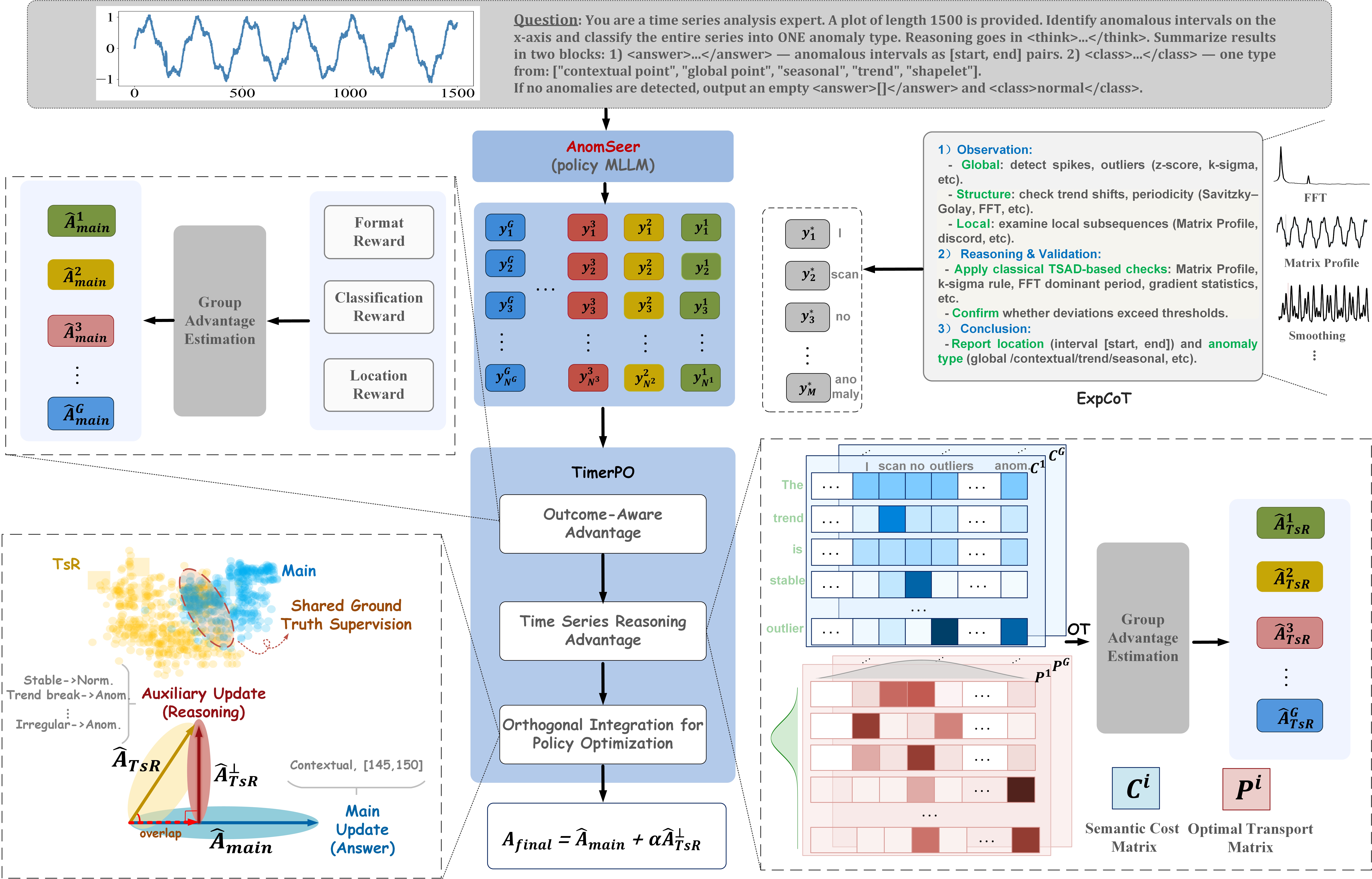
AnomSeer leverages reinforcement learning to enhance multimodal LLMs, providing accurate anomaly detection and explainable reasoning grounded in time-series data.
While large language models show promise in time-series analysis, they often struggle with the detailed, multi-dimensional reasoning required for accurate anomaly detection. This work introduces AnomSeer: Reinforcing Multimodal LLMs to Reason for Time-Series Anomaly Detection, a novel reinforcement learning framework that grounds LLM reasoning in classical time-series analysis techniques. By optimizing for both detection accuracy and verifiable reasoning traces-leveraging optimal transport and orthogonal projection-AnomSeer demonstrably outperforms larger commercial models in anomaly classification and localization. Can this approach to time-series grounded reasoning unlock more robust and interpretable AI systems for critical applications beyond anomaly detection?
The Challenge of Context in Time-Series Analysis
Conventional time-series anomaly detection techniques often falter when faced with anomalies embedded within complex, real-world datasets. These methods typically rely on statistical thresholds or predefined patterns, proving inadequate when anomalies aren’t simply outliers but deviations contingent on specific contextual factors. For instance, a sudden spike in server load might be normal during a product launch but indicative of a denial-of-service attack at other times; traditional algorithms struggle to differentiate these scenarios. Similarly, seasonal patterns and long-term trends, if not accurately modeled, can mask subtle yet significant anomalies. The inability to account for these contextual dependencies limits the effectiveness of established TSAD methods, leading to both false positives and missed critical events-a major challenge in fields like predictive maintenance, fraud detection, and network security.
The recent surge in capabilities demonstrated by Large Language Models (LLMs) has naturally extended to the field of time-series anomaly detection, yet directly applying these models presents significant hurdles. LLMs, traditionally trained on textual data, require substantial adaptation to effectively process the continuous, ordered nature of temporal information. Innovative approaches, such as representing time-series data as “tokens” analogous to words in a sentence, or employing attention mechanisms specifically designed to capture temporal dependencies, are crucial. Furthermore, successful integration necessitates methods for handling the varying scales and complexities inherent in real-world time-series, often demanding techniques like data augmentation or specialized embedding strategies. These adaptations aren’t merely about formatting data; they represent a fundamental shift in how LLMs interpret and learn from sequential patterns, unlocking their potential to not only detect anomalies, but also to contextualize and potentially predict them within a dynamic system.
Truly effective time-series anomaly detection transcends simple identification; a robust system must pinpoint where an anomaly occurs within the temporal sequence and, crucially, elucidate why it deviated from expected behavior. This contextual understanding is paramount, as anomalies aren’t isolated events but often symptoms of underlying systemic changes or external influences. Identifying a spike in server load, for example, is insufficient; a comprehensive system would correlate that spike with specific application updates, increased user traffic from a particular region, or even a denial-of-service attack – providing actionable insights beyond mere alerts. Consequently, research is increasingly focused on developing methods that not only flag unusual data points but also generate explanations grounded in the historical context and interdependencies within the time series itself, transforming anomaly detection from a reactive measure into a proactive diagnostic tool.

AnomSeer: Elevating Multimodal LLMs for Temporal Insight
AnomSeer is designed to improve the performance of multimodal large language models (MLLMs) specifically in the task of time-series anomaly detection. Traditional MLLMs often struggle with sequential data due to limitations in processing temporal dependencies; AnomSeer addresses this by enabling MLLMs to analyze time-series data more effectively. This enhancement allows the models to identify deviations from expected patterns within time-series data, which is crucial for applications like predictive maintenance, fraud detection, and system health monitoring. The system’s architecture is specifically engineered to translate the challenges of time-series analysis into a format suitable for MLLM processing, thereby increasing both accuracy and efficiency in anomaly identification.
Visual Time-Series Representation (VTSR) transforms univariate or multivariate time-series data into a visually interpretable format suitable for processing by multimodal large language models (MLLMs). This conversion involves mapping time-series values to image pixels, where pixel intensity or color represents the magnitude of the time-series at specific points in time. By representing temporal data visually, VTSR allows MLLMs to leverage their existing image processing capabilities to identify patterns, trends, and anomalies that would be difficult to detect directly from the raw numerical data. The resulting images capture the temporal dependencies within the time-series, enabling the MLLM to analyze the data as a visual sequence and perform anomaly detection based on deviations from expected visual patterns.
The AnomSeer architecture is built upon Qwen2.5-VL, a multimodal large language model selected for its demonstrated capabilities in visual and language understanding. Qwen2.5-VL provides the core reasoning engine for anomaly detection after time-series data has been converted into a visual format. This model’s inherent capacity to process and correlate visual information with textual prompts allows AnomSeer to interpret temporal patterns represented in the visual time-series data and identify deviations indicative of anomalies. The selection of Qwen2.5-VL as the foundational MLLM ensures a strong base for both feature extraction and the subsequent reasoning process required for accurate anomaly detection within time-series data.
Refining Reasoning: Expert Knowledge and Reinforcement Learning in Harmony
Expert Chain-of-Thought (ExpCoT) is a technique employed by AnomSeer to integrate domain-specific knowledge into its reasoning process. This involves constructing a series of logical steps, or a “chain of thought,” informed by expert insights regarding potential anomaly characteristics and system behavior. Rather than relying solely on data-driven patterns, ExpCoT provides the model with pre-defined reasoning paths that reflect established expert understanding. These expert-defined trajectories serve as a guide during the learning phase, enabling the model to prioritize and interpret data in a manner consistent with expert analysis, ultimately improving the accuracy and interpretability of anomaly detection.
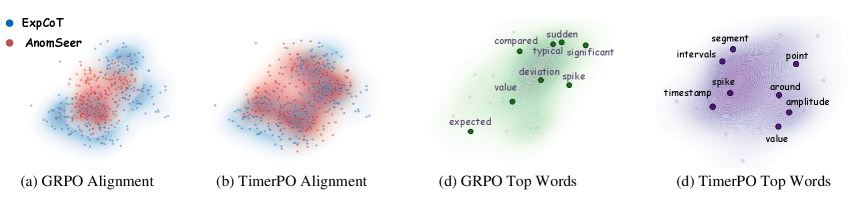
Time-Series Grounded Policy Optimization (TimerPO) is a reinforcement learning algorithm employed to refine AnomSeer’s reasoning process by directly optimizing the model’s behavior against the expert trajectories generated by Expert Chain-of-Thought (ExpCoT). TimerPO utilizes time-series data to define a reward function that incentivizes the model to mimic the logical steps and decision-making patterns demonstrated in the ExpCoT outputs. This optimization process involves iteratively adjusting the model’s parameters to maximize cumulative rewards, thereby aligning its internal reasoning with the provided expert knowledge and improving the accuracy and reliability of anomaly detection and localization.
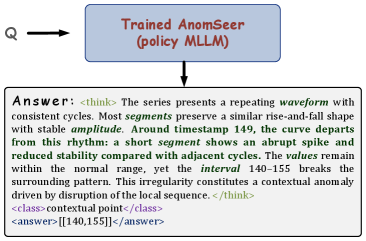
Anomaly Localization within AnomSeer extends beyond simple anomaly detection by identifying the specific data points contributing to the anomalous behavior. This is achieved through the integration of Expert Chain-of-Thought (ExpCoT) trajectories with Time-Series Grounded Policy Optimization (TimerPO); the model learns to associate detected anomalies with their corresponding locations in the time-series data. TimerPO refines the model’s reasoning process, encouraging it to not only flag deviations but also to accurately pinpoint the timeframe and data points responsible, enabling more granular analysis and targeted intervention. This localization capability provides a significant advantage over systems that merely indicate the presence of an anomaly without specifying its source.
Comprehensive Anomaly Understanding: Discerning Types and Impacts
AnomSeer distinguishes itself through a nuanced approach to anomaly classification, moving beyond simple outlier detection to pinpoint the nature of unusual data points. The system effectively categorizes anomalies as either contextual point anomalies – individual data instances that deviate significantly from their immediate surroundings – or trend shift anomalies, which represent abrupt changes in established patterns over time. This granular understanding is crucial; a sudden spike in server load, for instance, might be a contextual anomaly requiring immediate attention, while a gradual decline in user engagement could signal a trend shift necessitating strategic adjustments. By accurately discerning between these distinct anomaly types, AnomSeer provides a more actionable and insightful analysis than traditional methods, enabling targeted responses and proactive mitigation of potential issues.
Rigorous evaluation of the AnomSeer model centers on the Affinity F1 Score, a metric specifically chosen to assess performance in identifying complex anomaly patterns. This score comprehensively measures the balance between precision and recall, ensuring that the model not only flags potential anomalies accurately, but also avoids missing critical instances. Testing across multiple benchmark datasets demonstrates that AnomSeer consistently achieves state-of-the-art results, surpassing existing anomaly detection techniques. This superior performance stems from the model’s refined ability to discern subtle deviations from expected behavior, validating its accuracy and reliability in real-world applications where timely and precise anomaly detection is paramount.
AnomSeer distinguishes itself through its capacity to not merely detect anomalies, but to precisely categorize them, thereby enabling timely and effective responses to developing issues. This nuanced classification – encompassing contextual and trend-based anomalies – allows for targeted interventions that mitigate potential negative consequences across various applications. Rigorous benchmarking demonstrates AnomSeer consistently outperforms existing methods in anomaly type classification accuracy, translating to fewer false alarms and a more reliable system for proactive problem solving. The model’s ability to pinpoint the type of anomaly, rather than simply its presence, represents a significant advancement, allowing decision-makers to implement specific corrective actions and minimize disruptions before they escalate.
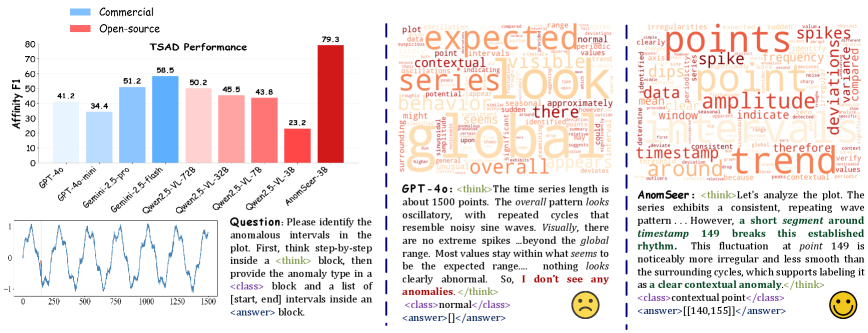
The pursuit of explainable AI, as demonstrated by AnomSeer, necessitates a rigorous distillation of complex data into comprehensible structures. This aligns with the assertion, “The essence of a problem is rarely found in its complexity, but in the simplicity with which it can be understood.” AnomSeer’s integration of classical time-series analysis with multimodal LLMs embodies this principle; it doesn’t merely detect anomalies, but provides a reasoned account, grounded in established methodologies. The reinforcement learning framework serves to refine this reasoning process, stripping away extraneous information to reveal the core causal factors contributing to anomaly identification. This pursuit of clarity is not merely a technical optimization, but a fundamental principle of cognitive compassion.
The Road Ahead
The pursuit of explainable anomaly detection, as exemplified by AnomSeer, inevitably reveals the core difficulty: explanation is not inherent in the data, but imposed upon it. The system diligently constructs a narrative, aligning observed deviations with established time-series principles. However, this alignment is, at best, a reasoned approximation. The true signal remains stubbornly obscured, and the elegance of the explanation should not be mistaken for fidelity to the originating event. Future work must confront this fundamental limitation.
A fruitful, if challenging, direction lies in minimizing the reliance on Large Language Models as generative engines. The current architecture, while producing coherent explanations, risks prioritizing linguistic fluency over analytical precision. A parsimonious approach-focusing on distilling the essential information needed for anomaly characterization-could yield more robust and interpretable systems. The goal isn’t to tell a story about the anomaly, but to precisely define its deviation from expectation.
Ultimately, the value of any anomaly detection system rests not on its ability to flag the unusual, but on its capacity to reduce the need for human intervention. AnomSeer represents a step toward that goal, but true progress demands a relentless commitment to subtraction-removing layers of complexity until only the signal, and its demonstrable deviation, remains.
Original article: https://arxiv.org/pdf/2602.08868.pdf
Contact the author: https://www.linkedin.com/in/avetisyan/
See also:
- 21 Movies Filmed in Real Abandoned Locations
- 2025 Crypto Wallets: Secure, Smart, and Surprisingly Simple!
- 10 Hulu Originals You’re Missing Out On
- The 11 Elden Ring: Nightreign DLC features that would surprise and delight the biggest FromSoftware fans
- The 10 Most Beautiful Women in the World for 2026, According to the Golden Ratio
- 10 Underrated Films by Ben Mendelsohn You Must See
- ICP: $1 Crash or Moon Mission? 🚀💸
- 20 Games Where the Canon Romance Option Is a Black Woman
- 17 Black Voice Actors Who Saved Games With One Line Delivery
- Bitcoin’s Ballet: Will the Bull Pirouette or Stumble? 💃🐂
2026-02-10 19:33