Author: Denis Avetisyan
A novel deep learning model leverages regional connections to provide more accurate and reliable predictions of solar power generation, accounting for inherent uncertainty.
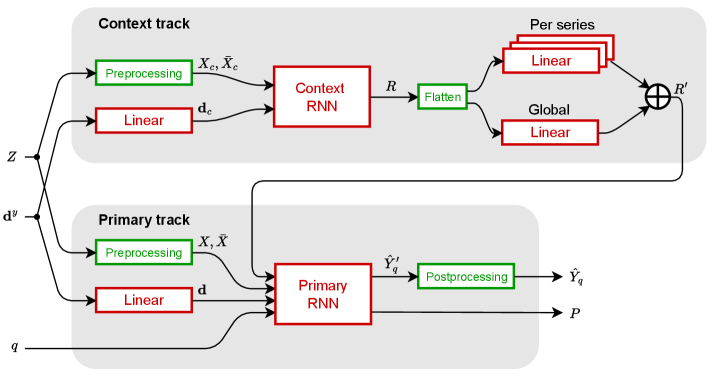
This paper introduces an Any-Quantile Recurrent Neural Network (AQ-RNN) for probabilistic multi-regional solar power forecasting with improved uncertainty quantification.
Accurate power system management increasingly demands more than point predictions given the inherent intermittency of renewable sources. This need is addressed in ‘Probabilistic Multi-Regional Solar Power Forecasting with Any-Quantile Recurrent Neural Networks’, which introduces a novel deep learning framework for forecasting photovoltaic generation across multiple regions. By combining an any-quantile approach with a dual-track recurrent neural network, the model delivers calibrated probabilistic forecasts that effectively capture spatial dependencies and improve prediction interval quality. Will this approach enable more robust and efficient integration of renewable energy into future power grids?
The Inherent Challenge of Intermittent Generation
The increasing integration of photovoltaic (PV) energy into modern power grids presents a substantial forecasting challenge, directly impacting grid stability and the efficiency of energy management systems. Unlike traditional power sources with predictable outputs, PV generation is inherently intermittent, heavily reliant on fluctuating weather conditions – cloud cover, temperature, and solar irradiance. This variability introduces uncertainty that, if not accurately predicted, can lead to imbalances between energy supply and demand, potentially causing grid instability or necessitating costly reserve capacity. Consequently, robust and precise PV forecasting is not merely desirable, but essential for optimizing energy dispatch, reducing curtailment of renewable energy, and ensuring a reliable power supply as reliance on solar energy continues to grow. The complexities arise not only from the meteorological factors, but also from the geographical distribution of PV installations and the need to model the collective output of numerous, independently variable sources.
Conventional time series analyses, such as Autoregressive Integrated Moving Average (ARIMA) models and Theta methods, frequently fall short when applied to forecasting photovoltaic (PV) power generation across multiple geographic regions. These techniques typically assume data points are independent, failing to account for the intricate relationships between solar irradiance and output in neighboring locations – a phenomenon known as spatial correlation. Furthermore, they struggle with temporal dependencies extending beyond simple past values, overlooking how weather patterns propagate across regions or how cloud movements influence production in interconnected solar farms. Consequently, predictions based on these models often exhibit diminished accuracy and an inability to effectively represent the dynamic interplay between regional PV systems, hindering optimal grid management and energy dispatch strategies.
Effective energy management increasingly relies not simply on what photovoltaic generation will be, but on a quantified understanding of the potential range of outcomes. While point forecasts offer a single predicted value, they fail to convey the inherent variability of renewable energy sources like solar power, which are profoundly affected by weather patterns and other unpredictable factors. This lack of information poses significant risks to grid operators, who must balance supply and demand while maintaining system stability; knowing the likelihood of different generation scenarios – represented by probabilistic forecasting – allows for proactive adjustments, optimized resource allocation, and reduced reliance on costly reserve capacity. Consequently, incorporating uncertainty quantification into predictive models is no longer a refinement, but a necessity for building resilient and efficient energy systems.

Introducing AQ-RNN: A Probabilistic Solution Rooted in Mathematical Rigor
AQ-RNN is a deep learning architecture developed for probabilistic forecasting of photovoltaic (PV) power generation across multiple geographic regions. The model utilizes recurrent neural networks (RNNs) to process sequential data, specifically historical power output and relevant meteorological variables. This approach allows AQ-RNN to learn temporal dependencies and predict future PV generation. Unlike traditional forecasting methods, AQ-RNN is designed to handle the complexities of spatially distributed PV installations, enabling simultaneous forecasts for multiple regions within a single framework. The architecture’s novelty lies in its ability to provide probabilistic forecasts, estimating the uncertainty associated with predictions and offering a range of possible outcomes rather than a single point estimate.
AQ-RNN’s core functionality centers on Any-Quantile Probabilistic Forecasting, a method for directly estimating conditional quantiles of photovoltaic (PV) generation. This approach differs from traditional quantile regression which necessitates model retraining for each desired quantile level. Instead, AQ-RNN employs a single model capable of producing any quantile – such as the 10th, 50th, or 90th percentile – directly from its output distribution, without additional training iterations. This is achieved through a specific architectural design allowing the model to natively express the full conditional distribution of future PV output, facilitating the efficient calculation of any desired quantile on demand.
The Context Adaptation Mechanism within AQ-RNN addresses the spatial correlation inherent in geographically distributed photovoltaic (PV) installations. This mechanism utilizes information from neighboring regions to refine forecasts for a target region, effectively leveraging the principle that weather patterns and irradiance levels are often correlated across short distances. Specifically, the model incorporates feature maps representing contextual information from surrounding PV plants as additional input to the recurrent layers. This allows AQ-RNN to dynamically adjust its predictions based on the prevailing conditions in neighboring areas, leading to improved forecast accuracy, particularly during periods of rapid irradiance changes or cloud movement. The implementation involves a weighted aggregation of contextual features, where weights are learned during training to prioritize the most relevant neighboring regions for each target installation.
AQ-RNN employs a ‘Patching’ mechanism during input sequence processing, dividing the time series data into smaller, non-overlapping segments, or patches. This approach enables the model to prioritize the identification of localized temporal dependencies within the historical energy generation data. By focusing on these shorter-term patterns, AQ-RNN can more effectively capture the immediate factors influencing photovoltaic output, such as transient cloud cover or localized temperature fluctuations, without being unduly influenced by long-range correlations that may not be consistently predictive. The patch size is a hyperparameter tuned during model training to optimize performance based on the characteristics of the input time series data.
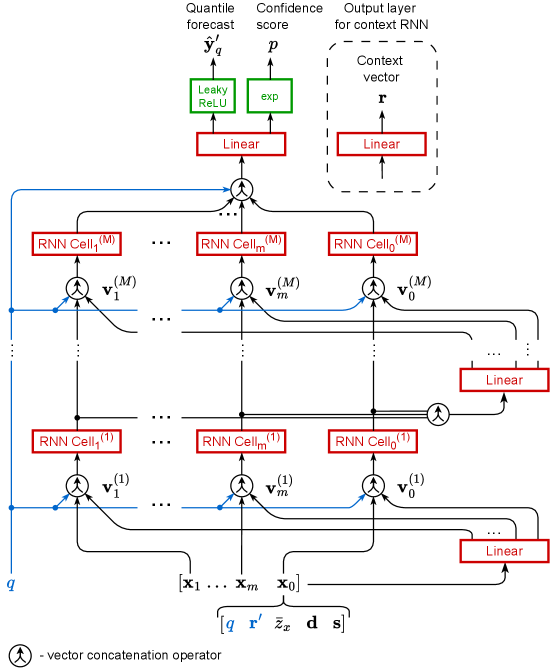
Architectural Enhancements: Achieving Robustness Through Mathematical Formulation
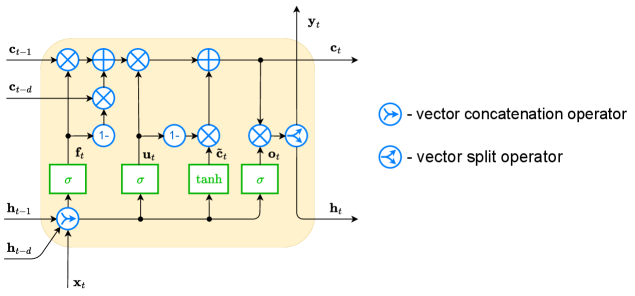
AQ-RNN utilizes dilated recurrent neural network (RNN) cells to address the challenge of capturing long-term temporal dependencies within photovoltaic (PV) power generation data. Standard RNNs are limited by a receptive field that diminishes with sequential processing; dilated RNNs introduce gaps between memory states, effectively increasing the network’s ability to consider data points further back in time without a proportional increase in computational cost. This dilation factor expands the receptive field exponentially with each layer, enabling the model to identify and incorporate patterns spanning extended periods-critical for accurate PV forecasting which is influenced by factors like weather patterns and seasonal changes. The implementation allows AQ-RNN to efficiently process longer sequences of historical PV data, improving its capacity to model complex, non-linear relationships and generate more reliable predictions.
The AQ-RNN model utilizes a ‘Team-Based Ensemble’ strategy to improve forecasting robustness by integrating predictions from multiple, specialized predictors. This approach involves training individual predictors, each focused on capturing specific patterns or characteristics within the photovoltaic (PV) power data. These predictors are then combined, with their outputs weighted based on performance, to generate a final, consolidated forecast. This ensemble method reduces the risk of relying on a single model and mitigates the impact of individual predictor errors, leading to more stable and accurate probabilistic forecasts across diverse geographical locations and varying weather conditions.
The Continuous Ranked Probability Score (CRPS) serves as the primary evaluation metric for AQ-RNN’s probabilistic forecasting performance. CRPS quantifies the difference between the predicted cumulative distribution function (CDF) of the forecasted variable and the observed value; a lower CRPS indicates a better-calibrated and accurate probabilistic forecast. Unlike metrics requiring a single point forecast, CRPS directly assesses the entire predicted distribution, making it suitable for evaluating the reliability of probabilistic forecasts which are crucial for applications requiring risk assessment and decision-making under uncertainty. The score is calculated as the integral of the absolute difference between the predicted CDF and the empirical CDF of the observation, effectively penalizing both inaccurate central tendency and poor uncertainty representation.
AQ-RNN demonstrated statistically significant improvements in probabilistic photovoltaic (PV) power forecasting across a broad geographical scope. Evaluation using the Continuous Ranked Probability Score (CRPS) revealed lower values for AQ-RNN compared to all benchmark models tested across 259 distinct European regions. This improvement in CRPS indicates a higher degree of accuracy and reliability in the probabilistic forecasts generated by AQ-RNN. Statistical significance was established with a p-value less than 0.05, confirming that the observed performance difference is unlikely due to random chance.
Implications for Grid Stability and the Future of Renewable Integration
The enhanced accuracy of the Attention-based Quantile Recurrent Neural Network (AQ-RNN) presents a promising route toward stabilizing power grids increasingly reliant on intermittent renewable energy sources. Traditional forecasting methods often struggle with the inherent unpredictability of wind and solar generation, leading to imbalances and potential disruptions; however, AQ-RNN’s ability to generate calibrated probabilistic forecasts allows grid operators to proactively manage these fluctuations. By anticipating not just what the renewable energy output will be, but also the range of likely outcomes, the model facilitates optimized energy storage strategies, targeted demand response programs, and more efficient allocation of resources. This proactive approach minimizes the need for costly backup power and contributes to a more sustainable and resilient energy infrastructure, paving the way for greater integration of clean energy technologies.
The enhanced decision-making capabilities afforded to grid operators represent a significant advancement facilitated by AQ-RNN’s probabilistic forecasting. Rather than simply predicting a single value for renewable energy generation, the model provides a range of likely outcomes, each associated with a specific probability. This allows operators to proactively manage the inherent variability of sources like solar and wind power. Accurate probabilistic forecasts directly inform strategies for energy storage – determining when to store excess energy and when to release it – and enable more effective demand response programs, incentivizing consumers to adjust usage based on predicted supply. Furthermore, the model’s output facilitates optimized resource allocation, ensuring that available power is directed to where it is most needed, minimizing waste and maximizing grid stability.
The Adaptive Quantile Recurrent Neural Network (AQ-RNN) distinguishes itself through notably improved forecast calibration and sharper predictive intervals when contrasted with existing benchmark models. This enhanced performance isn’t simply about predicting a value, but about accurately gauging the uncertainty around that prediction – a critical factor for reliable grid management. Evaluation using the Winkler Score, a metric specifically designed to assess the reliability of probabilistic forecasts, consistently demonstrated AQ-RNN’s superiority. This means the model doesn’t just predict more accurately on average, but its prediction intervals – the range within which the actual value is likely to fall – are both narrower and more trustworthy, offering grid operators a more precise understanding of potential energy fluctuations and enabling more effective decision-making regarding resource allocation and grid stability.
A key strength of the developed model lies in the reliability of its prediction intervals. Unlike many forecasting systems that offer overly optimistic or pessimistic ranges, this approach consistently generated probabilistic forecasts closely aligned with their intended coverage. Specifically, the study demonstrated that approximately 90% of actual renewable energy output fell within the model’s 90% prediction intervals – a result indicating well-calibrated uncertainty quantification. This accuracy is crucial for practical grid management, as it allows operators to confidently assess risks and make informed decisions based on the likelihood of various scenarios, effectively bridging the gap between point forecasts and actionable intelligence for resource planning and grid stability.

The pursuit of robust forecasting, as demonstrated in this work concerning probabilistic multi-regional solar power, echoes a fundamental principle of mathematical reasoning. It isn’t simply about predicting a single value, but understanding the entire distribution of possibilities. As Carl Friedrich Gauss observed, “I prefer a beautiful model to a correct answer.” This sentiment perfectly encapsulates the approach taken here; the Any-Quantile Recurrent Neural Network (AQ-RNN) prioritizes a calibrated probabilistic forecast – a model that accurately reflects uncertainty – rather than merely minimizing point error. The architecture’s ability to leverage cross-regional context and deliver any-quantile predictions speaks to a commitment to mathematical elegance and a rigorous understanding of the underlying phenomena, letting N approach infinity – what remains invariant is a trustworthy and well-defined probabilistic prediction.
What Lies Ahead?
The presented architecture, while demonstrating improved performance in probabilistic forecasting, merely addresses the symptoms of a deeper issue. The reliance on recurrent neural networks, however sophisticated, remains a fundamentally empirical approach. A truly elegant solution would derive from a first-principles model, grounded in the physics of photovoltaic energy conversion and atmospheric dynamics. The cross-regional correlations, successfully exploited by the AQ-RNN, hint at underlying deterministic chaos – a tantalizing prospect, yet one currently obscured by layers of learned approximation.
Future work must prioritize interpretability. Achieving high accuracy is insufficient if the model remains a black box. The ‘any-quantile’ approach, while pragmatic, feels suspiciously like a statistical patch – a way to describe uncertainty rather than understand its origins. A rigorous error analysis, extending beyond standard metrics, is crucial. One must ask not just how well the model predicts, but why it fails, and under what specific conditions those failures occur.
Ultimately, the field requires a shift in perspective. The pursuit of ever-more-complex neural networks risks becoming a self-fulfilling prophecy – chasing diminishing returns while neglecting the foundational principles. The true challenge lies not in fitting data, but in explaining it. Only then can one move beyond prediction towards genuine understanding – and a truly robust, provable system for forecasting renewable energy generation.
Original article: https://arxiv.org/pdf/2602.05660.pdf
Contact the author: https://www.linkedin.com/in/avetisyan/
See also:
- Gold Rate Forecast
- Games That Faced Bans in Countries Over Political Themes
- Silver Rate Forecast
- 22 Films Where the White Protagonist Is Canonically the Sidekick to a Black Lead
- Unveiling the Schwab U.S. Dividend Equity ETF: A Portent of Financial Growth
- How to Do Sculptor Without a Future in KCD2 – Get 3 Sculptor’s Things
- Celebs Who Narrowly Escaped The 9/11 Attacks
- 14 Movies Where the Black Character Refuses to Save the White Protagonist
- 20 Movies Where the Black Villain Was Secretly the Most Popular Character
- The Best Directors of 2025
2026-02-08 01:43