Author: Denis Avetisyan
A new neural network framework is pushing the boundaries of optimization, delivering improved solutions for notoriously difficult routing problems.
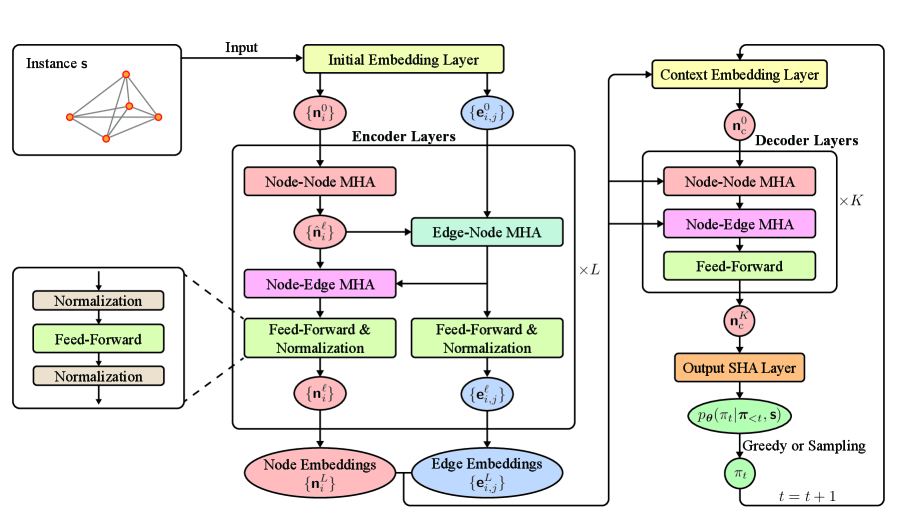
This paper introduces EGAM, an extended graph attention model that leverages reinforcement learning to achieve state-of-the-art performance on problems like the Traveling Salesman Problem.
Despite advances in neural combinatorial optimization, effectively capturing complex relationships within graph-based routing problems remains a challenge. This paper introduces ‘EGAM: Extended Graph Attention Model for Solving Routing Problems’, a novel framework leveraging extended graph attention mechanisms and reinforcement learning to improve solution quality and scalability. Our model, which updates both node and edge embeddings via multi-head attention, demonstrably outperforms existing methods-particularly on highly constrained problems-by better representing graph structure. Could this approach unlock new efficiencies for a broader range of logistical and network optimization tasks?
The Inevitable Failure of Conventional Routes
Conventional routing algorithms, designed for simpler networks, increasingly falter when faced with the intricacies of modern logistical challenges. The computational complexity arises not merely from the number of possible routes, but from the proliferation of real-world constraints – time windows, vehicle capacities, traffic congestion, and dynamic demand – that transform route optimization into a combinatorial explosion. Each added constraint exponentially increases the search space, rendering exhaustive methods impractical even for moderately sized problems. Consequently, solutions derived from traditional approaches often prove suboptimal, failing to account for crucial factors and resulting in increased costs, delays, and inefficiencies. The inherent limitations of these methods necessitate the development of innovative techniques capable of navigating this complexity and delivering truly optimized routes.
Modern routing challenges extend far beyond the capabilities of established algorithmic approaches due to the immense scale and constant flux of real-world networks. Traditional methods, designed for static environments and smaller datasets, falter when confronted with millions of nodes, fluctuating link capacities, and unpredictable demand patterns. This necessitates a shift towards solutions exhibiting greater computational efficiency and, crucially, the ability to adapt in real-time to changing conditions. Researchers are actively exploring techniques like machine learning and distributed algorithms to create routing systems that not only find viable paths but also learn from network behavior, predict future congestion, and proactively adjust to maintain optimal performance – a level of responsiveness simply unattainable with conventional, pre-programmed strategies.
Graph Neural Networks: A Topology of Possibility
Graph Neural Networks (GNNs) provide a method for representing routing problems as graphs, where individual cities or locations are defined as nodes and the routes connecting them are represented as edges. This direct representation allows GNNs to move beyond traditional routing algorithms that often rely on grid-based or matrix-based approaches. By framing the problem as a graph, GNNs can directly operate on the relationships between locations, facilitating the analysis of network topology and connectivity. This is particularly useful for complex routing scenarios with varying distances, capacities, and constraints, as the graph structure inherently captures this relational data. The adjacency matrix and feature vectors associated with each node and edge then form the input for the GNN, enabling it to learn patterns and optimize routes based on the graph’s characteristics.
Attention mechanisms within Graph Neural Networks (GNNs) function by assigning weights to different neighboring nodes during message passing, effectively quantifying the importance of each connection in the graph. These weights are dynamically calculated based on the node features and the relationships between nodes, allowing the GNN to focus on the most relevant parts of the route when making predictions. Specifically, the attention weight a_{ij} between node i and its neighbor j is determined through a learnable function, often involving a dot product or neural network, which assesses their relevance. This prioritization of key connections enables the GNN to better capture complex dependencies within the routing problem and improve the accuracy of route optimization or prediction tasks by emphasizing influential nodes and edges.
Node and Edge Embedding are central to the computational efficiency of Graph Neural Networks. Node embedding transforms each node within a graph into a vector of real numbers, capturing its features and relationships to other nodes. Similarly, edge embedding represents the connections between nodes as vectors, encoding information about the edge itself and the nodes it connects. These vector representations allow graph algorithms to be implemented using standard linear algebra operations, which are highly optimized for modern hardware. The resulting dense vector format enables parallel processing and significantly reduces computational complexity compared to traditional graph algorithms operating on discrete structures. The dimensionality of these embeddings is a key parameter, influencing both the expressiveness of the model and the computational cost.
EGAM: An Extended Glimpse into Inevitable Complexity
The Extended Graph Attention Model (EGAM) utilizes both Node-Edge and Edge-Node attention mechanisms to improve information propagation within graph-based routing problems. Traditional graph attention networks typically employ unidirectional attention, where node features influence edge representations or vice versa. EGAM’s bidirectional approach allows for iterative refinement of both node and edge embeddings; Node-Edge attention enables nodes to selectively attend to relevant edge features, while Edge-Node attention allows edges to gather information from connected nodes. This reciprocal information exchange facilitates a more comprehensive understanding of the graph structure and enables the model to capture complex relationships between nodes and edges, ultimately improving routing performance. The combined effect of these attention mechanisms is a richer, more informed representation of the routing landscape.
The Extended Graph Attention Model (EGAM) employs Reinforcement Learning (RL) via the REINFORCE algorithm to dynamically optimize routing decisions. REINFORCE, a policy gradient method, directly learns the optimal routing policy by estimating the gradient of the expected reward with respect to the policy parameters. In EGAM, the policy dictates the selection of the next node to visit, and the reward is based on the reduction in total route cost or travel time. This approach allows EGAM to adapt to varying problem instances and changing network conditions without requiring explicit retraining for each scenario, enabling robust performance across diverse routing challenges. The algorithm iteratively refines the policy based on sampled trajectories, maximizing cumulative rewards and improving routing efficiency.
The Extended Graph Attention Model (EGAM) improves training stability and efficiency by implementing a Symmetry-Based Baseline. This baseline leverages the inherent symmetries present in many routing problems-such as permutations of intermediate nodes in the Traveling Salesman Problem-to reduce variance during Reinforcement Learning. By subtracting a baseline reward calculated from symmetrically equivalent states, EGAM diminishes the impact of stochasticity and accelerates convergence. This technique effectively normalizes the reward signal, allowing the model to more reliably differentiate between genuinely better and worse routing policies, ultimately leading to more robust and efficient training.
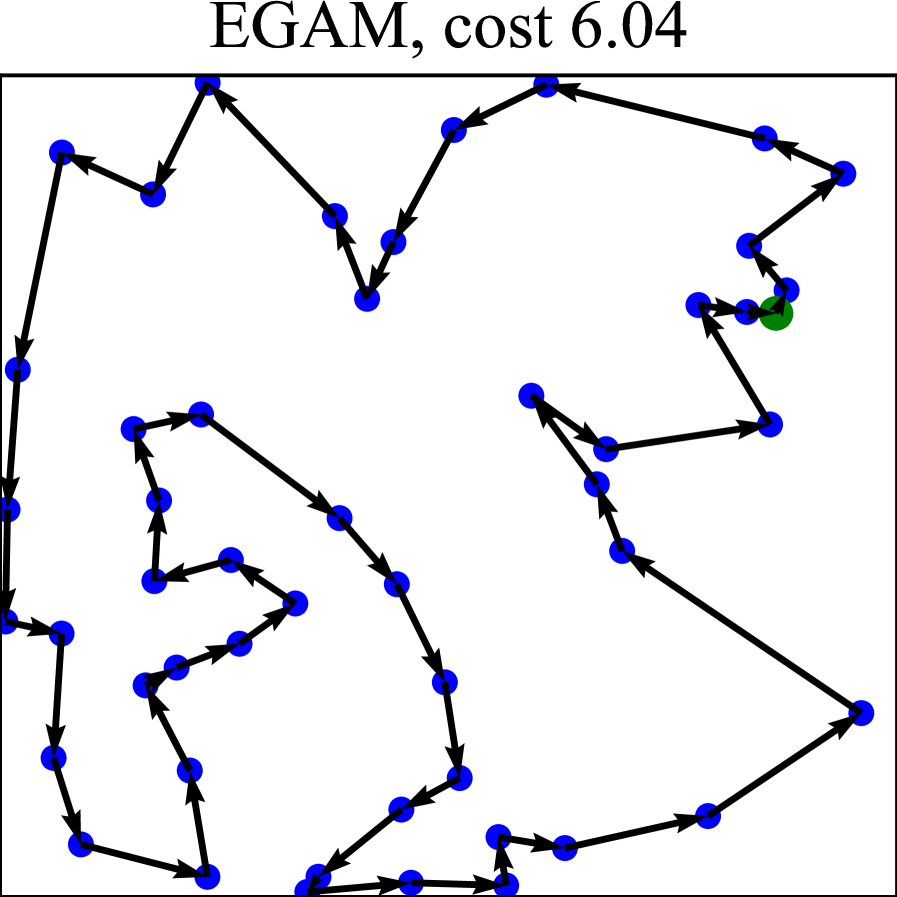
The Extended Graph Attention Model (EGAM) demonstrates performance improvements across several common routing problems. Evaluations conducted under single-decision settings show a 2.29% reduction in the optimality gap for the Traveling Salesman Problem with Time Windows (TSPTW) compared to existing methods. Similarly, EGAM achieves a 2.21% reduction in the optimality gap for the Traveling Salesman Problem with Draft Limit (TSPDL). For the Vehicle Routing Problem with Time Windows (VRPTW), EGAM delivers a 2.04% reduction in the optimality gap, indicating its ability to optimize solutions for complex, real-world routing scenarios.
The Inevitable Horizon: Beyond Optimization, Towards Prediction
The Emergent Goal-driven Agent Model (EGAM) demonstrates significant potential to revolutionize operations within the logistics, transportation, and delivery sectors due to its robust handling of real-world complexities. Unlike traditional routing algorithms often constrained by static parameters, EGAM adeptly navigates diverse limitations – encompassing traffic congestion, fluctuating fuel costs, delivery time windows, and vehicle capacity – while simultaneously adapting to dynamic environmental changes. This capability allows for the creation of highly flexible and responsive delivery networks, optimizing routes not just for distance, but for a multitude of interwoven constraints. The model’s strength lies in its ability to continuously re-evaluate and adjust strategies, ensuring efficient resource allocation and timely deliveries even amidst unforeseen disruptions, ultimately reducing operational costs and enhancing customer satisfaction.
Current routing algorithms, while effective, often rely on autoregressive models that generate solutions sequentially, limiting their speed and responsiveness in dynamic scenarios. Future investigations are poised to explore the benefits of integrating non-autoregressive models – those capable of generating entire solutions in parallel – into EGAM. This shift promises to dramatically accelerate inference times, enabling real-time routing decisions crucial for applications like delivery services and traffic management. By bypassing the sequential processing bottleneck, these models could provide near-instantaneous route adjustments in response to unforeseen circumstances – such as road closures or fluctuating demand – ultimately enhancing efficiency and adaptability in complex logistical networks.
The true potential of EGAM lies in its capacity to evolve from a reactive routing system to a predictive one. By assimilating real-time data – encompassing traffic patterns, weather forecasts, event schedules, and even social media reports of disruptions – and integrating these insights with predictive modeling techniques, EGAM can anticipate logistical challenges before they arise. This proactive approach extends beyond simply rerouting around existing congestion; it allows the system to forecast potential bottlenecks, adjust delivery schedules preemptively, and optimize routes based on predicted future conditions. Consequently, EGAM transitions from a tool that responds to change to one that anticipates and mitigates it, fundamentally enhancing the efficiency and resilience of logistics, transportation, and delivery networks.
The pursuit of optimal solutions in routing problems, as demonstrated by EGAM, inevitably introduces layers of complexity. This echoes a fundamental truth: scalability is just the word used to justify that complexity. John McCarthy observed, “It is better to do a good job of a little than a poor job of a lot.” EGAM’s strength isn’t simply in tackling larger instances, but in intelligently navigating the trade-off between solution quality and computational cost. The model’s reliance on attention mechanisms suggests a recognition that not all connections are created equal – a nuanced approach that prioritizes relevant information, even within a vast problem space. Everything optimized will someday lose flexibility, and EGAM’s architecture, while powerful, represents a specific adaptation to the current landscape of routing challenges.
What’s Next?
The elegance of EGAM lies not in its solutions, but in the prophecies embedded within its architecture. Each attention head, a nascent oracle, divines potential paths, yet remains blind to the inevitable distortions of real-world complexity. The model achieves performance, yes, but at what cost? The true measure isn’t merely shortest routes, but the accumulation of unforeseen consequences – the phantom traffic jams, the unpredicted detours, the very reshaping of the network it seeks to navigate.
Future work will inevitably focus on scaling – larger graphs, more complex constraints. But this is merely treating the symptom, not the disease. The fundamental limitation is not computational, but epistemic. EGAM, like all such systems, operates under the illusion of complete information. The next generation must embrace uncertainty, building models that anticipate their own failures, that learn from the shadows of incomplete data.
Perhaps the most fruitful avenue lies not in improving the model itself, but in understanding the ecosystem it inhabits. Routing problems are not static puzzles, but dynamic negotiations between agents with conflicting desires. To truly solve them requires not optimization, but a kind of applied anthropology – a careful study of the patterns of chaos, and a humble acceptance of the inherent unpredictability of any complex system.
Original article: https://arxiv.org/pdf/2601.21281.pdf
Contact the author: https://www.linkedin.com/in/avetisyan/
See also:
- 20 Movies Where the Black Villain Was Secretly the Most Popular Character
- Transformers Under the Microscope: What Graph Neural Networks Reveal
- Celebs Who Narrowly Escaped The 9/11 Attacks
- Silver Rate Forecast
- Trading on Thin Air: AI Agents Conquer Crypto Volatility
- Gold Rate Forecast
- Invincible Season 4 Gender Swaps Tech Jacket As Fans Question Major Comic Change
- Every Notable ‘Star Trek: The Original Series’ Actor Who Died
- 22 Films Where the White Protagonist Is Canonically the Sidekick to a Black Lead
- Trading Smarter: AI-Powered Execution Schedules
2026-02-02 02:52