
The firm known as Figma—a designation which, like so many corporate titles, feels less a description than a cipher—began its public existence last July with a flourish. A momentary ascent, a shimmering illusion of value, reaching a peak before succumbing, as all peaks must, to the gravity of the market. It is a familiar trajectory, mirroring the rise and fall of empires chronicled in forgotten histories. The current valuation, however, presents a curious case, a labyrinth of numbers demanding careful navigation.
One approaches Figma not as a mere collection of algorithms and quarterly reports, but as a potential echo within the vast Library of Babel. Each line of code, each user subscription, represents a unique combination of symbols, contributing to the infinite possibilities of digital creation. The question, then, is not simply whether the stock is a ‘buy,’ but whether this particular arrangement of symbols holds a coherence, a fleeting resonance within the chaos.
The Weaver’s Loom: Figma’s Strategic Design
Figma’s strategy, it appears, is one of subtle integration, a grafting of artificial intelligence onto the established framework of design. The acquisition of Weavy—now reimagined as Figma Weave—is not merely a business transaction, but a symbolic act of weaving the future into the present. The intention, seemingly, is not to replace the designer, but to augment their capabilities, to offer a collaborator rather than a usurper. A sensible approach, given the inherent limitations of even the most advanced automatons.
The reported adoption of Figma Make by a significant segment of their higher-revenue clientele—some thirty percent—suggests a genuine utility. It is a modest, yet intriguing statistic. One imagines a network of designers, each exploring the infinite variations offered by this digital loom, shaping and refining their creations. The company’s CFO, Praveer Melwani, speaks of ‘AI native workflows,’ a phrase that evokes images of self-organizing systems, evolving in response to the demands of their users.
The addition of over a thousand high-value clients in a single quarter is a further indication of this momentum. And a net dollar retention rate of 131% suggests a degree of client loyalty rarely encountered in this ephemeral digital landscape. It is as if Figma has discovered a key to unlocking a deeper engagement, a resonance that transcends mere transactional value.
The Cipher of Revenue: A Financial Examination
The company’s revenue growth—a 38% increase year-over-year—is a tangible manifestation of this underlying momentum. Each quarter reveals a new record, a further inscription upon the ever-expanding scroll of digital commerce. Revenue has ascended steadily since the first quarter of 2024, when it stood at $156.2 million. A predictable, yet reassuring pattern.
Their projections for the fourth quarter—between $292 million and $294 million—suggest that this trajectory will continue. The balance sheet, too, is remarkably robust, with over $1.5 billion in cash and marketable securities. A fortress of capital, shielding the company from the inevitable fluctuations of the market.
However, the third quarter also revealed a substantial net loss—$1.1 billion—attributable to stock-based compensation. A curious anomaly, suggesting a temporary distortion of value. The second quarter, by contrast, saw a modest net income of $28.2 million. A reminder that even the most carefully constructed systems are subject to unpredictable forces.
Navigating the Labyrinth: A Judgment
The recent decline in Figma’s share price, coupled with its lofty valuation, presents a perplexing challenge. The question is not whether the stock will rebound—such predictions are the province of fortune tellers—but whether its current price reflects a genuine, underlying value. To assess this, one must consider the price-to-sales ratio, a metric that measures the market’s willingness to pay for each dollar of revenue.
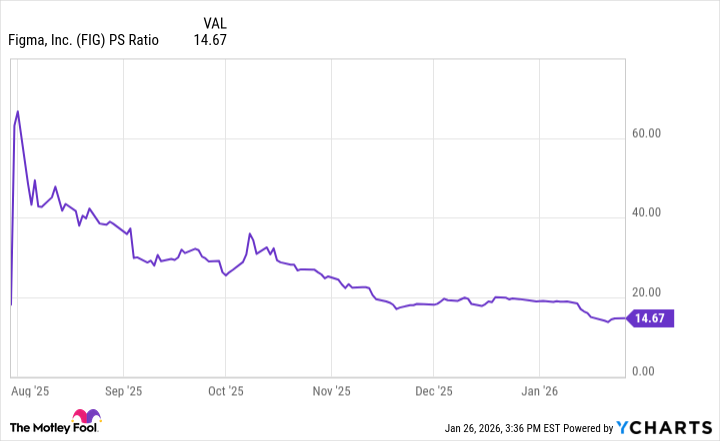
The chart reveals a steady decline in Figma’s sales multiple since its initial public offering. A reduction from over 60 to approximately 15. A more reasonable valuation, suggesting that the market is beginning to recognize the company’s underlying potential.
Figma’s commitment to AI, not as a replacement for human creativity, but as an enabling force, is a sensible strategy. It acknowledges the inherent limitations of algorithms, while harnessing their power to augment human capabilities. The company appears to be making the right moves, laying the foundation for long-term success in an increasingly complex and unpredictable world. Whether this translates into a profitable investment remains, of course, a matter of conjecture. But within the labyrinth of the market, Figma appears to be charting a course worth observing.
Read More
- 20 Movies Where the Black Villain Was Secretly the Most Popular Character
- Transformers Under the Microscope: What Graph Neural Networks Reveal
- Celebs Who Narrowly Escaped The 9/11 Attacks
- Trading on Thin Air: AI Agents Conquer Crypto Volatility
- Silver Rate Forecast
- Gold Rate Forecast
- Invincible Season 4 Gender Swaps Tech Jacket As Fans Question Major Comic Change
- 22 Films Where the White Protagonist Is Canonically the Sidekick to a Black Lead
- Trading Smarter: AI-Powered Execution Schedules
- Every Notable ‘Star Trek: The Original Series’ Actor Who Died
2026-01-31 16:43