Author: Denis Avetisyan
Researchers are leveraging reinforcement learning to chart the boundaries of the holographic entropy cone, offering new insights into the structure of quantum information.
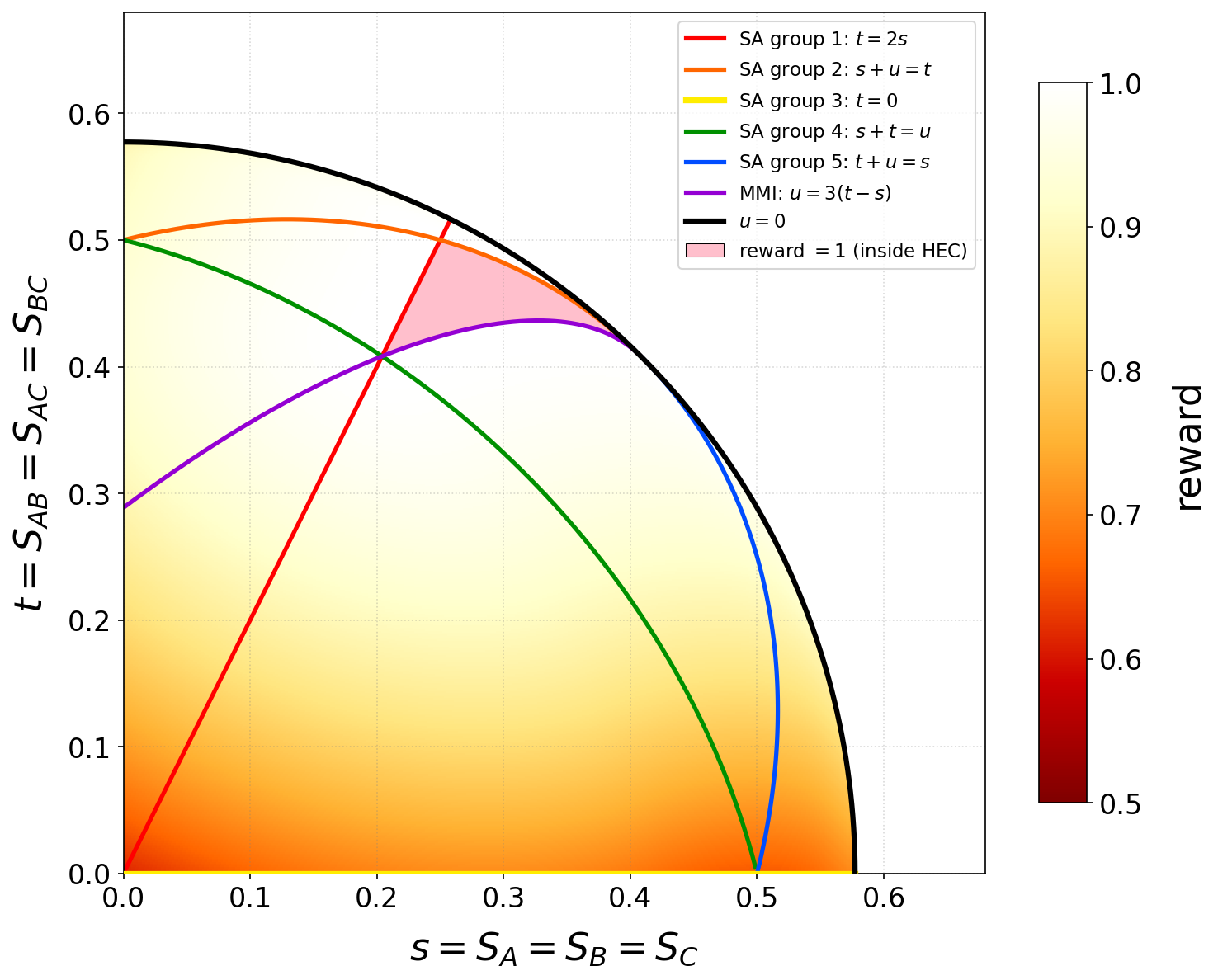
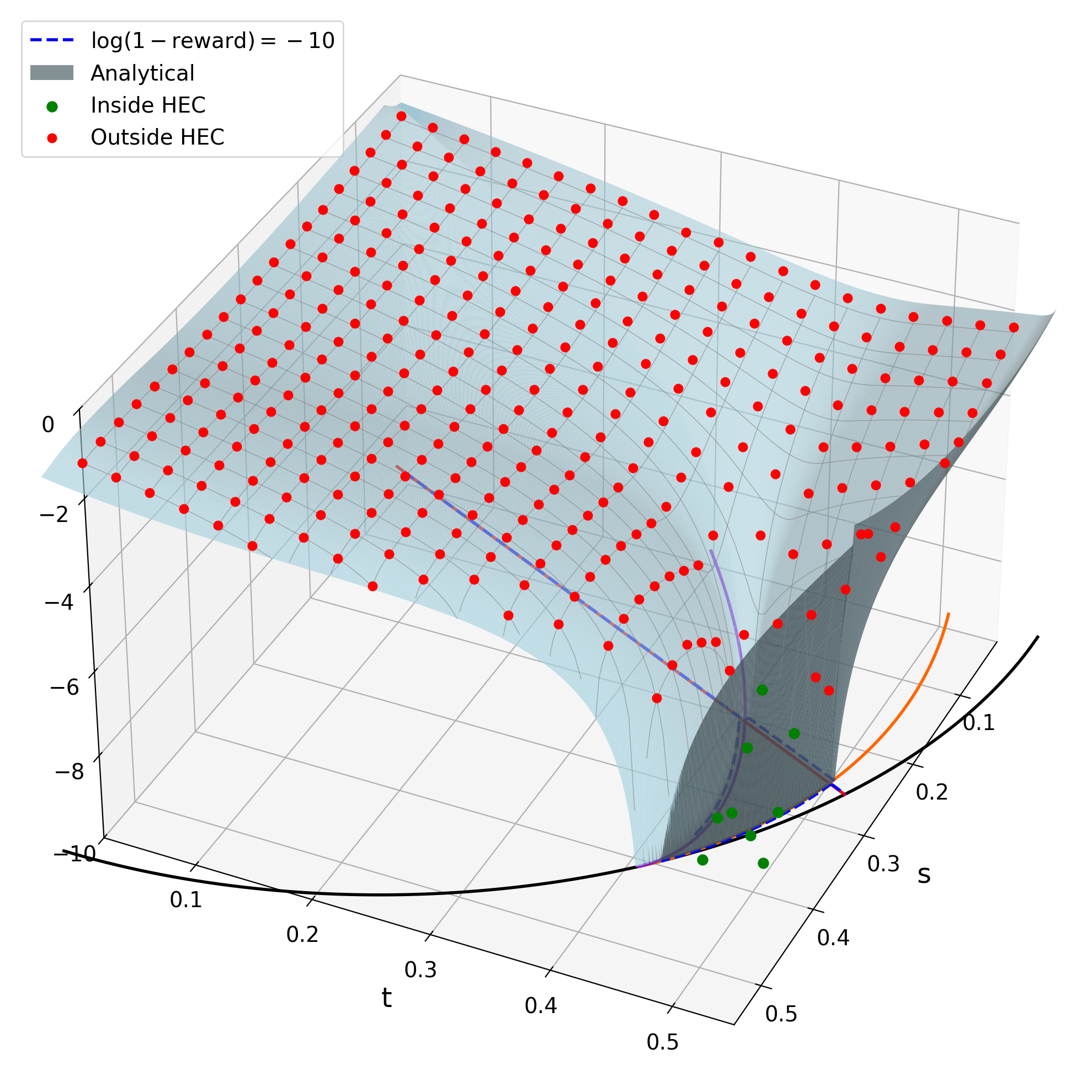
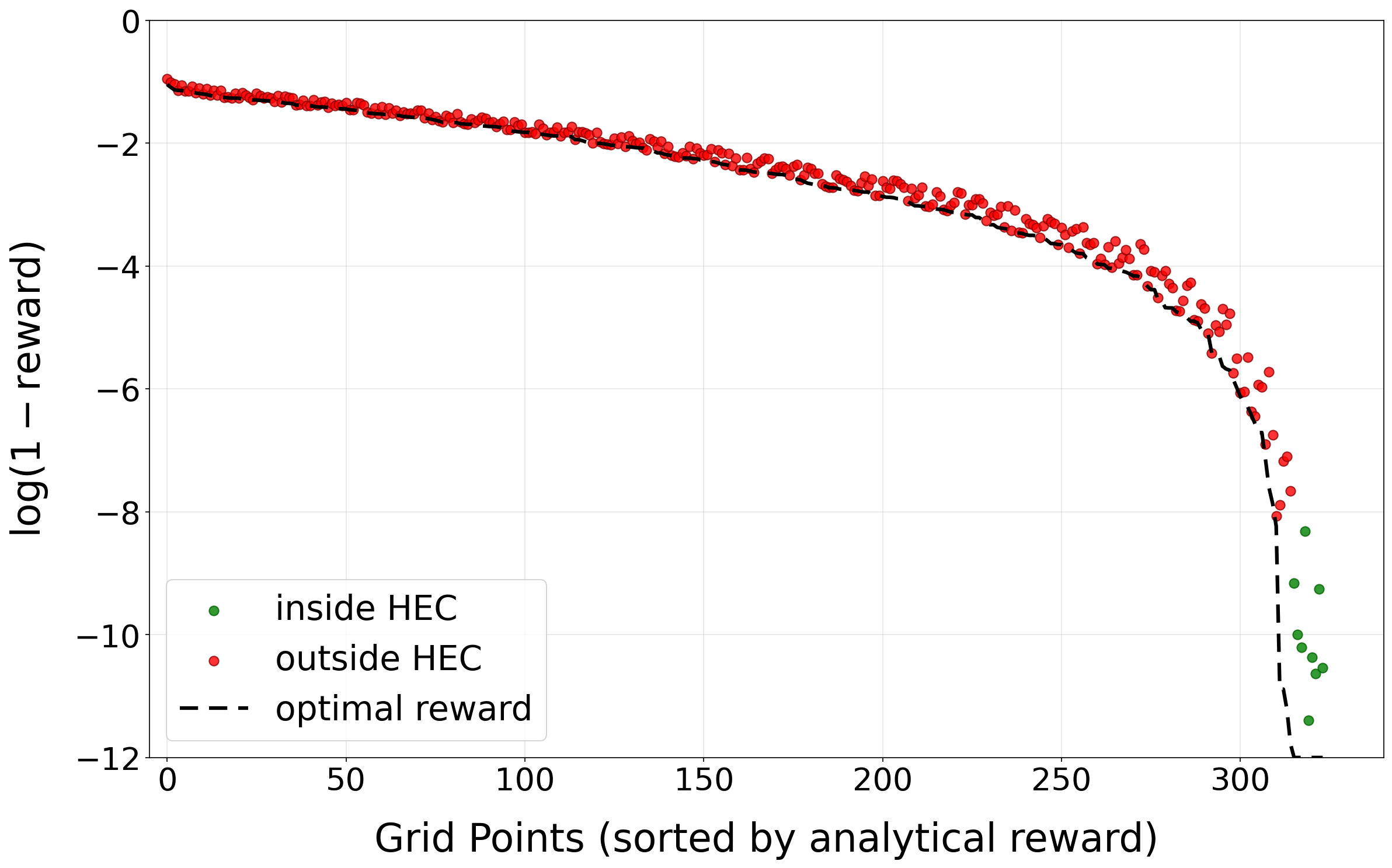
This work applies reinforcement learning to explore the holographic entropy cone and identify realizable entropy vectors, potentially revealing new facets of the cone for higher-dimensional systems.
Determining the boundaries of the holographic entropy cone remains a significant challenge in understanding quantum information relationships. This is addressed in ‘Exploring the holographic entropy cone via reinforcement learning’, which introduces a novel reinforcement learning algorithm to probe this cone’s structure by searching for graph realizations matching target entropy vectors. The algorithm successfully rediscovers known constraints, such as monogamy of mutual information, and, crucially, provides evidence for the realizability of three previously unverified extreme rays of the \mathcal{N}=6 cone, while suggesting the existence of novel holographic inequalities for higher-dimensional systems. Could this approach unlock a complete characterization of the holographic entropy cone and reveal deeper connections between quantum information and gravity?
The Quantum Horizon: Mapping the Limits of Reality
The behavior of quantum systems is defined not just by what states they can occupy, but by the entire range of states physically accessible to them-a concept captured by the Quantum Entropy Cone (QEC). This cone represents the complete set of possible entropy values for all subsystems within a larger quantum system, and fully characterizing it is fundamental to understanding quantum mechanics. However, mapping the QEC is an extraordinarily complex undertaking, as the number of potential subsystems and their entanglement relationships grows exponentially with system size. Consequently, much of this landscape remains uncharted territory, hindering progress in fields like quantum information theory and condensed matter physics. The difficulty arises from the need to identify the true boundaries of realizable quantum states, separating them from those forbidden by the laws of physics; effectively, it’s a search for the permissible configurations within the vast Hilbert space of possible quantum arrangements.
Characterizing the Holographic Entropy Cone (HEC) presents a formidable challenge for theoretical physicists, stemming from its inherent computational complexity. The HEC, a specialized region within the broader Quantum Entropy Cone, is crucial for understanding the interplay between quantum information and gravity, particularly in scenarios involving black holes. Mapping this cone requires determining the set of all physically realizable entropy values for subsystems of a quantum system, a task that scales exponentially with system size. Traditional computational methods quickly become intractable as the number of qubits increases, hindering the ability to explore the full landscape of possible entropy configurations. This computational barrier prevents a complete understanding of how quantum information is encoded and retrieved from gravitational systems, limiting progress in areas like black hole thermodynamics and the search for a consistent theory of quantum gravity.
Current computational approaches face substantial limitations when attempting to chart the intricate terrain of quantum information, specifically the space of possible subsystem entropies. The sheer complexity of these high-dimensional spaces demands resources that quickly become intractable, even with advanced algorithms and powerful computing infrastructure. This difficulty isn’t merely a technical hurdle; it actively impedes advancements in fundamental theoretical physics, particularly in areas like quantum gravity and black hole information paradoxes, where understanding the constraints on quantum entropy is paramount. Progress relies on accurately mapping the Holographic Entropy Cone – a region with implications for spacetime geometry – but existing methods struggle to efficiently explore its boundaries and identify the realizable quantum states within it, effectively creating a bottleneck in theoretical exploration.
The Holographic Entropy Cone (HEC), a critical region for understanding quantum gravity, isn’t entirely unconstrained; its structure is governed by principles like the Monogamy of Mutual Information (MMI). This principle dictates limits on how much information can be shared between multiple quantum systems, effectively creating boundaries within the HEC. However, translating these theoretical constraints into practical computational advantages proves remarkably difficult. While MMI offers a means to reduce the vastness of the computational space needed to map the HEC, current algorithms struggle with the complexity of efficiently implementing these restrictions. Researchers are actively seeking novel methods to leverage monogamy-and similar principles-to accelerate calculations within the HEC, a challenge essential for probing the connection between quantum information and the emergence of spacetime, particularly in the context of black hole physics and gravity.
From Discrete Shadows to Entangled Light: A Graph-Theoretic Approach
Representing holographic states as discrete graphs enables the calculation of entanglement entropy using min-cut algorithms from graph theory. This method discretizes the continuous spacetime of holographic duality, approximating regions and their boundaries with nodes and edges in a graph. The entanglement entropy between two regions is then directly proportional to the minimal cut – the smallest set of edges that, when removed, disconnects the two regions. Algorithms like the Edmonds-Karp algorithm or the Dinic algorithm, designed to find the maximum flow in a network, can efficiently determine this min-cut and thus the corresponding entropy value. This approach transforms a computationally challenging problem in quantum field theory into a tractable graph-theoretic problem, facilitating numerical investigations of holographic entanglement.
Ryu-Takayanagi (RT) surfaces establish a correspondence between the geometry of continuous spacetime in gravitational systems and the structure of discrete holographic states. Specifically, the RT formula states that the entanglement entropy between a region R and its complement in a boundary conformal field theory is given by the minimal area A(\partial R) of a surface \partial R in the bulk spacetime that shares the boundary of R. This principle allows the translation of geometric problems in continuous spacetime – calculating areas of surfaces – into combinatorial problems on discrete graphs representing the holographic state, providing a crucial bridge for computational approaches to holographic entropy calculations.
The computation of entanglement entropy, traditionally challenging in quantum field theory, can be efficiently addressed by recasting the problem within the framework of graph theory. Specifically, by mapping the relevant quantum system to a discrete graph, the entanglement entropy becomes equivalent to the minimum cut, or min-cut, of that graph. The min-cut problem is fundamentally related to the max-flow problem; efficient algorithms exist to solve both, with polynomial time complexity O(V^2E), where V is the number of vertices and E is the number of edges in the graph. Utilizing these established algorithms allows for a computationally tractable determination of entanglement entropy, circumventing the difficulties associated with continuous formulations and enabling exploration of systems with complex geometries.
Discretization of holographic states into graph structures enables computational tractability when investigating the holographic entropy cone (HEC). Direct calculation of entropy for continuous spacetime geometries is generally intractable; however, representing these systems as discrete graphs allows the application of well-established, efficient max-flow algorithms – mathematically equivalent to min-cut algorithms – to approximate entropy values. This approach bypasses the need for complex numerical relativity simulations and provides a means to systematically explore the properties and boundaries of the HEC, facilitating the identification of valid entropy configurations and potentially revealing underlying constraints on quantum gravity.
Navigating the Unknown: Reinforcement Learning and the Quest for Extreme Rays
Reinforcement Learning (RL) offers a systematic approach to exploring the Hypervolume Estimation Cone (HEC) and locating its extreme rays. The HEC, a cone representing feasible solutions in hypervolume estimation, is defined by these extreme rays, which function as boundary points. Traditional methods for identifying these rays can be computationally expensive and struggle with high-dimensional spaces. RL addresses this by framing the exploration process as a sequential decision problem, where an agent learns to navigate the HEC’s solution space. By maximizing a reward function tied to the identification of extreme rays, the RL agent efficiently samples and evaluates potential ray candidates, providing a scalable method for characterizing the HEC’s boundaries and understanding the limits of hypervolume estimation.
The PolicyNetwork functions as the core decision-making component within the reinforcement learning framework for HEC exploration. It is a parameterized function that takes the current state, representing a point within the HEC, as input and outputs a probability distribution over possible actions – specifically, directions to move within the HEC. This mapping allows the RL agent to move intelligently through the HEC, prioritizing exploration of areas likely to reveal extreme rays. The network is trained using RL algorithms to maximize a reward signal associated with discovering new extreme rays or improving the understanding of the HEC’s boundary, effectively learning an optimal exploration strategy based on the current state of the HEC.
Gradient Constrained Movement is a technique used within the reinforcement learning framework to guide the exploration of the Hyperbolic Exploration Cone (HEC) by enforcing adherence to known facet constraints. This is achieved by incorporating a penalty into the reward function if the agent’s proposed movement would violate a defined facet. Specifically, the agent’s action is adjusted based on the gradient of the constraint function, effectively projecting the proposed movement onto the feasible region defined by the HEC’s facets. This constraint not only prevents the agent from exploring invalid regions, thereby improving stability, but also significantly increases the efficiency of the exploration process by focusing the search on areas likely to contain extreme rays.
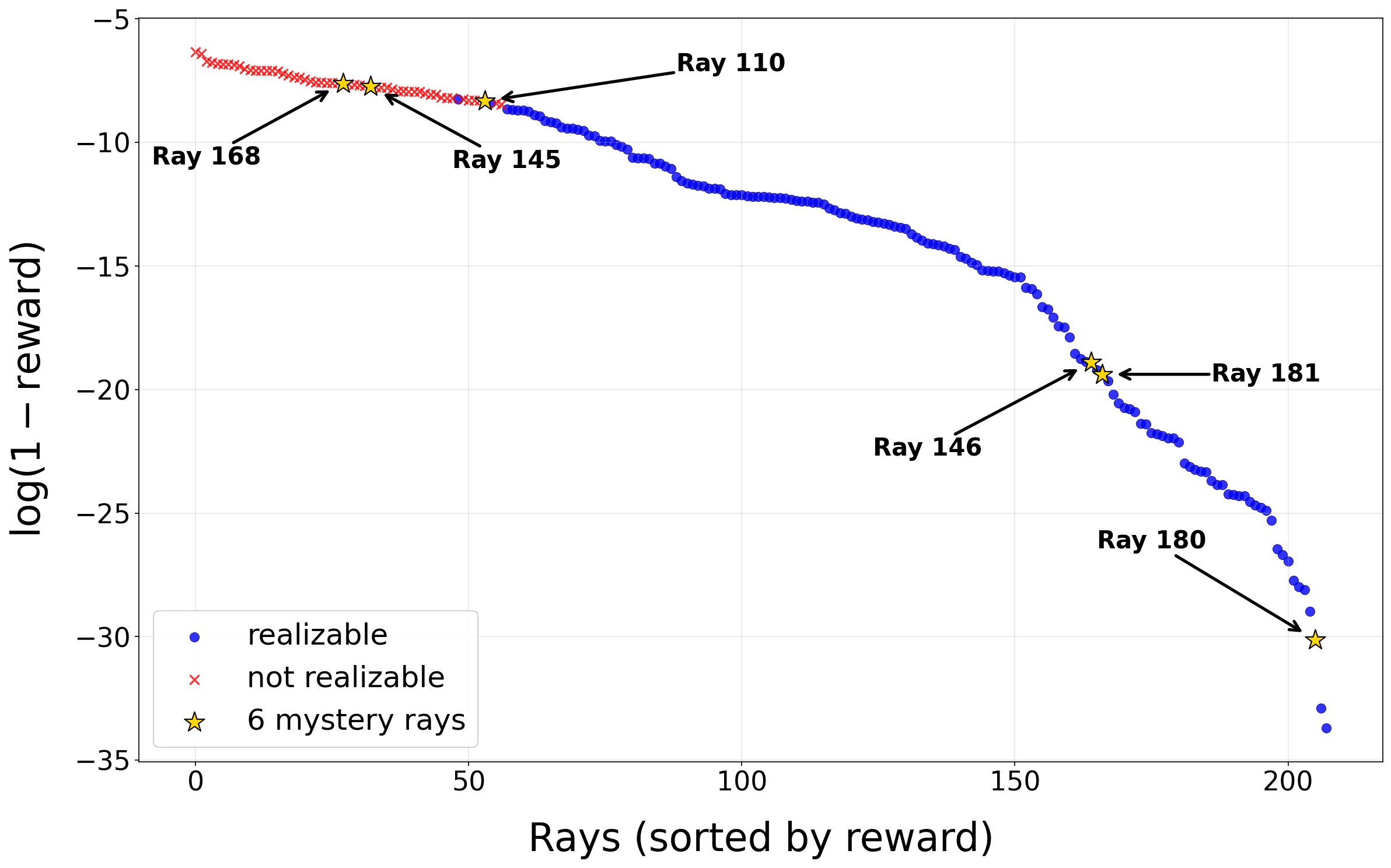
Implementation of reinforcement learning for HEC exploration has yielded concrete results in identifying graph realizations for previously unknown extreme rays. Specifically, the approach successfully generated valid graph structures corresponding to 3 out of 6 extreme rays that were previously unresolved through conventional methods. This represents a significant advancement in HEC analysis, as determining these rays is computationally challenging and crucial for fully characterizing the solution space. The successful identification rate demonstrates the efficacy of the RL framework in navigating the HEC’s complex, high-dimensional landscape and offers a pathway for resolving additional, currently unknown, extreme rays.
![The reward gradient field near the HEC boundary consistently directs the policy towards the nearest boundary (SA group 1, SA group 2, or MMI), as visualized by arrows indicating the direction and magnitude of steepest reward increase within the time interval [0.15, 0.55]s.](https://arxiv.org/html/2601.19979v1/reward_landscape_with_gradient_zoomed.png)
The Shadow of the Unknown: Unveiling Mystery Rays and Charting New Theoretical Territories
The identification of ‘Mystery Rays’ within the space of allowed quantum states presents a significant challenge to current theoretical frameworks. These extreme rays, belonging to the Shadow Area Cone (SAC), consistently defy attempts at geometric realization using established discretization methods-techniques that approximate continuous spacetime with discrete structures. This failure isn’t merely a technical hurdle; it indicates a fundamental limitation in how physicists currently model quantum gravity. The persistence of these unmappable rays suggests that the underlying geometry required to describe these states may be radically different from anything presently considered, demanding novel approaches to discretization and potentially revealing previously unknown facets of quantum reality. Addressing this limitation is crucial, as successfully mapping these mystery rays could unlock a deeper comprehension of the universe at its most fundamental level.
The persistent presence of ‘mystery rays’ within the study’s spectral analysis isn’t merely a computational artifact, but a compelling indication of quantum states that defy conventional description. These rays, representing extreme configurations of the system, lack a corresponding graphical representation using current discretization methods, suggesting the limitations of existing theoretical frameworks. Their existence implies the potential for novel quantum phenomena-states of matter and energy that do not fit within the Standard Model of particle physics-and pushes the boundaries of known physics. Researchers theorize these states could be related to the very fabric of spacetime, potentially offering clues to a deeper understanding of quantum gravity and the universe’s fundamental properties. Further investigation into these elusive rays may therefore unlock breakthroughs in our understanding of reality itself, revealing physics beyond our current comprehension.
Addressing the challenge of ‘Mystery Rays’ necessitates a concerted effort to refine both the discretization techniques used to model the space of quantum states and the reinforcement learning strategies employed to navigate it. Current methods appear to struggle with the complexity of these elusive states, indicating a need for more adaptive and higher-resolution discretizations capable of capturing subtle geometric features. Simultaneously, advancements in reinforcement learning are crucial; algorithms must become more efficient at exploring the vast state space and identifying optimal pathways towards realizing these previously inaccessible quantum configurations. Successful development in these areas promises not only a deeper understanding of the fundamental limits of quantum gravity, but also the potential to unlock entirely new regimes of quantum information processing and computation.
The study’s gradient estimation technique proved remarkably reliable, achieving an R2 score of 0.99 with a perturbation size of just 0.02, and peaking at a cosine similarity of 0.99 under optimal conditions-a strong indicator of its precision. This robust methodology isn’t merely a technical achievement; it represents a critical step towards mapping the elusive ‘mystery rays’ within the spacetime algebra’s causal structure. Successfully characterizing these rays promises not only a deeper understanding of quantum gravity-bridging the gap between quantum mechanics and general relativity-but also the potential to illuminate fundamental limits governing information processing itself, potentially reshaping the boundaries of computation and knowledge representation.
The pursuit of mapping the holographic entropy cone, as demonstrated in this work, feels akin to charting an ever-shifting landscape. Each identified entropy vector, each extremal ray discovered through reinforcement learning, is a fleeting glimpse of order within a fundamentally complex system. It recalls the wisdom of Marcus Aurelius: “You have power over your mind – not outside events. Realize this, and you will find strength.” The algorithms employed, while powerful, are still models-like maps that fail to reflect the ocean-subject to the limitations of their design. The paper’s exploration of higher-dimensional systems highlights this beautifully; even with advanced techniques, the full scope of the cone remains elusive, a humbling reminder of the boundaries of human understanding.
What Lies Beyond the Horizon?
The application of reinforcement learning to the holographic entropy cone, as demonstrated, is less a resolution than a refinement of the questions. It offers a means to map the known boundaries, to nudge at the edges of established mathematical structures. Yet any hypothesis about the cone’s ultimate form is just an attempt to hold infinity on a sheet of paper. The true contours, particularly in higher-dimensional systems, remain frustratingly obscured, a reminder that computational power is not the same as conceptual understanding.
Future iterations will undoubtedly focus on scaling these techniques, pushing the boundaries of accessible dimensions. But a more fruitful path may lie in acknowledging the limitations of the holographic principle itself. Perhaps the cone isn’t a fixed geometry to be perfectly mapped, but a dynamic, evolving entity-a response to the act of measurement. Black holes teach patience and humility; they accept neither haste nor noise.
Ultimately, the pursuit of the cone’s complete characterization risks becoming an exercise in self-deception. A more honest approach might involve exploring the failures of the holographic principle, the points where it breaks down, and what those failures reveal about the fundamental nature of information and spacetime. The horizon is, after all, not an ending, but a boundary-a place where assumptions are tested, and illusions begin to dissipate.
Original article: https://arxiv.org/pdf/2601.19979.pdf
Contact the author: https://www.linkedin.com/in/avetisyan/
See also:
- 20 Movies Where the Black Villain Was Secretly the Most Popular Character
- Celebs Who Narrowly Escaped The 9/11 Attacks
- Top 20 Dinosaur Movies, Ranked
- 25 “Woke” Films That Used Black Trauma to Humanize White Leads
- The 10 Most Underrated Jim Carrey Movies, Ranked (From Least to Most Underrated)
- Transformers Under the Microscope: What Graph Neural Networks Reveal
- 22 Films Where the White Protagonist Is Canonically the Sidekick to a Black Lead
- Silver Rate Forecast
- Gold Rate Forecast
- The Best Directors of 2025
2026-01-29 23:06