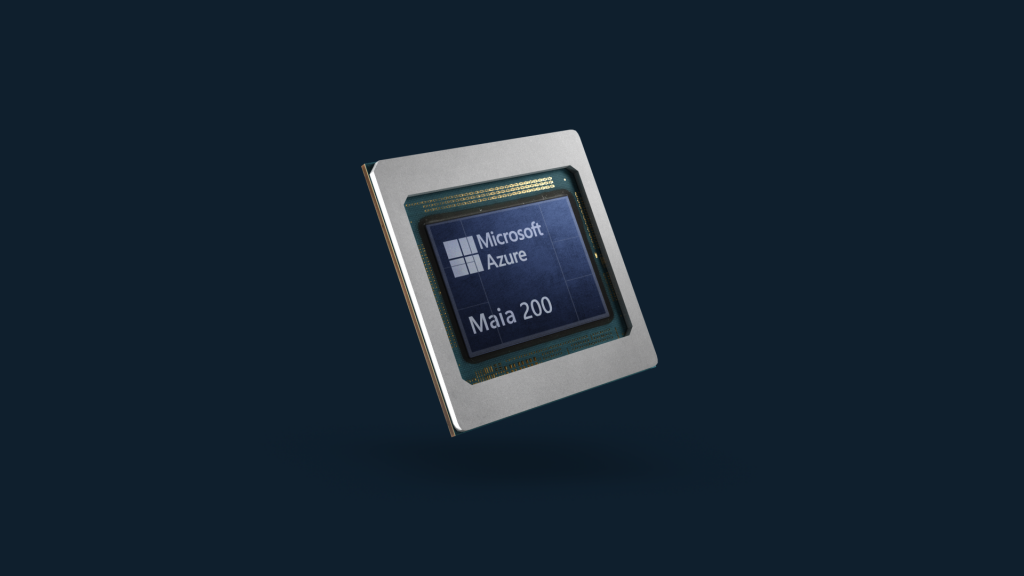
The prevailing narrative, relentlessly promoted, asserts Nvidia’s dominance in the provision of processing units for artificial intelligence. This is, for the moment, demonstrably true. However, to assume this will remain the case indefinitely is a failure of economic observation. Any established power invites challenge, and Microsoft has now entered the arena with its Maia 200 chip.
The announcement, released on Monday, is less a boast of technological triumph than a statement of strategic intent. Microsoft, through its executive vice president of Cloud + AI, Scott Guthrie, frames Maia as an attempt to reduce the costs associated with AI token generation. This, in plain terms, means they intend to offer a competitive alternative, and to recapture some of the expenditure currently flowing towards their Californian rival.
A Chip Designed by Necessity
The specifications, as presented, are predictably impressive. Maia 200 boasts increased memory bandwidth, reportedly exceeding Amazon’s Trainium and Alphabet’s TPU. The claim of being the “most performant, first-party silicon from any hyperscaler” is, of course, marketing language. What matters is not the superlative, but the demonstrable cost-benefit. Microsoft emphasizes both performance and efficiency, a combination increasingly vital in a market sensitive to energy consumption and escalating operational costs.
The reconfigured memory system, designed to prevent data bottlenecks, is a practical improvement. It suggests a focus on optimization, rather than simply pursuing raw computational power. A 30% improvement in performance per dollar is a significant figure, if verifiable. Such gains, however incremental, are the foundations of long-term profitability.
The immediate benefit for Microsoft lies in powering its Copilot and Azure OpenAI services. This vertical integration allows them to control costs and improve margins. The deployment to Microsoft 365 Copilot and Foundry represents a calculated move to leverage their own hardware within their existing ecosystem. It is a logical step, and one that any responsible management team would be expected to take.
The promise of wider customer availability, unlike the previous iteration which remained an internal project, is a welcome development. The release of a Software Development Kit (SDK) is a necessary condition for attracting third-party developers and fostering a broader user base. Whether this will be sufficient to dislodge Nvidia’s established network remains to be seen.
The Illusion of Unchallenged Dominance
Maia is merely the latest in a series of attempts to reduce dependence on Nvidia’s GPUs. The market is beginning to recognize the inherent risk of relying on a single supplier, however dominant. Nvidia currently commands a staggering 92% share of the data center GPU market, according to IoT Analytics. This is not a healthy situation, and it invites disruption.
While Maia may offer advantages for Microsoft’s specific inference workloads, Nvidia’s GPUs still provide superior computational horsepower and greater flexibility. They remain the preferred choice for complex AI training and a wider range of applications. However, this advantage is not insurmountable. Cost is a powerful motivator, and Microsoft is positioning itself to exploit this.
Microsoft’s valuation, at 34 times earnings, appears more reasonable compared to Nvidia’s multiple of 47. This discrepancy suggests that the market has already factored in some of the risks associated with Nvidia’s dominance. It also implies that Microsoft may offer a more attractive entry point for long-term investors.
I maintain positions in both Microsoft and Nvidia. This is not a declaration of faith in either company’s inevitable triumph, but a recognition of their current importance in a rapidly evolving landscape. The AI revolution is not a zero-sum game. There is room for multiple players, provided they can deliver value to their customers and maintain a sustainable cost structure.
Read More
- Top 20 Dinosaur Movies, Ranked
- 20 Movies Where the Black Villain Was Secretly the Most Popular Character
- Celebs Who Narrowly Escaped The 9/11 Attacks
- 25 “Woke” Films That Used Black Trauma to Humanize White Leads
- Spotting the Loops in Autonomous Systems
- Gold Rate Forecast
- The 10 Most Underrated Jim Carrey Movies, Ranked (From Least to Most Underrated)
- The Best Directors of 2025
- Transformers Under the Microscope: What Graph Neural Networks Reveal
- Silver Rate Forecast
2026-01-27 23:03