I’ve been watching Ethereum closely, and there’s been a surge of interest after a long-inactive large holder – what we call a ‘whale’ – moved $145 million worth of ETH. Right now, we’re trying to understand what this means for the future – is it a sign of confidence in Ethereum’s long-term value, or will this movement put downward pressure on the price?
Recent activity shows a large Ethereum holder, who hadn’t made any transactions for years, has moved a substantial amount of ETH. This transfer happened while the price of ETH is currently facing downward pressure. Despite this, experts still believe Ethereum has strong potential for future growth based on its underlying strengths.
Inactive Ethereum Wallet Transfers 50,000 ETH to Exchange
A long-inactive Ethereum user, often called a ‘whale’ due to holding a large amount of cryptocurrency, recently made transactions after several years of inactivity. On Sunday, the wallet moved 50,000 ETH, worth almost $145 million, in two separate transfers. According to blockchain analysis firm EmberCN, each transfer sent 25,000 ETH to a wallet belonging to Gemini.
一个休眠了 9 年之久的 ETH 巨鲸地址,在最近 12 个小时里醒来把 5 万枚 ETH ($1.45 亿) 转进了 Gemini 交易所。
This address withdrew 135,000 ETH (worth approximately $12.17 million at the time) from the Bitfinex exchange nine years ago, when ETH was trading around $90. Since then, the price of ETH has increased thirty-two-fold. After transferring 50,000 ETH today, the address still holds 85,000 ETH.
— 余烬 (@EmberCN)
In 2017, a wallet address – “0xb5…Fb168D6” – took out approximately 135,000 ETH from Bitfinex, worth around $12.17 million at the time (when ETH was trading at $90). The wallet hadn’t been used since, until recently when some transfers were made.
Despite several large withdrawals, the wallet still holds a significant amount of cryptocurrency. It currently contains 85,283 ETH, worth approximately $244 million, based on blockchain data.
Large transfers of cryptocurrency to exchanges frequently worry people, as they might indicate someone plans to sell. However, market analysts haven’t yet confirmed any selling activity.
Currently, the coin is trading just below $2,900 after a relatively unchanged day. It hasn’t been able to surpass $2,950, and recent selling has pushed its price down to below $2,840.
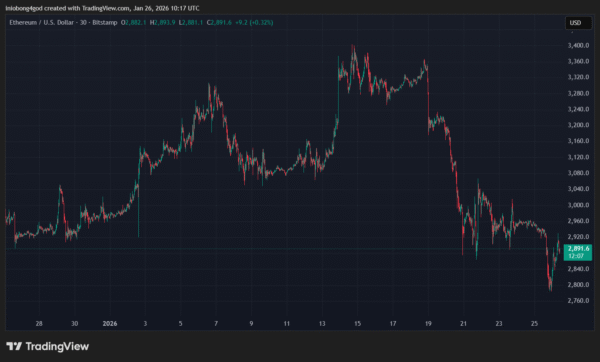
Image Source: TradingView
Experts believe if the token consistently stays above $3,000, it could rise to $3,065. If it continues to gain momentum, it might even reach $3,120 or $3,150 soon.
Analyst Points to Macro Shifts Supporting Ethereum’s Outlook
With the way the market is right now, many analysts believe Ethereum could be a good long-term investment, similar to holding valuable assets like gold. Lorenzo Valente recently shared this idea on X, explaining his view of Ethereum from a broad economic perspective.
Ethereum (ETH) seems to be in a particularly strong position when looking at the broader economic landscape. Here are a few reasons why:
The potential of quantum computing poses a significant, long-term risk. While it might not be an immediate problem within the next decade, financial markets tend to anticipate future challenges. If you’re looking for an investment you can simply hold for a long period of time…
— Lorenzo Valente (@LorenzoARK)
He pointed out that planned improvements to protect against quantum computing threats could make their argument stronger in the future. Because markets tend to anticipate potential risks, careful long-term planning is crucial.
I’ve been reading up on security in crypto, and one thing that really struck me was a point made by Valente. He’s highlighting the risks that come with AI quickly generating code. Basically, if we keep finding bugs even with this new AI-generated code, it throws into question the idea that complex systems like Ethereum are ever truly ‘finished’ and don’t need updates. That’s actually a good thing, though! Ethereum’s commitment to constantly upgrading itself could be a real strength in this changing landscape, giving it the ability to adapt and stay secure.
Valente highlighted Ethereum’s stable monetary policy, pointing out its low inflation rate compared to other cryptocurrencies like Solana. While many layer-one networks experience around 5% annual inflation, Ethereum’s net inflation has been significantly lower – around 0.8% in the last 30 days and just 0.21% since the Merge. This is even lower than the long-term growth rate of gold’s supply.
He explained that Ethereum doesn’t compete with AI data centers for resources like electricity or funding. This means the network won’t face the same financial pressures as AI spending increases, and its security can remain strong. The analyst believes this distinction will become increasingly significant in the future.
Valente also pointed out the potential benefits of stablecoins, tokenized assets, and automatic payments. Increased adoption of these technologies could lead to more ETH being burned with each transaction, potentially making ETH deflationary again.
Read More
- Top 20 Dinosaur Movies, Ranked
- 20 Movies Where the Black Villain Was Secretly the Most Popular Character
- Celebs Who Narrowly Escaped The 9/11 Attacks
- 25 “Woke” Films That Used Black Trauma to Humanize White Leads
- Spotting the Loops in Autonomous Systems
- Gold Rate Forecast
- The 10 Most Underrated Jim Carrey Movies, Ranked (From Least to Most Underrated)
- Silver Rate Forecast
- Transformers Under the Microscope: What Graph Neural Networks Reveal
- The Best Directors of 2025
2026-01-26 15:11