Author: Denis Avetisyan
New research uses economic principles and a novel simulator to understand why short-form video is so addictive, and how platforms can design more responsible recommendation systems.
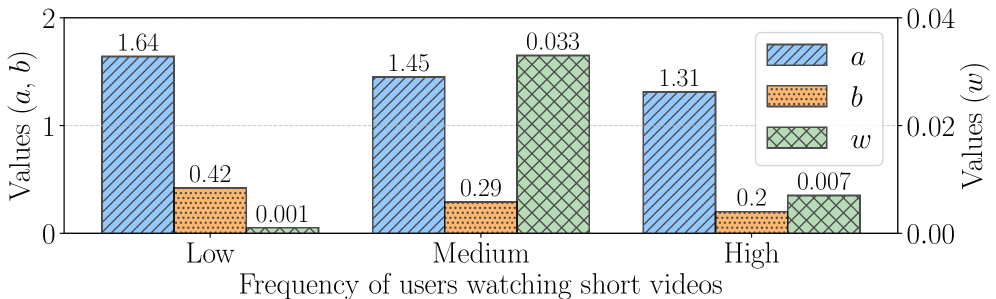
Researchers developed AddictSim, a reinforcement learning-based simulator, to analyze short-video addiction and demonstrate the effectiveness of diversity-aware algorithms in reducing compulsive behavior.
Despite the increasing prevalence of short-video platforms, understanding and mitigating potentially addictive usage patterns remains a significant challenge. This paper, ‘Unveiling and Simulating Short-Video Addiction Behaviors via Economic Addiction Theory’, leverages economic addiction theory and large-scale behavioral data to model these patterns, proposing a novel simulator, AddictSim, trained via reinforcement learning. Our analysis demonstrates that short-video addiction exhibits functional similarities to established addictive behaviors and, crucially, that diversity-aware recommendation algorithms can effectively lessen addictive tendencies within the simulated environment. Can these findings translate into real-world platform interventions that promote healthier user engagement?
Decoding the Dopamine Loop: How Short-Form Video Captures Attention
The proliferation of short-video platforms has occurred alongside escalating concerns regarding potentially compulsive user behaviors. These platforms aren’t simply offering entertainment; their success hinges on sophisticated recommendation algorithms designed to maximize engagement. These algorithms analyze user data – viewing history, likes, shares, and even dwell time – to predict and deliver content with remarkable accuracy, creating a personalized stream tailored to individual preferences. This constant stream of rewarding stimuli activates the brain’s dopamine system, fostering a feedback loop that encourages continued viewing. The speed and ease with which users can consume content, coupled with the algorithm’s ability to anticipate desires, effectively bypasses typical self-regulation mechanisms, leading to extended sessions and, for some, problematic usage patterns. This dynamic isn’t accidental; it’s a core principle of the platform’s design, prioritizing sustained attention above all else.
The compelling nature of short-video platforms isn’t simply a matter of captivating content; user engagement closely follows principles of operant conditioning, mirroring patterns observed in established addiction models. Each scroll, like a lever press, delivers a variable reward – an unpredictable burst of engaging content – which powerfully reinforces the behavior. This intermittent reinforcement schedule, proven effective in animal training and understood in the context of gambling, creates a compelling feedback loop. The brain anticipates a reward, releasing dopamine with each interaction, and this neurochemical response drives continued use, even in the absence of consistent, high-value content. Consequently, compulsive scrolling isn’t a random habit, but a learned response shaped by the platform’s design to maximize engagement through carefully calibrated rewards and the anticipation thereof.
Conventional models of user engagement, frequently built on notions of conscious decision-making and rational benefit analysis, prove inadequate when applied to the current landscape of short-video platforms. These frameworks struggle to account for the speed, scale, and subtle persuasive technologies employed by recommendation algorithms, which operate largely below the threshold of conscious awareness. The dynamic isn’t simply about users actively choosing to consume content; rather, it’s a system where algorithms proactively shape preferences and maintain attention through a continuous stream of personalized stimuli. A more robust understanding, therefore, demands a shift toward frameworks incorporating principles of behavioral economics, neurobiology, and the study of habit formation, allowing researchers to dissect the complex interplay between algorithmic design and compulsive engagement.

Modeling the Compulsion: An Economic Framework
The Addiction Model presented utilizes the economic principle of utility maximization to describe and predict compulsive consumption behaviors. This approach posits that users engage with content not simply for inherent enjoyment, but to maximize an internal Utility function. This function considers factors beyond immediate gratification, incorporating elements of delayed rewards and potential negative consequences. By framing user actions as attempts to optimize this utility, the model moves beyond purely descriptive analyses of behavior and allows for predictive capabilities based on inferred user preferences and valuation of different content attributes. The integration of observed behaviors – such as viewing duration, content selection, and session frequency – serves to quantify the variables influencing this utility function for each user.
The Addiction Model utilizes implicit feedback – data generated as a byproduct of user interaction – to determine individual preferences and forecast engagement. This includes metrics such as total ‘Watch Time’, session duration, frequency of sessions, and the specific videos consumed within each session. Unlike explicit feedback like ratings or surveys, implicit feedback requires no direct user input and provides a continuous stream of behavioral data. By analyzing these patterns, the model infers the relative value a user assigns to different content and predicts future consumption, enabling the quantification of reinforcing stimuli and compulsive behaviors without relying on subjective self-reporting.
The integration of session-level data – encompassing metrics such as session duration, frequency, and time of day – with video-level data – including watch time, completion rates, and content attributes – allows for the quantification of reinforcement loops associated with compulsive consumption. This combined dataset facilitates the modeling of user engagement as a function of content characteristics and behavioral patterns. Evaluation demonstrated a significant reduction in both Mean Absolute Error (MAE) and Root Mean Squared Error (RMSE) compared to baseline predictive models, indicating improved accuracy in forecasting user behavior and validating the model’s ability to capture the dynamics of compulsive engagement. These metrics confirm the model’s enhanced predictive power over simpler approaches.
AddictSim: A Digital Laboratory for Behavioral Analysis
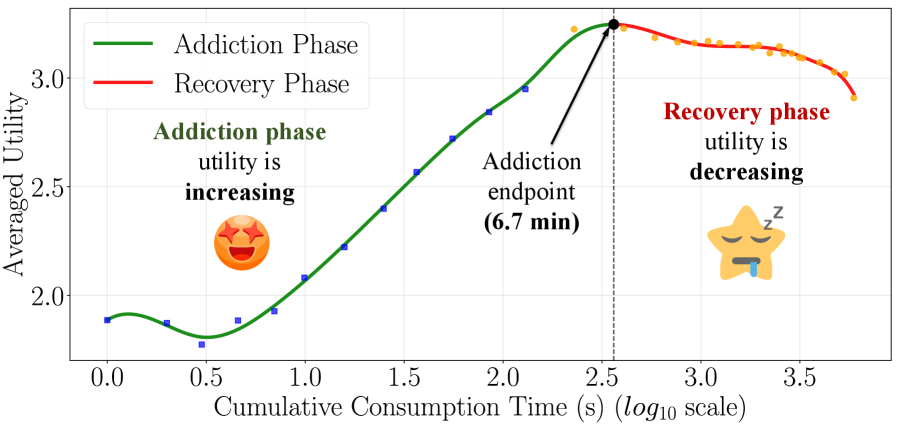
AddictSim is a simulation environment constructed upon a Large Language Model (LLM) architecture and utilizes a training methodology termed M2A Training. This approach initially establishes a baseline understanding of typical behavioral patterns by learning from aggregated, average data. Following this initial phase, the model personalizes its responses and predictions to simulate individual user behavior. This two-stage process allows AddictSim to both reflect general addiction tendencies and adapt to nuanced, person-specific characteristics, creating a more realistic simulation environment for research purposes.
The AddictSim simulator employs Generalized Reinforcement Policy Optimization (GRPO) training to refine the agent’s behavioral policy. This optimization process aims to accurately replicate observed addiction patterns as defined by our established Addiction Model. GRPO allows for efficient policy improvement by learning from a distribution of experiences, enabling the simulation of diverse user behaviors. Validation against the Addiction Model confirms the simulator’s ability to reproduce key characteristics of addictive tendencies, providing a controlled environment for testing intervention strategies and analyzing their effectiveness.
Within AddictSim, a Non-Functional Model (NFM) was implemented as the foundational recommendation system to provide a standardized basis for comparative analysis. This allowed researchers to conduct controlled experiments, systematically varying mitigation strategies – such as altering recommendation algorithms or introducing behavioral interventions – and measuring their impact against the NFM’s baseline performance. By establishing a consistent, quantifiable reference point, the NFM facilitated objective evaluation of the effectiveness of different approaches to address and potentially reduce addictive behaviors simulated within the environment. The NFM’s parameters and outputs were logged throughout each simulation run to enable detailed post-hoc analysis and statistical comparison of results.
Disrupting the Cycle: Mitigating Addiction Through Diversified Recommendations
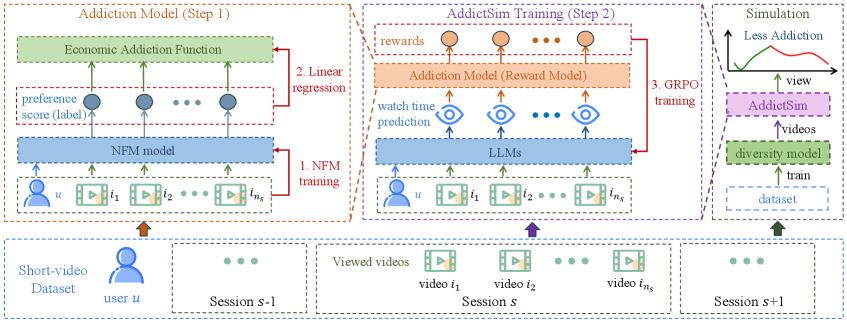
Simulations conducted within the ‘AddictSim’ environment reveal that strategies prioritizing content diversity can demonstrably lessen compulsive behaviors by disrupting the cyclical reinforcement that fuels addiction. The research indicates that continuously presenting users with varied options – rather than repeatedly serving content aligning with existing preferences – effectively breaks the positive feedback loop driving excessive engagement. This approach doesn’t simply limit access to favored content, but actively broadens exposure, diminishing the potency of habitual reward pathways. Consequently, the study suggests that platforms can intervene to reduce addictive tendencies by implementing recommendation systems that consciously prioritize a balanced distribution of content categories, fostering healthier user habits without necessarily compromising overall satisfaction.
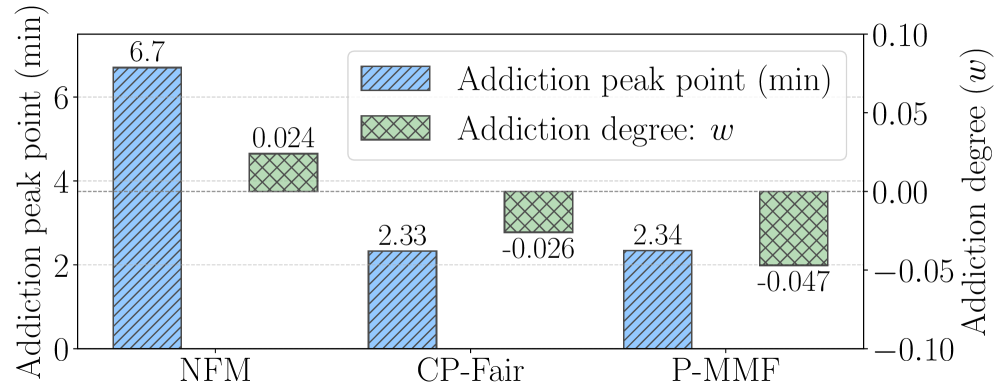
To address the potential for algorithmic reinforcement of addictive behaviors, two novel re-ranking algorithms, CP-Fair and P-MMF, were developed and rigorously evaluated within the AddictSim environment. CP-Fair operates by ensuring proportional fairness across video categories, preventing any single category from dominating a user’s recommendations, while P-MMF employs a personalized Markov model to predict and mitigate the risk of users becoming fixated on a limited range of content. Testing revealed both algorithms effectively broadened content exposure, moving beyond simple popularity-based recommendations to prioritize a balanced distribution of video categories. This diversification wasn’t achieved at the expense of user experience; the algorithms maintained high relevance scores, suggesting that platforms can intervene to reduce compulsive engagement without negatively impacting satisfaction.
Research indicates that strategically diversifying content recommendations holds significant promise for mitigating compulsive engagement on digital platforms. Experiments within the ‘AddictSim’ environment demonstrate a marked reduction in the time users reach their ‘Addiction Peak Point’ – decreasing from an average of 6.7 minutes with conventional, non-diversified recommendations, to approximately 2.3 minutes when utilizing diversity-aware algorithms. Furthermore, these algorithms not only shorten the duration of compulsive behavior but also fundamentally alter the nature of engagement, shifting the ‘Addiction Degree (w)’ from a positive value – indicating a reinforcing cycle – to a negative one, suggesting a disruption of the addictive feedback loop without negatively impacting user satisfaction. This suggests that platform interventions prioritizing balanced content exposure can effectively reduce the risk of compulsive behavior and promote healthier digital habits.
The pursuit within this research mirrors a fundamental tenet of rigorous inquiry: to dismantle assumptions and expose underlying mechanisms. The AddictSim simulator, by modeling short-video addiction through economic principles and reinforcement learning, doesn’t merely observe behavior-it probes it, testing the boundaries of engagement. As David Hilbert famously stated, “One must be able to say clearly what one is looking for.” This sentiment directly applies; the study meticulously defines ‘addiction’ within the context of recommendation systems, then subjects that definition to computational stress-testing. The findings – that diversity-aware algorithms can interrupt addictive loops – aren’t simply observations, but confirmations revealed through controlled disruption of the system itself. The work isn’t about preventing engagement, but understanding the very architecture of compulsion.
Beyond the Scroll: Charting Future Exploits
The construction of AddictSim represents, less a culmination, than an exploit of comprehension. The simulator successfully models the feedback loops driving short-video engagement, revealing the predictable irrationality inherent in these systems. However, the simulation’s fidelity remains constrained by the inherent messiness of human motivation. Current models treat the user as a remarkably consistent reward-seeker, a simplification that, while useful, obscures the subtle shifts in preference, the emergence of novelty-seeking, and the confounding influence of entirely external stimuli. The true test will lie in predicting behaviors not explicitly incentivized by the platform itself.
Future work must dissect the interaction between algorithmic diversity and individual cognitive biases. The demonstrated mitigation of addictive behaviors via diversity-aware algorithms is promising, but feels… incomplete. It addresses the symptoms of addiction, not the underlying vulnerabilities. A deeper investigation into the neurobiological correlates of “infinite scroll” and its relationship to dopamine release-paired with a more nuanced understanding of user agency-could reveal points of intervention beyond simply altering recommendation strategies.
Ultimately, the challenge isn’t to eliminate engagement-an impossible, and perhaps undesirable, goal-but to reshape it. To engineer systems that acknowledge the user’s inherent susceptibility to reward-driven behavior, and subtly redirect that susceptibility toward more… productive loops. The game, it seems, isn’t about breaking the habit, but about rewriting the rules.
Original article: https://arxiv.org/pdf/2601.15975.pdf
Contact the author: https://www.linkedin.com/in/avetisyan/
See also:
- Top 20 Dinosaur Movies, Ranked
- 20 Movies Where the Black Villain Was Secretly the Most Popular Character
- 25 “Woke” Films That Used Black Trauma to Humanize White Leads
- Celebs Who Narrowly Escaped The 9/11 Attacks
- Gold Rate Forecast
- Spotting the Loops in Autonomous Systems
- Silver Rate Forecast
- The 10 Most Underrated Jim Carrey Movies, Ranked (From Least to Most Underrated)
- The Best Directors of 2025
- 22 Films Where the White Protagonist Is Canonically the Sidekick to a Black Lead
2026-01-25 09:31